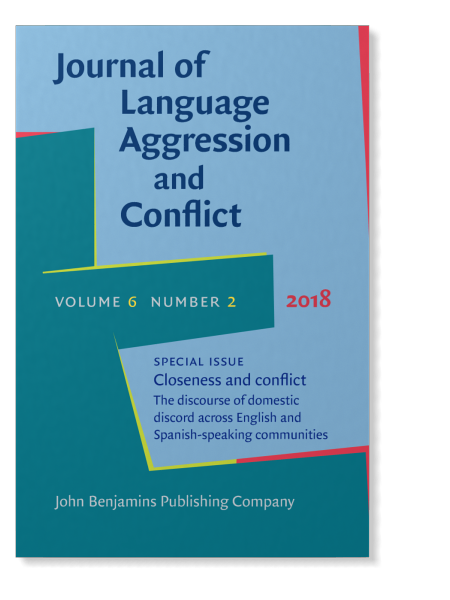
Introduction published In: Closeness and conflict: The discourse of domestic discord across English and Spanish-speaking communities
Edited by Diana Boxer and María Elena Placencia
[Journal of Language Aggression and Conflict 6:2] 2018
► pp. 167–176
Introduction
Closeness and conflict
This article is available free of charge.
Published online: 26 November 2018
https://doi.org/10.1075/jlac.00008.int
https://doi.org/10.1075/jlac.00008.int

References (45)
Anderson, Kristin L., and Jill Cermele. 2014. “Public/Private Language Aggression against Women. Tweeting Rage and Intimate Partner Violence.” In Language Aggression against Women, Special Issue, edited by Patricia Bou-Franch, Journal of Language Aggression and Conflict 21: 274–93.
Arcidiacono, Francesco, and Antonio Bova. 2017. Interpersonal Argumentation in Educational and Professional Contexts. Springer: New York.
Attardo, Salvatore. 2000. “Irony as Relevant Inappropriateness.” Journal of Pragmatics 321: 793–826.
Bou-Franch, Patricia, Garcés-Conejos Blitvich, Pilar. 2014. “Conflict Management in Massive Polylogues: A Case Study from YouTube.” Journal of Pragmatics 731: 19–36.
Boxer, Diana. 1993. “Social Distance and Speech Behavior: The Case of Indirect Complaints.” Journal of Pragmatics 191: 103–25.
Bravo, Diana. 1999. “¿Imagen ‘positiva’ vs imagen ‘negativa’?: Pragmática sociocultural y componentes de face
.” Oralia 21: 155–84.
Brenes Peña, Ester. 2011. Tertulia televisiva y descortesía verbal. Análisis pragmalingüístico. Berne: Peter Lang.
Brown, David. 2000. “Educational Beliefs: An Overview.” In Interactive Learning: Vignettes from America’s Most Wired Campuses, edited by David Brown, 3–7. Boston: Anker.
Cloke, Kenneth and Joan Goldsmith. 2011. Resolving Conflicts at Work: Ten Strategies for Everyone on the Job. San Francisco: Jossey-Bass.
Fant, Lars. 1989. “Cultural Mismatch in Conversation: Spanish and Scandinavian Communicative Behaviour in Negotiation Settings.” Hermes Journal of Linguistics 31: 247–65.
Fuentes Rodríguez, Catalina, and Esperanza Alcaide Lara. 2008. (Des)cortesía, agresividad y violencia verbal en la sociedad actual. Sevilla: Universidad Internacional de Andalucía.
Fuentes Rodríguez, Catalina, and Esperanza Alcaide Lara. 2009. Manifestaciones textuales de la descortesía y agresividad verbal en diversos ámbitos comunicativos. Sevilla: Universidad Internacional de Andalucía.
Fuentes Rodríguez, Catalina, and María Elena Placencia. 2013. “Polémica y/o descortesía en programas televisivos de crónica social en Ecuador y España: El caso de Vamos con todo y Sálvame diario.” In (Des)cortesía para el espectáculo: estudios de pragmática variacionista, edited by Catalina Fuentes Rodríguez, 127–65. Madrid: Arco/Libros.
García-Gómez, Antonio. 2012. “Perceptions of Assertiveness among Women: Triggering and Managing Conflict in Reality Television.” Discourse & Communication 6 (4): 379–399.
González, Marina. 2010. “Las funciones del insulto en debates políticos televisados.” Discurso & Sociedad 41: 828–52.
Goodwin, Marjorie H. 1982. “Processes of Dispute Management among Urban Black Children.” American Ethnologist 91: 76–96.
Grimshaw, Allen. 1990. Conflict Talk: Sociolinguistic Investigations of Arguments in Conversations. Cambridge: Cambridge University Press.
Häggkvist, Cilla, and Lars Fant. 2000. “El intercambio de opiniones en conversaciones intra e interculturales.” Oralia 31: 95–111.
Hernández Flores, Nieves. 2002. La cortesía en la conversación española de familiares y amigos: la búsqueda del equilibrio entre la imagen del hablante y la imagen del destinatario. Aalborg: Institut for Sprog og Internationale Kurturstudier, Aalborg Universitet, Vol 371.
. 2004. “Politeness as ‘Face’ Enhancement: An Analysis of Spanish Conversations between Family and Friends.” In Current Trends in the Pragmatics of Spanish, edited by Rosina Márquez Reiter and María Elena Placencia, 265–84. Amsterdam/Philadelphia: John Benjamins.
Lorenzo-Dus, Nuria. 2007. “(Im)Politeness and the Spanish Media: The Case of Audience Participation Debates.” In Research on Politeness in the Spanish-speaking World, edited by María Elena Placencia and Carmen García, 145–66. Mahwah, N.J: Lawrence Erlbaum.
. 2008. “Real Disorder in the Court: An Investigation of Conflict Talk in US Television Courtroom Shows.” Media, Culture & Society 30 (1): 81–107.
Lorenzo-Dus, Nuria, Pilar Garcés-Conejos Blitvich, and Patricia Bou-Franch. 2011. “On-line Polylogues and Impoliteness: The Case of Postings Sent in Response to the Obama Reggaeton YouTube Video.” Journal of Pragmatics 431: 2578–93.
Mancera Rueda, Ana, and Ana Pano Alamán. 2013. El discurso político en Twitter. Anthropos: Barcelona.
Norrick, Neal R., and Alice Spitz. 2008. Humor as a resource for mitigating conflict in interaction. Journal of Pragmatics, 40 (10): 1661–1686.
Padilla García, Xose A., and María Belén Alvarado Ortega. 2010. “Being Polite through Irony.” In Dialogue in Spanish: Studies in Functions and Contexts, edited by Koike, Dale and Lidia Rodríguez-Alfano, 69–87. Amsterdam/Philadelphia: John Benjamins.
Papke, Edgar. 2016. The Elephant in the Boardroom: How Leaders Use and Manage Conflict to Reach Greater Levels of Success. Wayne, N. J.: The Career Press.
Pexman, Penny M., and Kara M. Olineck. 2002. “Does Sarcasm Always Sting? Investigating the Impact of Ironic Insults and Ironic Compliments.” Discourse Processes 33 (3): 199–217.
Placencia, María Elena. 2008. “(Non)Compliance with Directives among Family and Friends: Responding to Social Pressure and Individual Wants.” Intercultural Pragmatics 5 (3): 315–44.
. 2011. La insistencia entre familiares y amigos en el español quiteño: ¿de la interconexión hacia la autonomía? In Estudios de variación pragmática en español, edited by Carmen García and María Elena Placencia, 185–214. Buenos Aires: Dunken.
Placencia, María Elena, and Ana Mancera Rueda. 2011. “
Vaya, ¡qué chungo! Rapport-building Talk in Service Encounters: The Case of Bars in Seville at Breakfast Time.” In Spanish at Work: Analysing Institutional Discourse across the Spanish-speaking World, edited by Nuria Lorenzo-Dus, 192–207. Basingstoke: Palgrave Macmillan.
Placencia, María Elena, and Catalina Fuentes Rodríguez. 2013. “In Between Spectacle and Political Correctness: Vamos con todo – An Ambivalent News/Talk Show.” Pragmatics 231: 117–45.
Rühlemann, Christoph. 2010. “What Can a Corpus Tell us about Pragmatics?” In The Routledge Handbook of Corpus Linguistics, edited by Anne O’Keeffe, and Michael McCarthy, 288–301. London: Routledge.
. 1985. “Everyday Argument: The Organization of Diversity in Talk.” In Handbook of Discourse Analysis, edited by Teun A. van Dijk, 35–46. London: Academic Press.
Sheldon, Amy. 1990. “Pickle Fights: Gendered Talk in Pre-school Disputes.” Discourse Processes 13 (1): 5–31.
Stewart, Katherine A., and Madeline M. Maxwell. 2010. Storied Conflict Talk: Narrative Construction in Mediation. Amsterdam/Philadelphia: John Benjamins.
Tannen, Deborah. 1998. The Argument Culture. Stopping America’s War of Words. New York: The Random House Publishing Group.
Thurén, Britt-Marie. 1988. Left Hand Left Behind: The Changing Gender System of a Barrio in Valencia, Spain. Stockholm Studies in Social Anthropology, 22. Stockholm: University of Stockholm.
Cited by (1)
Cited by one other publication
Fernández-Amaya, Lucía
2020. Managing conflict originated by feminism. Journal of Language Aggression and Conflict 8:1 ► pp. 88 ff.
This list is based on CrossRef data as of 13 november 2025. Please note that it may not be complete. Sources presented here have been supplied by the respective publishers. Any errors therein should be reported to them.