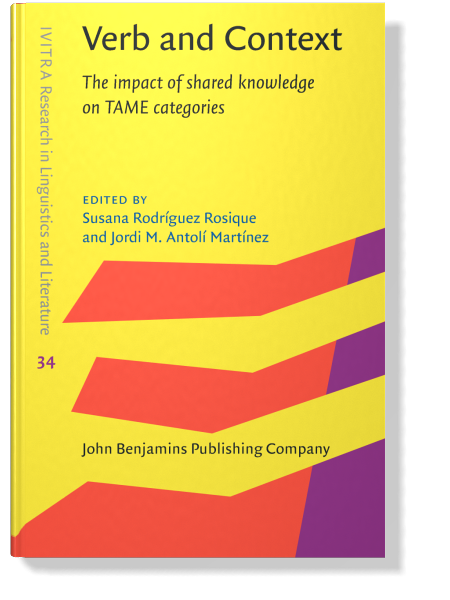
In:Verb and Context: The impact of shared knowledge on TAME categories
Edited by Susana Rodríguez Rosique and Jordi M. Antolí Martínez
[IVITRA Research in Linguistics and Literature 34] 2023
► pp. 307–326
Meaning, degrees of abstraction and shared knowledge
Published online: 4 January 2023
https://doi.org/10.1075/ivitra.34.13san
https://doi.org/10.1075/ivitra.34.13san
Abstract
Human communication has proven to be a complex, multi-layered phenomenon, embracing social and individual, abstract and concrete, conceptual and referential elements. This complexity has found its reflection in the several linguistic branches devoted to its study: cognitive and functional linguistics, semantics, pragmatics, sociolinguistics, psycholinguistics, discourse analysis, conversational analysis, among others. Far from excluding each other, these different strands can be complementary and contribute to a better understanding of human communication and the semiotic system attached to it. The main objective of this chapter is to bring together the knowledge on human communication, language and meaning construction in order to relate meaning with its different levels of abstraction and pinpoint a definition of shared knowledge.
Article outline
- 1.Introduction
- 2.Language and meaning
- 3.Language and abstraction levels
- 3.1Form, meaning and transmitted knowledge
- 3.2Degrees of transmitted knowledge
- 3.3Transmitted knowledge and language segmentation
- 4.Cultural models, shared knowledge and common ground
- 5.An intermediate degree of abstraction: Form, meaning and context
- 6.Conclusion
Notes References

References (72)
Brewer, William F. and Treyens, James C. 1981. “Role of schemata in memory for places.” Cognitive Psychology 13: 207–230.
British National Corpus (BNC). [URL]
Brown-Schmidt, Sarah, Gunlogson, Christine and Tanenhaus, Michael K. 2008. “Addressees distinguish shared from private information when interpreting questions during interactive conversation.” Cognition 107: 1122–1134.
Busse, Dietrich. 2008. “Linguistische Epistemologie. Zur Konvergenz von kognitiver und kulturwissenschaftlicher Semantik am Beispiel von Begriffsgeschichte, Diskursanalyse und Frame-Semantik.” In Sprache-Kognition-Kultur. Sprache zwischen mentaler Struktur und kultureller Prägung, Heidrun Kamper and Ludwig M. Eichinger (eds), 73–114. Berlin/New York: de Gruyter.
Bybee, Joan. 2007. Frequency of Use and the Organization of Language. Oxford: Oxford University Press.
Clark, Herbert H. and Carlson, Thomas B. 1981. “Context for comprehension.” In Attention and Performance IX, John B. Long and Alan Baddeley (eds), 313–330. Hillsdale, NJ: Lawrence Erlbaum.
Clark, Herbert H. and Marshall, Catherine R. 1981. “Definite reference and mutual knowledge.” In Elements of Discourse Understanding, Arvind K. Joshi, Bonnie L. Webber and Ivan A. Sag (eds), 10–63. Cambridge: Cambridge University Press.
Clark, Herbert H., Schreuder, Robert and Buttrick, Samuel. 1983. “Common ground and the understanding of demonstrative reference.” Journal of Verbal Learning and Verbal Behavior 22: 245–258.
D’Andrade, Roy. 1987. “A folk model of the mind”. In Cultural models in language and thought, D. Holland & N. Quinn, 112–148. Cambridge: Cambridge University Press.
D’Andrade, Roy G. 1992. “Schemas and motivation.” In Human Motivation and Cultural Models, Roy G. D’Andrade and Claudia Strauss (eds), 23–44. Cambridge: Cambridge University Press.
Diessel, Holger. 2014. “Usage-Based Linguistics.” In Oxford Bibliographies. Oxford: Oxford University Press.
Evans, Vyv. 2006. “Lexical Concepts, Cognitive Models and Meaning-construction.” Cognitive Linguistics 17 (4): 491–534.
Fauconnier, Gilles. 1985. Mental spaces: Aspects of meaning construction in natural language. Cambridge: Cambridge University Press.
Fillmore, Charles. 1982. “Frame Semantics.” In Universals in Linguistic Theory, Emmon Bach and Robert T. Harms (eds), 1–88. New York: Holt, Rinehart and Winston.
Geeraerts, Dick and Cuickens, Hubert. 2007. The Oxford Handbook of Cognitive Linguistics. Oxford: Oxford University Press.
Geeraerts, Dirk and Grondelaers, Stefan. 1995. “Looking back at anger: Cultural traditions and looking back at anger: Cultural traditions and metaphorical.” In Language and the Construal of the World, John Taylor and Robert MacLaury (eds), 153–180. Berlin: Mouton de Gruyter.
Goldberg, Adele. 1995. Constructions: A Construction Grammar Approach to Argument Structure. Chicago: University of Chicago Press.
. 2006. Constructions at Work: The Nature of Generalization in Language. Oxford: Oxford University Press.
. 2013. “Constructionist approaches.” In Construction Grammar Handbook, Thomas Hoffmann and Graeme Trousdale (eds). Oxford: Oxford University Press.
Grice, H. Paul. 1975. “Logic and conversation.” In Syntax and Semantics 3: Speech Acts, Peter Cole and Jerry Morgan (eds), 41–58. London: Academic Press.
Hanna, Joy E., Tanenhaus, Michael K. and Trueswell, John C. 2003. “The effects of common ground and perspective on domains of referential interpretation.” Journal of Memory and Language 49: 43–61.
Heller, Daphna, Grodner, Daniel and Tanenhaus, Michael K. 2008. “The role of perspective in identifying domains of reference.” Cognition 108: 831–836.
Holland, Dorothy and Quinn, Naomi. 1987. “Culture and cognition.” In Cultural Models in Language and Thought, Dorothy Holland and Naomi Quinn (eds), 3–42. Cambridge: Cambridge University Press.
Horton, William S. 2012. “Shared knowledge, mutual understanding and meaning negotiation.” In Cognitive pragmatics, Hans-Jörg Schmid (ed), 375–404. Berlin: De Gruyter Mouton.
Horton, William S. and Gerrig, Richard J. 2005. “Conversational common ground and memory processes in language production.” Discourse Processes 40: 1–35.
Johnson, Mark. 2007. The Meaning of the Body. Aesthetics of Human Understanding. Chicago: University of Chicago Press.
Johnson-Laird, Philip N. 1983. Mental Models. Towards a Cognitive Science of Language, Inference and Consciousness. Cambridge, UK: Cambridge University Press.
Kecskes, Istvan. 2007. “Formulaic language in English lingua franca”. In Explorations in pragmatics: Linguistic, cognitive and intercultural aspects, Istvan Kecskes and Laurence R. Horn, 191–219. Berlin: Mouton de Gruyter.
Kecskes, István. 2008. “Dueling Context: A dynamic model of meaning.” Journal of Pragmatics 40 (3): 385–406.
Kecskes. 2010. “The paradox of communication: Socio-cognitive approach to pragmatics.” Pragmatics and Society 1 (1): 50–73.
Kecskes, Istvan. 2012. “Encyclopaedic knowledge and cultural models.” In Cognitive pragmatics, Hans-Jörg Schmid (ed), 177–200. Berlin: De Gruyter Mouton.
Kecskes, István and Zhang, Fenghui. 2009. “Activating, Seeking and Creating Common Ground: A socio-cognitive approach.” Pragmatics & Cognition 17 (2): 331–355.
Lakoff, George. 1987. Women, Fire and Dangerous Things. What Categories Reveal About The Mind. Chicago: University of Chicago Press.
Langacker, Ronald. 1987. Foundations of Cognitive Grammar I: Theoretical Prerequisites. Stanford: Stanford University Press.
Levinson, Stephen. 1995. “Three levels of meaning.” In Grammar and Meaning: Essays in Honour of Sir John Lyons, Frank R. Palmer (ed), 90–115. Cambridge: Cambridge. University Press.
. 2000. Presumptive meanings: The theory of generalized conversational implicature. Cambridge: The MIT Press.
Martines, Josep. 2020. “Cap a una semàntica cognitiva del català (I): la cognició, el cos, l’espai i el temps.” Estudis Romànics 42: 323–343.
Michaelis, Laura A. and Min-Chun, Hsiao (Allen). 2021. “Verbing and Linguistic Innovation.” Frontiers in Communication, 6.
Minsky, Marvin. 1975. “A framework for representing knowledge”. In The psychology of computer vision, P. H. Winston. New York: McGraw-Hill Book.
Pickering, Martin J. and Garrod, Simon. 2004. “Toward a mechanistic psychology of dialogue.” Behavioral and Brain Sciences 27: 169–226.
. 2006. “Alignment as the basis for successful communication.” Research on Language and Computation 4: 203–228.
Piirainen, Elisabeth. 2012. Widespread Idioms in Europe and Beyond. Toward a Lexicon of Common Figurative Units. New York: Peter Lang.
Reddy, Michael. 1979. “The conduit metaphor.” In Metaphor and thought. Andrew Ortony (ed). Cambridge Cambridge University Press.
Sánchez-López, Elena. 2015. “Phraseologization as a process of semantic change.” Catalan Journal of Linguistics 14: 159–177.
. 2020. “On the importance of a diachronic approach to phraseology.” In Changes in Meaning and Function: Studies in historical linguistics with a focus on Spanish, Jorge Fernández and Herminia Provencio (eds), 300–329. Amsterdam: John Benjamins Publishing Company.
. 2021. “Llengua, significat i la unitat mínima.” In Variació i canvi lingüístic. Un acostament diacrònic. Valencia: Tirant lo Blanch.
Schank, Roger C. and Abelson, Robert P. 1977. Scripts, Plans, Goals, and Understanding: An Inquiry into Human Knowledge Structures. Hillsdale, NJ: Lawrence Erlbaum.
Schmid, Hans-Jörg. 2003. “An outline of the role of context in comprehension.” In Anglistentag 2002 Bayreuth. Proceedings, Ewald Mengel, Hans-Jörg Schmid and Michael Steppat (eds). Trier: Wvt.
. 2007. “Entrenchment, salience, and basic levels.” In The Oxford Handbook of Cognitive Linguistics, Dick Geeraerts and Hubert Cuickens, 117–138. Oxford: Oxford University Press.
. 2012b. “Generalizing the apparently ungeneralizable. Basic ingredients of a cognitive-pragmatic approach to the construal of meaning in-context.” In Cognitive pragmatics, Hans-Jörg Schmid (ed), 3–24. Berlin: De Gruyter Mouton.
Schwarz, Monika. 1992. Kognitive Semantiktheorie and neuropsychologische Realität. Berlin: De Gruyter Mouton.
Searle, John. 1983. Intentionality: An essay in the philosophy of mind. Cambridge: Cambridge University Press.
Sperber, Dan and Wilson, Deirdre. 1985–1996. Relevance: Communication and Cognition. Oxford: Blackwell.
Taylor, John R. 2006. “Polysemy and the lexicon.” In Cognitive Linguistics: Current Applications and Future Perspectives, Gitte Kristiansen, Michel Achard, Rene Dirven and Francisco Ruiz de Mendoza Ibanez (eds), 51–80. Berlin: Mouton de Gruyter.
2012. “Contextual salience, domains, and active zones.” In Cognitive pragmatics, Hans-Jörg Schmid (ed), 151–174. Berlin: De Gruyter Mouton.
Traugott, Elizabeth C. and Dasher, Richard B. 2002. Regularity in Semantic Change. Cambridge: Cambridge University Press.
Traugott, Elizabeth C. and Trousdale, Graeme. 2013. Constructionalization and constructional changes. Oxford: Oxford University Press.
Traugott, Elizabeth C. 2015. “Toward a coherent account of grammatical constructionalization.” In Diachronic Construction Grammar, Jóhanna Barðdal, Elena Smirnova, Lotte Sommerer and Spike Gildea (eds), 51–80. Amsterdam: John Benjamins Publishing Company.
Trousdale, Graeme. 2014. “Theory and data in diachronic Construction Grammar. The case of the what with construction.” In Theory and Data in Cognitive Linguistics, Nikolas Gisborne and Willem B. Hollmann (eds), 115–140. Amsterdam: John Benjamins.
Wengeler, Martin and Ziem, Alexander. 2014. “Wie über Krisen geredet wird: Einige Ergebnisse eines diskursgeschichtlichen Forschungsprojektex.” Zeitschrif für Literatur und Linguistik 173: 52–74.
Ziem, Alexander. 2008. Frames und sprachliches Wissen: kognitive Aspekte der semantischen Kompetenz. Berlin: Walter de Gruyter.
. 2010. “Lexicalische Felder, konzeptuelle Metaphern und Domänenmischungen im Interdiskurs Fußball.” Zeitschrift für Semiotik 32 (3–4): 305–328.