In:Gender Across Languages: The linguistic representation of women and men
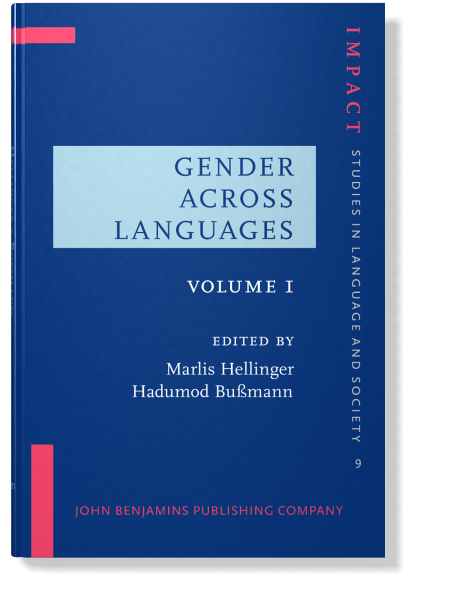
Edited by Marlis Hellinger and Hadumod Bußmann
[IMPACT: Studies in Language, Culture and Society 9] 2001
► pp. 105–112
English. Gender in a global language
Published online: 9 October 2001
https://doi.org/10.1075/impact.9.09hel
https://doi.org/10.1075/impact.9.09hel
1.Introduction
2. Gender in English
2.1. Grammatical gender
2.2. Lexical and social gender
3. Semantic derogation
4. Reforming English
5. Varieties of English represented in “Gender across languages”
Notes
References

Cited by (13)
Cited by 13 other publications
Perry, Véronique
Erdocia, Iker
Koster, Dietha
Loureiro-Porto, Lucía & Turo Hiltunen
Jones, Sally & Jan P. Warhuus
Wauquier, Marine, Cécile Fabre, et Nabil Hathout, F. Neveu, B. Harmegnies, L. Hriba & S. Prévost
Motschenbacher, Heiko
Motschenbacher, Heiko
2016. Inclusion and foreign language education. ITL - International Journal of Applied Linguistics 167:2 ► pp. 159 ff.
Lee, Jackie F. K.
Lee, Jackie F.K.
2015. Chairpersonorchairman? – A study of Chinese EFL teachers’ gender inclusivity. Australian Review of Applied Linguistics 38:1 ► pp. 24 ff.
Ronneberger-Sibold, Elke
This list is based on CrossRef data as of 12 december 2025. Please note that it may not be complete. Sources presented here have been supplied by the respective publishers. Any errors therein should be reported to them.