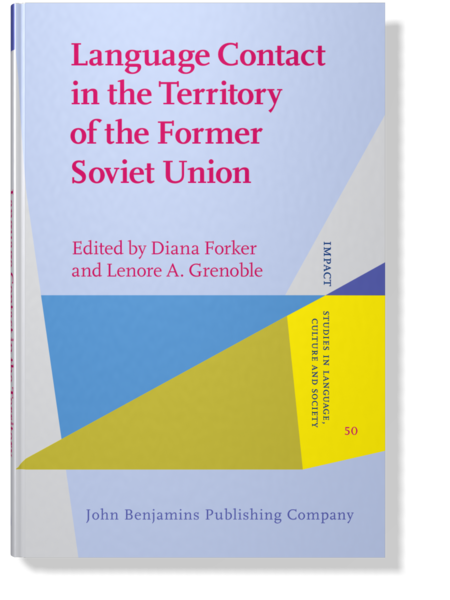
In:Language Contact in the Territory of the Former Soviet Union
Edited by Diana Forker and Lenore A. Grenoble
[IMPACT: Studies in Language, Culture and Society 50] 2021
► pp. 345–368
The choice of forms in contact varieties
Linguistic vs. social motivation (on the base of language contact in the Russian-Chinese border area)
Published online: 18 June 2021
https://doi.org/10.1075/impact.50.12fed
https://doi.org/10.1075/impact.50.12fed
Abstract
The article addresses the issue of language choice in
contact situations on the basis of linguistic intersection in the
Russian-Chinese border area. It aims to analyze morphological forms found in
Russian-Chinese communication, both in the past (in data on Russian-Chinese
pidgin) and in the present, and to reveal the nature of the motivations that determine
speakers’ choice of forms. The analysis of three sets of data – (1)
historical data on Russian-Chinese Pidgin; (2) modern data on actual
interethnic communication; (3) metalinguistic data obtained from consultants
without reference to a particular ethnic group (Chinese) – find more
similarities between the first two sets. It shows therefore that choice of
morphological forms can depend on social settings and linguistic stereotypes
rather than linguistic structure per se.
Article outline
- 1.Introduction
- 2.Language contact in the Russian-Chinese border area
- 3.Data and method
- 4.Choice of morphological forms in Russian-Chinese Pidgin data
- 5.Choice of morphological forms in experimental data
- 6.Choice of morphological forms in modern data on interethnic communication in the Russian-Chinese border area
- 7.Results: Comparing three sets of data
- 8.Conclusions
Notes List of abbreviations / glosses References

References (43)
Arsenjev, V. (1921). Po Ussurijskomu Kraju (Dersu-Uzala): Putešestvie v
Gornuju Oblast’ “Sixote-Alin’” [Through the Ussuri krai (Dersu-Uzala): A
travel to the mountain region “Sikhote-Alin’”]. Vladivostok: Tipografija “Exo”.
Bakker, P. (2003). Pidgin inflectional morphology and its implications for
creole morphology. In P. A. Doevendans, G. Booij, & J. van Merle (Eds), Yearbook of morphology 2002 (pp. 3–33). Dordrecht: Kluwer.
Belikov, V. I., & Perexval’skaja, E. V. (1990). Unpublished field data recorded in Kukan, Khabarovsk
Territory.
(2009). Adam’s tongue: How humans made language, how language made
humans. New York, NY: Hill and Wang.
Botha, R. (2006). Pidgin languages as a putative window on language
evolution. Language & Communication, 26(1), 1–14.
Broch, I., & Jahr, E. N. (1984). Russenorsk: A new look at the Russo-Norwegian pidgin in
Northern Norway. In P. Sture (Ed.), Scandinavian language contacts (pp. 21–65). Cambridge: Cambridge University Press.
Budeev, S. (2011). “Moja tvoja ne ponimaj”, ili kak roždajutsya
novye jazyki. [“I you no understand”, or how new languages
are born]. Published 14 November,
2011. Retrieved on 9 December,
2018 from [URL]
Čerepanov, S. I. (1853). Kjaxtinskoe kitajskoe narečie russkogo
jazyka [Chinese dialect of Russian]. Izvestija Imperatorskoj Akademii Nauk po Otdeleniju Russkogo
jazyka i Slovesnosti, 2, 370–377.
Fedorova, K. (2000). Specifika upotreblenija svjazki est’ i
processy uproščenija v russkom jazyke [On specifics of using copula
est’ and simplification processes in
Russian] In Problemy social’nogo i gumanitarnogo znanija (Vol. 2, pp. 334–348). St. Petersburg: European University Press.
(2006). Russian foreigner talk: Stereotype and
reality. In D. Stern & C. Voss (Eds.), Marginal linguistic identities. Studies in Slavic contact and
borderland varieties (pp. 177–190). Wiesbaden: Harrassowitz.
(2011). Transborder trade on the Russian-Chinese border: Problems
of interethnic communication. In B. Bruns & J. P. Miggelbrink (Eds.), Subverting borders. Doing research on smuggling and small-scale
trade (pp. 107–128). Wiesbaden: Verlag für Sozialwissenschaften, Springer.
(2013). Speaking with and about Chinese: Language attitudes,
ethnic stereotypes and discourse strategies in interethnic
communication on the Russian-Chinese border. Civilisations, 62(1–2), 71–89.
Ferguson, C. A. (1971). Absence of copula and the notion of simplicity: A study
of normal speech, baby talk, foreigner talk and
pidgins. In D. Hymes (Ed.), Pidginization and creolization of languages (pp. 141–145). Cambridge: Cambridge University Press.
(1975). Toward a characterization of English foreigner
talk. Anthropological Linguistics, 17(1), 1–14.
Ferguson, C. A., & DeBose, C. E. (1977). Simplified registers, broken language, and
pidginization. In A. Valdman (Ed.), Pidgin and creole linguistics (pp. 99–125). Bloomington, IN: Indiana University Press.
Klonova, O. (2006). Uproščennye Jazykovye Sistemy i Formirovanie
Pidžina: Na Materiale Russko-norvežskix YJzykovyx Kontaktov [Simplified language systems and pidgin
formation: Based on Russian-Norwegian contacts] (Dissertacija na soiskanie stepeni kandidata filologičeskix
nauk). St. Petersburg State University.
Kozinskij, I. S. (1973). K voprosu o proiskhoždenii kjakhtinskogo
(russko-kitajskogo) jazyka [On the problem of Kyakhta (Russian-Chinese)
language’s origin]. In Genetičeskie i areal’nye svjazi jazykov Azii i Afriki (pp. 36–38). Moscow: Akademiya Nauk SSSR, Institut Vostokovedenija.
Lee, N., Mikesell, L., Joaquin, A. D., Mates, A. W., & Schumann, J. H. (2009). The interactional instinct. The evolution and acquisition of
language. Oxford: Oxford University Press.
Long, M. H. (1981). Input, interaction and second language
acquisition. In H. Winitz (Ed.), Native language and foreign language acquisition (Annals of the New York Academy of Sciences, Vol. 379) (pp. 259–278). New York, NY: New York Academy of Sciences.
McWhorter, J. (2008). Why does a language undress? Strange cases in
Indonesia. In M. Miestamo, K. Sinnemäki, & F. Karlsson (Eds.), Language complexity: Typology, contact, change (pp. 167–190). Amsterdam: John Benjamins.
Mufwene, S. S. (2008). What do creoles and pidgins tell us about the evolution
of language? In B. Laks, S. Cleuziou, J-P. Demoule, & P. Encrevé (Eds.), The origin and evolution of languages: Approaches, models,
paradigms (pp. 272–297). London: Equinox.
(2009). The evolution of language: Hints from creoles and
pidgins. In J. Minett & W. Wang (Eds.), Language evolution and the brain (pp. 1–33). Hong Kong: City University of Hong Kong Press.
Mühlhäusler, P. (1997). Pidgin and creole linguistics (2nd ed.). London: University of Westminster Press.
Parkvall, M. (2003). The simplicity of creoles in a cross-linguistic
perspective. In M. Miestamo, K. Sinnemäki, & F. Karlsson (Eds.), Language complexity: Typology, contact, change (pp. 266–285). Amsterdam: John Benjamins.
Perexval’skaja, E. V. (2003). Vyraženie čisla v russko-kitajskom
pidžine [Expression of number in Russian-Chinese
pidgin]. In K. A. Dolinin (Ed.), Lingvistika. Istorija lingvistiki. Sociolingvistika (pp. 191–205). St. Petersburg: St. Petersburg State University Press.
(2010). Sovremennye formy russkogo pidžina:
Ussurijskij variant [Modern forms of Russian pidgin: Ussuri
variant]. In A. Mustajoki, E. Protassova, & N. Vakhtin (Eds.), Instrumentarium of linguistics: Sociolinguistic approaches to
non-standard Russian (pp. 175–187). Helsinki: University of Helsinki.
(2013). Russko-kitajskij pidžin i russkij
“interjazyk” [Russian-Chinese Pidging and Russian
“interlanuage”]. Acta Linguistica Petropolitana. Trudy Instituta lingvističeskix
issledovanij, 9(3), 332–346.
Roberge, P. (2008). The creation of pidgins as a possible window on language
evolution. In R. P. Botha & H. de Swart (Eds.), Language evolution: The view from restricted linguistic
systems (LOT Occasional Series, 8) (pp. 101–138). Utrecht: LOT.
Roberts, S. R., & Bresnan, J. (2008). Retained inflectional morphology in pidgins: A
typological study. Linguistic Typology, 12, 269–302.
Siegel, J. (2004). Morphological simplicity in pidgins and
creoles. Journal of Pidgin and Creole Languages, 19(1), 139–162.
Šprincin, A. G. (1968). O russko-kitajskom dialekte na Dal’nem
Vostoke [About Russian-Chinese dialect in the Far
East]. Strany i Narody Vostoka, 6, 78–85.
Stern, D. (2005). Myths and facts about the Kyakhta trade
pidgin. Journal of Pidgin and Creole Languages, 20, 175–187.
Thomason, S. (2003). What motivates changes that occur in emerging pidgins and
creoles? Journal of Pidgin and Creole Languages, 18(1): 107–120.
Versteegh, K. (2014). Pidgin verbs: Infinitives or imperatives? In I. Buchstaller, A. Holmberg, & M. Almoaily (Eds.), Pidgins and breoles beyond Africa-Europe encounters (Creole Language Library 47) (pp. 141–170). Amsterdam: John Benjamins.
Cited by (1)
Cited by one other publication
Stern, Dieter
2025. The linguistic impact of the Russian-American Company, with a special focus on Fort Ross. Journal of Pidgin and Creole Languages
This list is based on CrossRef data as of 12 december 2025. Please note that it may not be complete. Sources presented here have been supplied by the respective publishers. Any errors therein should be reported to them.