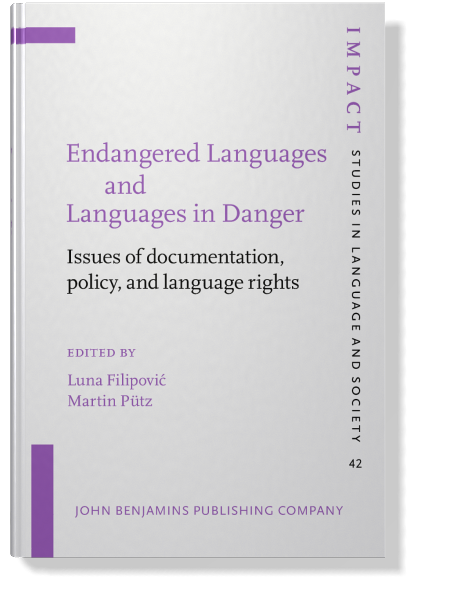
In:Endangered Languages and Languages in Danger: Issues of documentation, policy, and language rights
Edited by Luna Filipović and Martin Pütz
[IMPACT: Studies in Language, Culture and Society 42] 2016
► pp. 387–409
Get fulltext
Jewish language varieties
Loss and survival
Available under the Creative Commons Attribution-NonCommercial-NoDerivatives (CC BY-NC-ND) 4.0 license.
For any use beyond this license, please contact the publisher at rights@benjamins.nl.
Published online: 3 October 2016
https://doi.org/10.1075/impact.42.17spo
https://doi.org/10.1075/impact.42.17spo
Created in the special circumstances of diaspora isolation, persecution, and regular migration, Jewish language varieties that survived the Holocaust have proved, with the exception of Hasidic Yiddish, to be fragile and are becoming extinct as spoken vernaculars. Emancipation, especially when accompanied by admission to public and state schools, generally led to language shift. But postvernacularity, the building of a metalinguistic community through the preservation of the symbolic value of a language in place of its communicative use, has enabled many Jewish groups to maintain the identity associated with their ethnic heritage.
Keywords: diaspora, ethnic heritage, identity, Jewish, loss, migration, postvernacular, shift

References (100)
Avineri, N. 2012. Heritage Language Socialization Practices in Secular Yiddish Educational Contexts: The Creation of a Metalinguistic Community. PhD dissertation, UCLA.
. 2014. Yiddish endangerment as phenomenological reality and discursive strategy: Crossing into the past and crossing out the present. Language and Communication 38: 18–32.
Bacon, G. 2009. Jewish Women: A Comprehensive Historical Encyclopedia. Jewish Women’s Archive. Poland: Interwar.
Baumel, S.D. 2006. Sacred Speakers: Language and Culture Among the Haredim in Israel. Oxford: Berghahn Books.
Benor, S.B. 2011. Jewish languages in the age of the internet: An introduction. Language and Communication 31(2): 95–98.
Botticini, M. & Eckstein, Z. 2012. The Chosen Few: How Education Shaped Jewish History, 70–1492. Princeton NJ: Princeton University Press.
Brink-Danan, M. 2011. The meaning of Ladino: The semiotics of an online speech community. Language and Communication 31(2): 107–118.
Bunis, D. 2008. The names of Jewish languages: A taxonomy. In Il mio cuore è a oriente. Studi di linguistica storica, filologia e cultura ebraica dedicati a Maria Luisa Mayer, F. Aspesi, V. Brugnatelli, A.L. Callow & C. Rosenzweig (eds), 415–433. Modena: Quaderni di “Acme”.
. 2010. Judeo-Spanish. In Encyclopedia of Jews in the Islamic World, N.A. Stillman (ed.), 69–73. Leiden: Brill.
de Benedetti, J. 1997. Dabbera in Scionaccodesce (Speak Giudaico-Romancesco): Keeping the Jewish-Roman Dialect Alive. PhD dissertation, State University of New York. <[URL]>
de Swaan, A. 1998a. A political sociology of the world language system (1): The dynamics of language spread. Language Problems and Language Planning 22(1): 63–78.
. 1998b. A political sociology of the world language system (2): The unequal exchange of texts. Language Problems and Language Planning 22(2): 109–128.
Dean-Olmsted, E.M. 2011.
Shamis, halebis and shajatos: Labels and the dynamics of Syrian Jewishness in Mexico City. Language & Communication 31(2): 130–140.
. 2012. Speaking Shami: Syrian Jewish Mexican Language Practices as Strategies of Integration and Legitimation. PhD dissertation, Indiana University.
Enoch, R. 2013. Judeo-Georgian, Hebrew component. In Encyclopedia of Hebrew Language and Linguistics, G. Khan (ed.). Leiden: Brill.
Fader, A. 2001. Literacy, bilingualism, and gender in a Hasidic community. Linguistics and Education 12(3): 261–283.
. 2009. Mitzvah Girls: Bringing Up the Next Generation of Hasidic Jews in Brooklyn. Princeton NJ: Princeton University Press.
Fischel, W.J. 1960. Israel in Iran (A survey of Judeo-Persian literature). The Jews – Their History, Culture and Religion (New York, 1949), 827.
Fishman, D.E. 2005. The Rise of Modern Yiddish Culture. Pittsburgh PA: University of Pittsburgh Press.
Fishman, J.A. 1991. Yiddish: Turning to Life. Amsterdam: John Benjamins.
. 1997. In Praise of the Beloved Language: A Comparative Review of Positive Ethnolinguistic Consciousness. Berlin: Mouton de Gruyter.
Fleischer, J. 2005. Surbtaler und Hegauer Jiddisch. Tonaufnahmen und Texte zum Westjiddischen in der Schweiz und Südwestdeutschland. Tübingen: Niemeyer.
Freidenreich, F.-P. 2010. Passionate Pioneers: The Story of Yiddish Secular Education in North America, 1910–1960. Teaneck NJ: Holmes and Meier Publishers.
Friedman, V.A. 2010. Sociolinguistics in the Caucasus. In Handbook of Sociolinguistics Around the World, M.J. Ball (ed.), 127–138. Abingdon: Routledge.
Gamliel, O. 2013. Voices yet to be heard: On listening to the last speakers of Jewish Malayalam. Journal of Jewish Languages 1: 135–167.
Guggenheim-Grünberg, F. 1954. Horse dealers’ language of the Swiss Jews in Endingen and Lengnau. In The Field of Yiddish, U. Weinreich (ed.). New York: Publications of the Linguistic Circle of New York (now the International Linguistic Association).
Harlow, R. & Barbour, J. 2014. Māori in the 21st century: Climate change for a minority language? In Language Ecology for the 21st Century: Linguistic Conflicts and Social Environments, W. Vandenbusch, E.J. Håkon & P. Trudgill (eds), 241–266. Oslo: Novus Press.
. 2009. Translating Religion: Linguistic Analysis of Judeo-Arabic Sacred Texts from Egypt. Leiden: Brill.
Hutterer, C.J. 1969. Theoretical and practical problems of Western Yiddish dialectology. In The Field of Yiddish, Third Collection, M.I. Herzog, W. Ravid & U. Weinreich (eds.). The Hague: Mouton.
Jakobson, R. & Halle, M. 1964. The term Canaan in medieval Hebrew. In For Max Weinreich on his Seventieth Birthday, L.C. Dawidowicz (ed.), 147–172. Berlin: Walter de Gruyter.
. 1985. The term Canaan in medieval Hebrew. In Roman Jakobson: Selected Writings VI: Early Slavic Paths and Crossroads: Part Two: Medieval Slavic Studies, S. Rudy (ed.), 858–886. Berlin: Mouton de Gruyter.
Jochnowitz, G. 1978. Judeo-Romance languages. In Jewish Languages: Theme and Variations, H. Paper (ed.), 65–74. Cambridge MA: Association for Jewish Studies.
. 1981. Religion and taboo in Lason Akodesh (Judeo-Piedmontese). International Journal of the Sociology of Language 30: 107–117.
. 2013. Judeo-Italian, Hebrew component. In Encyclopedia of Hebrew Language and Linguistics, G. Khan (ed.). Leiden: Brill.
. Primo Levi, Linguist. 18. 06. 2012. <[URL]>
. The absence of northern features in the Judeo-Italian of Lombardy and Emilia. <[URL]>
Kaganovitch, A. 2008. The Bukharan Jewish diaspora at the beginning of the 21st century. In Bukharan Jews in the 20th Century: History, Experience and Narration, I. Baldauf, M. Gammer & T. Loy (eds), 111–116. Wiesbaden: Reichert Verlag.
Kakitelashvili, K. 2012. Defining Georgian Jewry: Reconstruction of history through identity building narrative. Civilizaciuri Ziebani 42.
Krivoruchko, J.G. 2011. Judeo-Greek in the era of globalization. Language and Communication. 31(2): 119–129.
Kushner-Bishop, J. 2004a. From shame to nostalgia: Shifting language ideologies in the Judeo-Spanish maintenance movement. In Proceedings of the Twelfth British Conference on Judeo-Spanish Studies, 24–26 June, 2001: Sephardic Language, Literature and History, H.S. Pomeroy & M. Alpert (eds), 23–31. Leiden: Brill.
. 2004b. More Than a Language, a Travel Agency: Ideology and Performance in the Israeli Judeo-Spanish Revitalization Movement. PhD dissertation, University of California, Los Angeles.
Kuznitz, C.E. 2004. Yiddish studies. In Oxford Handbook of Jewish Studies, M. Goodman (ed.). Oxford: OUP.
. 2014. YIVO and the Making of Modern Jewish Culture: Scholarship for the Yiddish Nation. Cambridge: CUP.
Labov, W. 2008. Unendangered dialects, endangered people. In Sustaining Linguistic Diversity: Endangered and Minority Languages and Language Varieties (Georgetown University Round Table on Languages and Linguistics), K.A. King, N. Schilling-Estes, L. Fogle, J.L. Lia & B. Soukup (eds), 219–238. Washington DC: Georgetown University Press.
Lewis, M., Simons, P., Gary, F. & Fennig, C.D. (eds). 2013. Ethnologue: Languages of the World. Dallas TX: SIL International.
Margolis, R. 2011. Hip Hop Khasene: A Marriage between Hip hop and Klezmer. Studies in Religion/Sciences Religieuses 40(3): 365–380.
. 2013. Choosing Yiddish in the classroom: Montreal’s national secular schools, 1910–1950. In Choosing Yiddish: New Frontiers of Language and Culture, L. Rabinovitch, S. Goren & H.S. Pressman (eds), 123–140. Detroit MI: Wayne State University Press,
May, S. & Hill, R. In press. Maori-medium education: Current issues and challenges. International Journal of Bilingual Education and Bilingualism 8(6).
Moskovich, W. & Ben Oren, G. 1981. The Hebrew-Aramaic and Georgian components in the spoken language of Georgian Jews. Paper presented at the
World Congress of Jewish Studies
.
. 2005. Language evolution: The population genetics way. In Gene, Sprachen und ihre Evolution, G. Hauska (ed.), 30–52. Regensburg: Regensburg University Press.
Naar, D. 2011. Jewish Salonica and the ‘Making of the Jerusalem of the Balkans,’ 1890–1943. PhD dissertation, Stanford University, Stanford CA.
Parker, S. 1978. Yiddish schools in North America. In Case Studies in Bilingual Education, B. Spolsky & R.L. Cooper (eds), 312–330. Rowley MA: Newbury House.
Perlin, R. 2014. Is the Islamic State exterminating the language of Jesus? Foreign Policy, 14 August 2014.
Preston, D.R. 2004. Three kinds of sociolinguistics: A psycholinguistic perspective. In Sociolinguistic Variation: Critical Reflections, C. Fought (ed.), 140–158. Oxford: OUP.
Sabar, A. 2008. My Father’s Paradise: A Son’s Search for His Jewish Past in Kurdish Iraq. Chapel Hill NC: Algonquin Books.
Sabar, Y. 2003. Aramaic, once an international language, now on the verge of extermination: Are the days of its last vestiges numbered? In When Languages Collide: Perspectives on Language Conflict, Language Competition, and Language Coexistence, B.D. Joseph, J. Stefano, N.G. Jacobs & I. Lehiste (eds), 222–235. Columbus OH: Ohio State University Press.
Sarhon, K.G. 2011. Ladino in Turkey: The situation today as reflected by the Ladino database project. European Judaism 44(1): 62–71.
Shandler, J. 2006. Adventures in Yiddishland: Postvernacular Language and Culture. Berkeley CA: University of California Press.
Shapira, D. 2003. Judeo-Persian. Jewish language research website, 8 August 2003. <[URL]>
Shapiro, D. 2010. Juhuri. In Encyclopedia of Jews in the Islamic World, N.A. Stillman (ed.), 80–81. Leiden: Brill.
Shternshis, A. 2006. Soviet and Kosher: Jewish Popular Culture in the Soviet Union, 1923–1939. Bloomington IN: Indiana University Press.
Spicehandler, E. 1968. A descriptive list of Judeo-Persian manuscripts at the Klau library of the Hebrew Union College. Studies in Bibliography and Booklore 8: 114–136.
Spolsky, B. 1987. Maori-English Bilingual Education. Wellington: New Zealand Department of Education.
. 2005. Maori lost and regained. In Languages of New Zealand, A. Bell, R. Harlow & D. Starks (eds), 67–85. Wellington: Victoria University Press.
. 2010. Conditions for language revitalization: A comparison of the cases of Hebrew and Maori. In Endangered Languages: Critical Concepts in Language Studies, P.K. Austin (ed.), 177–201. London: Routledge.
. 2015. Survival or loss: Lessons from Hebrew and Jewish language varieties. In Minority Languages: Threatened to Compete, P. Rewi & R. Higgins (eds).
Spolsky, B. & Shohamy, E. 1999. The Languages of Israel: Policy, Ideology and Practice. Clevedon: Multilingual Matters.
Starck, A. 1994. Westjiddisch: Mündlichkeit und Schriftlichkeit = Le Yiddish occidental: Actes du colloque de Mulhouse. Aarau: Verlag Sauerländer.
. 2007. Yiddish: Continuity and Change. Uppsala: Centre for Multiethnic Research, Uppsala University.
Stillman, N.A. (ed.). 1979. The Jews of Arab Lands: A History and Source Book. Philadelphia PA: Jewish Publication Society of America.
. (ed.). 1991. The Jews of Arab Lands in Modern Times. Philadelphia PA: Jewish Publication Society of America.
Uličná, L. & Polakovič, D. 2013. Knaanic glosses from the perspective of Judeo-Czech studies. In Knaanic language: Structure and historical background: Proceedings of a conference held in Prague on October 25–26, 2012, O. Bláha, R. Dittman & L. Uličná (eds), 303–317. Prague: Academia.
Weil, S. 2005. Motherland and fatherland as dichotomous diasporas: The case of the Bene Israel. Presses Universitaires de Rennes, Rennes, 91–99.
Weinreich, U. 1949. College Yiddish: An Introduction to the Yiddish Language and to Jewish Life and Culture. New York NY: Yiddish Scientific Institute.
Weiser, K.I. 2011. Jewish People, Yiddish Nation: Noah Prylucki and the Folkists in Poland. Toronto: University of Toronto Press.
Weiser, K. 2015. Warsaw: The Jewish “capital”. In Warsaw: The Jewish Metropolis: Essays in Honor of the 75th Birthday of Professor Antony Polonsky, G. Dynner & F. Guesnet (eds), 298–322. Leiden: Brill.