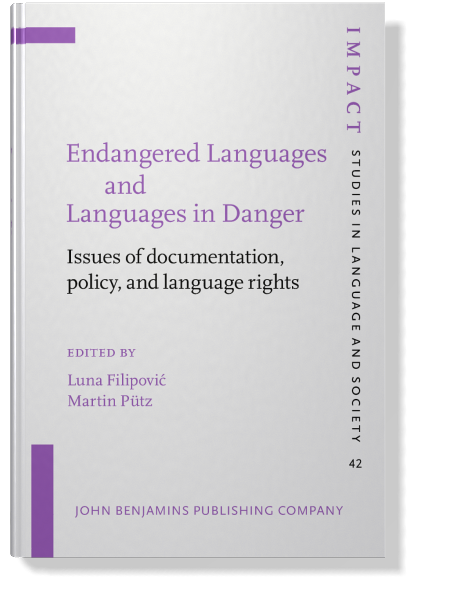
In:Endangered Languages and Languages in Danger: Issues of documentation, policy, and language rights
Edited by Luna Filipović and Martin Pütz
[IMPACT: Studies in Language, Culture and Society 42] 2016
► pp. 283–312
Get fulltext
The art of losing
Beyond java, patois and postvernacular vitality – Repositioning the periphery in global Asian ecologies
Available under the Creative Commons Attribution-NonCommercial-NoDerivatives (CC BY-NC-ND) 4.0 license.
For any use beyond this license, please contact the publisher at rights@benjamins.nl.
Published online: 3 October 2016
https://doi.org/10.1075/impact.42.12lim
https://doi.org/10.1075/impact.42.12lim
This paper discusses issues in endangerment and postvernacularity in the context of Asia, a region with complex dynamics in multilingual ecologies that also includes the presence – dominance – of English, a language that entered the ecologies through colonisation. I use as illustration two minority communities with endangered vernaculars – the Malays of Sri Lanka, brought from various parts of the Malay archipelago by the Dutch and British colonial powers, and their vernacular Sri Lanka Malay, traditionally known as java, a mixed language of trilingual base (Malay, Sinhala, Tamil); and the Peranakans, descendants of southern Chinese merchants who settled in Malaya and intermarried with local women, and their vernacular Baba Malay, a restructured variety of Malay with southern Sinitic influences, usually referred to as patois. I query if linguistic and cultural loss is inevitable, or if such situations of shift – to a language of wider communication or an emergent variety – are in fact instances of empowerment and evolution in response to change, where a repositioning of the periphery in the new global economy brings greater accessibility to and participation in the Centre, and better adaptation for surviving and thriving.
Keywords: Asia, ecology, empowerment, patois, Peranakans, postvernacular, shift, Sri Lanka Malay

References (81)
Aboh, E.O. & Ansaldo, U. 2007. The role of typology in language creation: A descriptive take. In Deconstructing Creole [Typological Studies in Language 73], U. Ansaldo, S. Matthews & L. Lim (eds), 39–66. Amsterdam: John Benjamins.
Adelaar, K.A. & Prentice, D.J. 1996. Malay: Its history, role and spread. In Atlas of Languages of Intercultural Communication in the Pacific, Asia and the Americas, S.A. Wurm, P. Mühlhäusler & D.T. Tryon (eds), 673–693. Berlin: Mouton de Gruyter.
Alliance for Linguistic Diversity. Baba Malay. Endangered Languages. <[URL]>
Ansaldo, U. 2008. Revisiting Sri Lanka Malay. In Lessons from Documented Endangered Languages [Typological Studies in Language 78], A. Dwyer, D. Harrison & D. Rood (eds), Amsterdam: John Benjamins.
. 2010. Identity alignment and language creation in multilingual communities. The Native Speaker and the Mother Tongue. Language Sciences 32(6): 615–623.
. 2011. Sri Lanka Malay and its Lankan adstrates. In Creoles, Their Substrates and Language Typology [Typological Studies in Language 95], C. Lefebvre (ed.), 367–382. Amsterdam: John Benjamins.
Ansaldo, U. & Lim, L. 2014. The lifecycle of Sri Lanka Malay. Language Documentation and Conservation 7: 100–113.
. Forthcoming. Citizenship theory and fieldwork practice in Sri Lanka Malay communities. In The Multilingual Citizen: Towards a Politics of Language for Agency and Change, L. Lim, C. Stroud & L. Wee (eds). Clevedon: Multilingual Matters.
Ansaldo, U., Lim, L. & Mufwene, S.S. 2007. The sociolinguistic history of the Peranakans: What it tells us about ‘creolization’. In Deconstructing Creole [Typological Studies in Language 73], U. Ansaldo, S. Matthews & L. Lim (eds), 203–226. Amsterdam: John Benjamins.
Ansaldo, U., Lim, L. & Nordhoff, S. 2006. Variation and shift in Sri Lanka Malay: Preliminary reflections. DoBeS (Documentation of Endangered Languages) Workshop 2006. MPI Nijmegen. 15–16 June.
Ansaldo, U. & Matthews, S.J. 1999. The Minnan substrate and creolization in Baba Malay. Journal of Chinese Linguistics 27(1): 38–68.
Ansaldo, U. & Nordhoff, S. 2009. Complexity and the age of languages. In Complex Processes in New Languages, E.O. Aboh & N. Smith (eds), 345–363. Amsterdam: John Benjamins.
Bailey, R.W. 1998. Majority language, minority misery. In Language Legislation and Linguistic Rights, D.A. Kibbee (ed.), 206–224. Amsterdam: John Benjamins.
Bloom, D. 1986. The English language in Singapore: A critical survey. In Singapore Studies, B.K. Kapur (ed.), 337–458. Singapore: Singapore University Press.
Braddell, T. 1853. Notes of a trip to the interior from Malacca. Journal of the Indian Archipelago and Eastern Asia 7: 73–104.
Documentation of Endangered Languages (DOBES). 2000–2015. Sri Lanka Malay. DOBES/ Volkswagen Stiftung. <[URL]>
Eades, D. 1988. They don’t speak in an Aboriginal language, or do they? In Being Black: Aboriginal Cultures in ‘Settled’ Australia, I. Keen (ed.), 97–115. Canberra: Aboriginal Studies Press.
Earl, G.W. 1837. The Eastern Seas or Voyages and Adventures in the Indian Archipelago in 1832–33–34. London: Allen & Co.
Endangered Language Alliance. 2012. Endangered Language Alliance. <[URL]>
Fernando, C. 1996. The post-imperial status of English in Sri Lanka 1940–1990: From first to second language. In Post-Imperial English, J.A. Fishman, A.W. Conrad & A. Rubal-Lopez (eds), 485–511. Berlin: Mouton de Gruyter.
Fishman, J.A. 1991. Reversing Language Shift: Theoretical and Empirical Foundations of Assistance to Threatened Languages. Clevedon: Multilingual Matters.
Garrett, P.B. 2006. Contact languages as “endangered” languages: What is there to lose? Journal of Pidgin and Creole Languages 21(1): 175–190.
Giles, H., Bourhis, R.Y. & Taylor, D.M. 1977. Towards a theory of language in ethnic group relations. In Language, Ethnicity and Intergroup Relations, H. Giles (ed.), 307–348. London: Academic Press.
Haspelmath, M. 2001. The European linguistic area: Standard Average European. In Language Typology and Language Universals: An International Handbook, Vol. 2. [Handbücher zur Sprach- und Kommunikationswissenschaft 20(2)], M. Haspelmath, E. König, W. Oesterreicher & W. Raible (eds), 1492–1510. Berlin: Walter de Gruyter.
Heller, M. 2013. Repositioning the multilingual periphery: Class, language and transnational markets in Francophone Canada. In Multilingualism and the Periphery, S. Pietikainen & H. Kelly-Holmes (eds), 17–34. Oxford: OUP.
Hinton, L. 2011. Revitalisation. In The Cambridge Handbook of Endangered Languages, P.K. Austin & J. Sallabank (eds). Cambridge: CUP.
Ho, M.L. & Platt, J. 1993. Dynamics of a Contact Continuum: Singaporean English. Oxford: Clarendon Press.
Hornsby, M. & Vigers, D. (eds). 2013. Breton: The Postvernacular Challenge. Special issue, International Journal of the Sociology of Language 223.
Hussainmiya, B.A. 1986. Melayu Bahasa: Some preliminary observations on the Malay creole of Sri Lanka. Sari 4(1): 19–30.
. 1990. Orang Rejimen: The Malays of the Ceylon Rifle Regiment. Kuala Lumpur: Universiti Kebangsan Malaysia.
Kwachka, P. 1992. Discourse structures, cultural stability, and language shift. International Journal of Society and Language 93: 67–73.
Kwan-Terry, A. 2000. Language shift, mother tongue, and identity in Singapore. International Journal of the Sociology of Language 143: 85–106.
Kwok, K.W. 2000. Singapore. In The Encyclopedia of the Chinese Overseas, L. Pan (ed.), 200–217. Singapore: Chinese Heritage Centre; Cambridge MA: Harvard University Press.
Lim, B.K. 1917. The Chinese in Malaya. In Present Days’ Impressions of the Far East and Prominent and Progressive Chinese at Home and Abroad: The History, People, Commerce, Industries and Resources of China, Hong Kong, Indo-China, Malaya and Netherlands India, W. Feldwisk (ed.), 875–882. London: Globe Encyclopedia.
Lim, L. 2010a. Peranakan English in Singapore. In The Lesser-Known Varieties of English, D. Schreier, P. Trudgill, E.W. Schneider & J.P. Williams (eds), 327–347. Cambridge: CUP.
. 2010b. Migrants and ‘mother tongues’: Extralinguistic forces in the ecology of English in Singapore. In L. English in Singapore: Modernity and Management, Lim, A. Pakir & L. Wee (eds), 19–54. Hong Kong: Hong Kong University Press.
. 2011. Tone in Singlish: Substrate features from Sinitic and Malay. In Creoles, Their Substrates and Language Typology [Typological Studies in Language 95], C. Lefebvre (ed.), 271–287. Amsterdam: John Benjamins.
. 2013. The politics of English (and Sinhala and Tamil) in Sri Lanka: Kaduva of privileged power, tool of rural empowerment? In The Politics of English in Asia: Language Policy and Cultural Expression in South and Southeast Asia and the Asia Pacific, L. Wee, R. Goh & L. Lim (eds), 61–80. Amsterdam: John Benjamins.
. 2013–2016. LinguisticMinorities.HK. <[URL]>
. 2014. Yesterday’s founder population, today’s Englishes: The role of the Peranakans in the (continuing) evolution of Singapore English. In The Evolution of Englishes [Varieties of English around the World G49], S. Buschfeld, T. Hoffmann, M. Huber & A. Kautzsch (eds), 401–419. Amsterdam: John Benjamins.
. 2016. Multilingual mediators: The role of the Peranakans in the contact dynamics of Singapore. In Multilingualism in the Chinese Diaspora World-Wide, L. Wei (ed.), 216–233. Abingdon: Routledge.
Lim, L. & Ansaldo, U. 2006. Keeping Kirinda vital: The endangerment-empowerment dilemma in the documentation of Sri Lanka Malay. Amsterdam Centre for Language & Communication Working Papers 1: 51–66.
. 2007. Identity alignment in the multilingual space: The Malays of Sri Lanka. In Linguistic Identity in Postcolonial Multilingual Spaces, E.A. Anchimbe (ed.), 218–243. Newcastle upon Tyne: Cambridge Scholars.
Lim, S. 1988. Baba Malay: The language of the ‘Straits-born’ Chinese. In Papers in Western Austronesian Linguistics No. 3, H. Steinhauer (ed.). Canberra: Department of Linguistics, Research School of Pacific Studies, Australian National University.
Liu, G. 1999. Singapore: A Pictorial History 1819–2000. Singapore: National Heritage Board and Editions Didier Miller.
. 2007. Population movements and contacts: Competition, selection, and language evolution. Journal of Language Contact 1: 63–91.
Peranakan Association Singapore. 1994–2008. The Peranakan. (newsletter). Singapore: The Peranakan Association.
Reershemius, G. 2009. Post-vernacular language use in a Low German linguistic community. Journal of Germanic Linguistics 21(2): 131–147.
Ricklefs, M.C. 1974. Jogjakarta under Sultan Mangkubumi, 1749–179. A History of the Division of Java. London: OUP.
Romaine, S. 2014. Linguistic diversity, sustainable development and the economics of language policy. Landau: Talk delivered at
36th International LAUD Symposium
, 31 March–3 April.
Rudolph, J. 1998. Reconstructing Identities. A Social History of the Babas in Singapore. Aldershot: Ashgate.
Saldin, B.D.K. & Lim, L. 2007. Kamus Bahasa Melayu Sri Lanka. A Sri Lanka Malay–Malay–English Dictionary. Frankfurt: Volkswagen Stiftung/DoBeS.
Shandler, J. 2006. Adventures in Yiddishland: Postvernacular Language and Culture. Berkeley, CA: University of California Press.
Siemund, P., Gogolin, I., Schulz, M.E. & Davydova, J. (eds). 2013. Multilingualism and Language Diversity in Urban Areas [Hamburg Studies on Linguistic Diversity 1]. Amsterdam: John Benjamins.
Song, O.S. 1923. One Hundred Years’ History of the Chinese in Singapore. London: John Murray. Reprinted 1967, Singapore: University of Malaya Press.
Sourjah, M.A. 2003. Malays in Sri Lanka: Came with their women-folk. WWW Virtual Library – Sri Lanka. 8 January 2004. <[URL]>
Tan, C.B. 1988a. The Baba of Malacca. Culture and Identity of a Peranakan Community in Malaysia. Petaling Jaya, Selangor: Pelanduk Publications.
. 1988b. Structure and change: Cultural identity of the Baba of Melaka. Bijdragen tot de Taal, Landen Volkenkunde 144: 297–314.
Thaliph, M.F. 2003. Book on Malay Grammar (Nahu): A Guide to Write and Speak Grammatical Malay. Wattala, Sri Lanka.
Thomson, J.T. 1875. The Straits of Malacca, Indo-China and China, or Ten Years’ Travels, Adventures and Residence Abroad. London: Sampson Low; Marston: Low & Searle.
Vaughan, J.D. 1879. Manners and Customs of the Chinese in the Straits Settlements. Singapore: The Mission Press.
Whorf, B.L. 1941. The relation of habitual thought and behavior to language. In Language, Culture, and Personality: Essays in Memory of Edward Sapir, L. Spier, A.I. Hallowell & S.S. Newman (eds), 75–93. Menasha: Sapir Memorial Publication Fund, Reprinted in 1956, in Carroll, J. B. (ed.), Language, Thought and Reality: Selected Writings of Benjamin Lee Whorf, 134–159. Cambridge MA: The MIT Press.
Cited by (5)
Cited by five other publications
Lim, Lisa
Ridge, Eleanor
2022. Patterns of variation in subject-indexing prefixes in Vatlongos, Southeast Ambrym. Asia-Pacific Language Variation 8:1 ► pp. 72 ff.
Lim, Lisa & Umberto Ansaldo
2021. Foundings and futures. In Variation Rolls the Dice [Contact Language Library, 59], ► pp. 243 ff.
Lee, Nala H.
This list is based on CrossRef data as of 12 december 2025. Please note that it may not be complete. Sources presented here have been supplied by the respective publishers. Any errors therein should be reported to them.