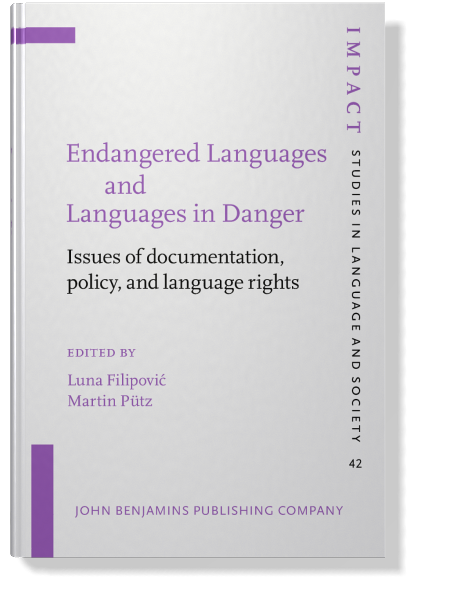
In:Endangered Languages and Languages in Danger: Issues of documentation, policy, and language rights
Edited by Luna Filipović and Martin Pütz
[IMPACT: Studies in Language, Culture and Society 42] 2016
► pp. 249–279
Get fulltext
Measuring and understanding ethnolinguistic vitality in Papapana
Available under the Creative Commons Attribution-NonCommercial-NoDerivatives (CC BY-NC-ND) 4.0 license.
For any use beyond this license, please contact the publisher at rights@benjamins.nl.
Published online: 3 October 2016
https://doi.org/10.1075/impact.42.11smi
https://doi.org/10.1075/impact.42.11smi
This paper presents a sociolinguistic profile of Papapana, spoken in Bougainville, Papua New Guinea, and investigates why and to what extent Papapana is endangered. Language endangerment is the result of complex and interrelated sociolinguistic variables. The study of language contact and use in the Papapana speech community demonstrates the unique ways in which these variables interact and provides crucial insights into factors affecting linguistic vitality in general. The assessment of Papapana using some of the many ethnolinguistic vitality assessment frameworks challenges the assumptions and definitions of these frameworks, and suggests they need re-evaluating, particularly as they often fail to distinguish symptoms and causes of linguistic endangerment. It is vital to make this separation as predictive and diagnostic assessments may have different applications.
Keywords: causes, endangerment, ethnolinguistic vitality, language contact, Papua New Guinea, status, use

References (45)
Baker, P. & Mühlhäusler, P. 1996. The origins and diffusion of Pidgin English in the Pacific. In Atlas of Languages of Intercultural Communication in the Pacific, Asia, and the Americas, Vol II(1), S.A. Wurm, P. Mühlhäusler & D.T. Tryon (eds), 551–583. Berlin: Mouton de Gruyter.
Barrena, A., Amorrortu, E., Ortega, A., Uranga, B., Izagirre, E. & Idiazabal, I. 2007. Does the number of speakers of a language determine its fate? International Journal of the Sociology of Language 186: 125–139.
Brenzinger, M., Yamamoto, A., Aikawa, N., Koundiouba, D., Minasyan, A., Dwyer, A., Grinevald, C., Krauss, M., Miyaoka, O., Sakiyama, P., Smeets, R. & Zepeda, O. 2003. Language vitality and endangerment. Document submitted to the
International Expert Meeting on UNESCO Programme Safeguarding of Endangered Languages
, Paris, 10–12 March. <[URL]>
Campbell, L. & Muntzel, M.C. 1989. The structural consequences of language death. In Investigating Obsolescence: Studies in Language Contraction and Death, N.C. Dorian (ed.), 181–196. Cambridge: CUP.
Dixon, R.M.W. 1991. The endangered languages of Australia, Indonesia and Oceania. In Endangered Languages, R.H. Robins & E.M. Uhlenbeck (eds), 229–255. Oxford: Berg.
Evans, B. 2009. Beyond pronouns: Further evidence for South Bougainville. In Discovering History through Language: Papers in Honour of Malcolm Ross, B. Evans (ed.), 73–101. Canberra: Pacific Linguistics.
Florey, M. 2005. Language shift and endangerment. In The Austronesian Languages of Asia and Madagascar, K.A. Adelaar & N.P. Himmelmann (eds), 43–64. London: Routledge.
Foley, W.A. 2004. Language endangerment, language documentation and capacity building: challenges from New Guinea. In Language Documentation and Description, P.K. Austin (ed.), 28–38. London: Hans Rausing Endangered Languages Project, Department of Linguistics.
Grenoble, L.A. & Whaley, L.J. 1998. Toward a typology of language endangerment. In Endangered Languages: Current Issues and Future Prospects, L.A. Grenoble & L.J. Whaley (eds), 22–54. Cambridge: CUP.
Himmelmann, N.P. 2010. Language endangerment scenarios: A case study from Northern Central Sulawesi. In Endangered Languages of Austronesia, M. Florey (ed.), 45–72. Oxford: OUP.
Kibrik, A.E. 1991. The problem of endangered languages in the USSR. In R.H. Robins & E.M. Uhlenbeck (eds), Endangered Languages, 257–273. Oxford: Berg.
. 1997. The indigenous languages of the North: A report on their present state. Northern minority languages: problems of survival. Senri Ethnological Studies 44: 1–34.
. 2007. Classification and terminology for degrees of language endangerment. In Language Diversity Endangered, M. Brenzinger (ed.), 1–8. Berlin: Walter de Gruyter.
Kulick, D. 1992. Language Shift and Cultural Reproduction: Socialization, Self, and Syncretism in a Papua New Guinean Village. Cambridge: CUP.
Landweer, M.L. 2012. Methods of language endangerment research: A perspective from Melanesia. International Journal of the Sociology of Language 214: 153–178.
Laracy, H. 1976. Marists and Melanesians: A History of Catholic Missions in the Solomon Islands. Honolulu HI: The University Press of Hawai’i.
. 2005a. 1914: Changing the guard at Kieta. In Bougainville Before the Conflict, A.J. Reagan & H.M. Griffin (eds), 136–140. Canberra: Pandanus Books.
. 2005b. ‘
Imperium in Imperio’? The catholic church in Bougainville. In Bougainville Before the Conflict, A.J. Reagan & H.M. Griffin (eds), 125–135. Canberra: Pandanus Books,
Lee, N.H. & Way, J.V. 2016. Assessing levels of endangerment in the Catalogue of Endangered Languages (ELCat) using the Language Endangerment Index (LEI). Language in Society 45(2): 271–292.
Lewis, M.P. 2006. Towards a categorization of endangerment of the world’s languages. SIL Electronic Working Papers 2006-002: 31.
Lewis, M.P. & Simons, G.F. 2010. Assessing endangerment: Expanding Fishman’s GIDS. Revue Roumaine de Linguistique 2: 103–120.
Lewis, M.P., Simons, G.F. & Fennig, C.D. 2014. Ethnologue: Languages of the World. 17th edn. Dallas TX: SIL International.
Matras, Y. 2005. Language contact, language endangerment, and the role of the ‘salvation linguist’. In Language Documentation and Description, P.K. Austin (ed.), 225–251. London: Hans Rausing Endangered Languages Project, Department of Linguistics, SOAS.
Mühlhäusler, P. 1976. Samoan Plantation Pidgin and the origins of New Guinea Pidgin: An introduction. Journal of Pacific History 11(2): 122–125.
Nettle, D. & Romaine, S. 2000. Vanishing Voices: The Extinction of the World’s Languages. Oxford: OUP.
Oliver, D. 1991. Black Islanders: A Personal Perspective of Bougainville 1937–1991. Melbourne: Hyland House.
Regan, A.J. & Griffin, H.M. (eds). 2005. Bougainville before the Conflict. Canberra: Pandanus Books.
Ross, M. 1996. Mission and church languages in Papua New Guinea. In Atlas of Languages of Intercultural Communication in the Pacific, Asia, and the Americas, Vol II, S.A. Wurm, P. Mühlhäusler & D.T. Tryon (eds), 595–617. Berlin: Mouton de Gruyter.
Tryon, D. 2005. The languages of Bougainville. In Bougainville Before the Conflict, A.J. Reagan & H.M. Griffin (eds), 31–46. Canberra: Pandanus Books.
Vernon, D. 2005. The Panguna mine. In Bougainville Before the Conflict, A.J. Reagan & H.M. Griffin (eds), 258–273. Canberra: Pandanus Books.
Wurm, S.A. 1979. The language situation in the New Guinea area. In New Guinea and Neighboring Areas: A Sociolinguistic Laboratory, S.A. Wurm (ed.), 3–10. Paris: Mouton.
. 1998. Methods of language maintenance and revival, with selected cases of language endangerment in the world. In
Studies in Endangered Languages: Papers from the International Symposium on Endangered Languages
,
Tokyo
Nov 18–20 1995, K. Matsumura (ed.). Tokyo: Hituzi Syobo.
. 2003. The language situation and language endangerment in the Greater Pacific area. In Language Death and Language Maintenance: Theoretical, Practical and Descriptive Approaches [Current Issues in Linguistic Theory 240], M. Janse & S. Tol (eds), 15–47. Amsterdam: John Benjamins.
Cited by (1)
Cited by one other publication
This list is based on CrossRef data as of 12 december 2025. Please note that it may not be complete. Sources presented here have been supplied by the respective publishers. Any errors therein should be reported to them.