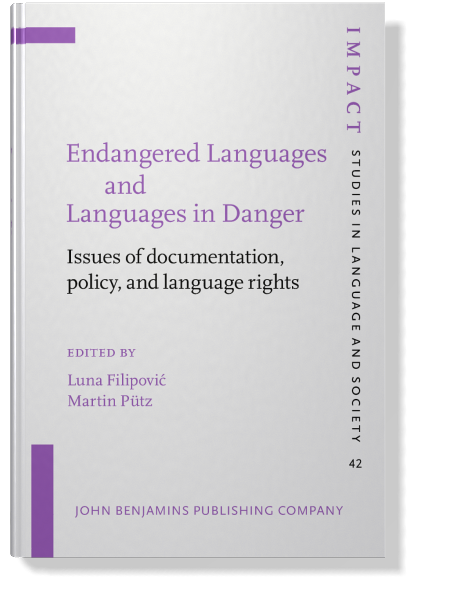
In:Endangered Languages and Languages in Danger: Issues of documentation, policy, and language rights
Edited by Luna Filipović and Martin Pütz
[IMPACT: Studies in Language, Culture and Society 42] 2016
► pp. 147–170
Get fulltext
Language documentation 20 years on
Available under the Creative Commons Attribution-NonCommercial-NoDerivatives (CC BY-NC-ND) 4.0 license.
For any use beyond this license, please contact the publisher at rights@benjamins.nl.
Published online: 3 October 2016
https://doi.org/10.1075/impact.42.07aus
https://doi.org/10.1075/impact.42.07aus
In the last decade of the 20th century a new field of language research emerged that has come to be known as ‘language documentation’ or ‘documentary linguistics’ (Himmelmann 1998, 2002, 2006; Lehmann 2001; Austin 2010; Grenoble 2010; Woodbury 2003, 2011). In this paper we explore how it was defined in the seminal work of Himmelmann (1998) and others, including what were presented as significant characteristics that distinguished language documentation from language description, and how the field has changed and evolved over the past 20 years. A focus on best practices, standards, tools and models for documentary corpora appeared in the early years, which led later to more critical discussions of the goals and methods of language documentation. The paper examines some current developments, including new approaches to language archiving, and suggests that there are opportunities for language documentation to adopt a more socially-engaged approach to languages and linguistic research, including better engagement with language revitalisation. There are also opportunities to work towards addressing what is currently a language documentation output gap through experimentation with new genres and innovations in writing and publication.

References (102)
Aikhenvald, A.Y. 2007. Linguistic fieldwork: Setting the scene. Sprachtypologie und Universalienforschung 60(1): 3–11.
Amery, R. 2009. Phoenix or relic? Documentation of languages with revitalization in mind. Language Documentation and Conservation 3(2): 138–148.
Aristar, A.R. 2003. The school of best practice. London: SOAS Workshop on Archives for Endangered Languages, November 21–22.
Aristar-Dry, H. 2004. E-MELD School of best practices in digital language documentation. Detroit: Presentation at
E-MELD Conference 2004: Workshop on linguistic databases and best practice
, July 15–18.
Austin, P.K. 2006a. Data and language documentation. In Essentials of Language Documentation [Trends in Linguistics. Studies and Monographs 178], J. Gippert, N. Himmelmann & U. Mosel (eds), 87–112. Berlin: Mouton de Gruyter.
. 2006b. Defining language documentation. Washington DC: Paper presented at the Georgetown University Roundtable on Linguistics, March.
. 2007. Survival of languages. In Survival: Darwin College Lectures, E.F. Shuckburgh (ed.), 80–98. Cambridge: CUP.
. 2008. Training for language documentation: Experiences at the School of Oriental and African Studies. In Documenting and Revitalising Austronesian Languages [Language Documentation and Conservation Special Publication 1], M. Florey & V. Rau (eds), 25–41. Hawaii HI: University of Hawaii Press.
. 2009. Meta-documentary linguistics. Kioloa: Paper given at the Aboriginal languages workshop, March 2009.
. 2010. Current issues in language documentation. Language Documentation and Description 7, 12–33. London: SOAS.
. 2013. Language documentation and meta-documentation. In Keeping Languages Alive: Documentation, Pedagogy and Revitalization, S. Ogilvie & M. Jones (eds), 3–15. Cambridge: CUP.
Austin, P.K. & Grenoble, L. 2007. Current trends in language documentation. Language Documentation and Description 4, 12–25. London: SOAS.
Austin, P.K. & Sallabank, J. 2014. Endangered Languages: Ideologies and Beliefs in Language Documentation and Revitalization. London: British Academy.
. 2015. Language documentation and language revitalization: Partners or just good friends? Ms, SOAS.
Bell, J. & Bird, S. 2000. Preliminary study of the structure of lexicon entries. Philadelphia: Proceedings of the
Workshop on Web-Based Language Documentation and Description
.
Bentahila, A. & Davies, E.E. 1993. Language revival: Restoration or transformation? Journal of Multilingual and Multicultural Development 14(5): 355–374.
Bird, S. & Liberman, M. 2001. A formal framework for linguistic annotation. Speech Communication 33(1–2): 23–60.
Bird, S. & Simons, G. 2003. Seven dimensions of portability for language documentation and description. Language 79(3): 557–582.
Blench, R. 2008. Endangered languages in West Africa. In Language Diversity Endangered, M. Brenzinger (ed.), 140–162. Berlin: Mouton de Gruyter.
Bowe, C., Hughes, B. & Bird, S. 2003. Towards a general model for interlinear text. Proceedings of EMELD-03, 12 August, 2013. <[URL]>
Bowern, C. 2011. Planning a language documentation project. In The Cambridge Handbook of Endangered Languages, P.K. Austin & J. Sallabank (eds), 459–482. Cambridge: CUP.
CELP. 2007. Adequacy of documentation. Document circulated at the
January 2007 meeting of the Linguistic Society of America Committee on Endangered Languages and Their Preservation
.
Childs, T., Good, J. & Mitchell, A. 2014. Beyond the ancestral code: Towards a model for sociolinguistic language documentation. Language Documentation and Conservation 8: 168–191.
Chomsky, N. 1964. Current issues in linguistic theory. In The Structure of Language, J.A. Fodor & J.J. Katz (eds), 50–118. Englewood Cliffs NJ: Prentice Hall.
Coelho, G. 2005. Language documentation and ecology: Areas of interaction. In Language Documentation and Description 3, P.K. Austin (ed.), 63–74. London: SOAS.
Cope, L. (ed.). 2014. Applied Linguists Needed: Cross-disciplinary Networking in Endangered Language Contexts. Abingdon: Routledge.
Dimmendaal, G. 2004. Capacity building in an African context. In Language Documentation and Description 2, P.K. Austin (ed.), 71–89. London: SOAS.
Dobrin, L., Austin, P.K. & Nathan, D. 2007. Dying to be counted: Commodification of endangered languages in documentary linguistics. Language Documentation and Description 6, 37–52. London: SOAS.
Eisenbeiss, S. 2005. Psycholinguistic contributions to language documentation. Language Documentation and Description 3, 106–140. London: SOAS.
Farrar, S. & Langendoen, D.T. 2003a. A linguistic ontology for the semantic web. GLOT International 7(3): 97–100.
. 2003b. Markup and the GOLD ontology.
Proceedings of EMELD-03
, 12 August 2013. <[URL]>
Farrar, S., Lewis, W.D. & Langendoen, D.T. 2002. A common ontology for linguistic concepts. Seattle WA: Proceedings of the
Knowledge Technologies Conference
, 12 August 2013. <[URL]>
Fillmore, C. 1992. ‘Corpus linguistics’ or ‘computer-aided armchair linguistics’. In Directions in Corpus Linguistics, J. Svartik (ed.), 35–45. Berlin: Mouton de Gruyter.
Fishman, J.A. 1991. Reversing Language Shift: Theory and Practice of Assistance to Threatened Languages. Bristol: Multilingual Matters.
. (ed.). 2001. Can Threatened Languages Be Saved? Reversing Language Shift, Revisited: A 21st Century Perspective. Bristol: Multilingual Matters.
Garrett, E. 2014. Participant driven language archiving. In Language Documentation and Description 12, D. Nathan & P.K. Austin (eds), 68–84. London: SOAS.
Gawne, L., Kelly, B.F., Berez, A. & Heston, T. 2015. Putting practice into words: Fieldwork methodology in grammatical descriptions. Hawaii: Paper presented at
ICLDC 4 Conference
.
Grenoble, L.A. 2010. Language documentation and field linguistics: The state of the field. In Language Documentation: Practice and Values, L.A. Grenoble & N.L. Furbee (eds), 289–309. Amsterdam: John Benjamins.
. 2011. Language ecology and endangerment. In The Cambridge Handbook of Endangered Languages, P.K. Austin & J. Sallabank (eds), 27–45. Cambridge: CUP.
Grenoble, L.A. & Whaley, L.J. 2006. Saving Languages: An Introduction to Language Revitalization. Cambridge: CUP.
Grinevald, C. 2003. Speakers and documentation of endangered languages. Language Documentation and Description 1: 52–72.
Gullberg, M. 2012. Bilingual multimodality and language documentation. In Potentials of Language Documentation: Methods, Analyses, and Utilization [Language Documentation and Conservation Special Publication 3], F. Seifart, G. Haig, N.P. Himmelmann, D. Jung, A. Margetts & P. Trilsbeek (eds), 46–53. Honolulu HI: University of Hawai’i Press.
Hale, K., Krauss, M., Watahomigie, L.J., Yamamoto, A.Y., Craig, C., Jeanne, L.M. & England, N.C. 1992. Endangered languages. Language 68(1): 1–42.
Harrison, K.D. 2005. Ethnographically informed language documentation. Documentation and Description 3, 22–41. London: SOAS,
. 2002. Documentary and descriptive linguistics. In Lectures on Endangered Languages, Vol. V, O. Sakiyama & F. Endo (eds), 37–83. Kyoto: Endangered Languages of the Pacific Rim,
. 2006. Language documentation: What is it and what is it good for? In Essentials of Language Documentation [Trends in Linguistics. Studies and Monographs 178], J. Gippert, N.P. Himmelmann & U. Mosel (eds), 1–30. Berlin: Mouton de Gruyter.
. 2008. Reproduction and preservation of linguistic knowledge: Linguistics’ response to language endangerment. Annual Review of Anthropology 37: 337–350.
. 2012. Linguistic data types and the interface between language documentation and description. Language Documentation and Conservation 6: 187–207.
. 2011. Revitalization of endangered languages. In The Cambridge Handbook of Endangered Languages, P.K. Austin & J. Sallabank (eds), 291–311. Cambridge: CUP.
. 2013. Bringing Our Languages Home: Language Revitalization for Families. Berkeley CA: Heyday Books
Hinton, L. & Hale, K. (eds). 2001. The Green Book of Language Revitalization in Practice. San Diego CA: Academic Press.
Holton, G. 2014. Mediating language documentation. In Language Documentation and Description 12, B. Nathan & P.K. Austin (eds), 37–52. London: SOAS.
Hornberger, N.H. 2010. Language shift and language revitalization. In The Oxford Handbook of Applied Linguistics, R.B. Kaplan (ed.), 365–373. Oxford: OUP.
Hymes, D. 1964. Introduction: Toward ethnographies of communication. American Anthropologist 66(6): 1–34.
Kapono, E. 1995. Hawaiian language revitalization and immersion education. International Journal of the Sociology of Language 112: 121.
Kroskrity, P.V. 2015. Designing a dictionary for an endangered language community: Lexicographical deliberations, language ideological clarifications. Language Documentation and Conservation 9: 140–157.
Lehmann, C. 2001. Language documentation: A program. In Aspects of Typology and Universals, W. Bisang (ed.), 83–97. Berlin: Akademie Verlag.
Linn, M.-A. 2014. Living archives: A community-based language archive model. In Language Documentation and Description 12, D. Nathan & P.K. Austin (eds), 53–67. London: SOAS.
Lüpke, F. 2009. Data collection methods for field-based language documentation. In Language Documentation and Description 6, P.K. Austin (ed.), 53–100. London: SOAS.
Lüpke, F. & Storch, A. 2013. Repertoires and Choices in African Languages. Berlin: Mouton de Gruyter.
Mühlhäusler, P. 1992. Preserving languages or language ecologies? A top-down approach to language survival. Oceanic Linguistics 31(2): 163–180.
Nathan, D. 2004. Documentary linguistics: Alarm bells and whistles? Seminar presentation,
SOAS
. 23 November 2004.
. 2006. Sound and unsound documentation: Questions about the roles of audio in language documentation. Washington DC: Paper presented at the Georgetown University Roundtable on Linguistics.
. 2009. The soundness of documentation: Towards an epistemology for audio in documentary linguistics. Journal of the International Association of Sound Archives 33. <[URL]> (22 March 2012).
. 2010a. Sound and unsound practices in documentary linguistics: Towards an epistemology for audio. Language Documentation and Description 7, 1–17. London: SOAS.
. 2010b. Archives 2.0 for endangered languages: From disk space to MySpace. International Journal of Humanities and Arts Computing 4(1–2): 111–124.
. 2014. Access and accessibility at ELAR, an archive for endangered languages documentation. In Language Documentation and Description 12, D. Nathan & P.K. Austin (eds), 187–208. London: SOAS.
Nathan, D. & Austin, P.K. 2004. Reconceiving metadata: Language documentation through thick and thin. In Language Documentation and Description 2, P.K. Austin (ed.), 179–187. London: SOAS.
Newman, P. 2003. The endangered languages issue as a hopeless cause. In Language Death and Language Maintenance [Current Issues in Linguistic Theory 240], M. Janse & S. Tol (eds), 1–13. Amsterdam: John Benjamins.
. 2009. Fieldwork and fieldmethods in linguistics. Language Documentation and Conservation 3(1): 113–125.
. 2013. The law of unintended consequences: How the endangered languages movement undermines field linguistics as a scientific enterprise. Seminar presented at
SOAS
, 15th October.
Niedzielski, H.Z. 1992. The Hawaiian model for the revitalization of native minority languages and cultures. In Maintenance and Loss of Minority Languages [Studies in Bilingualism 1], W. Fase, K. Jaspaert & S. Kroon (eds), 369–384. Amsterdam: John Benjamins.
Penton, D., Bow, C., Bird, S. & Hughes, B. 2004. Towards a general model for linguistic paradigms. In
Proceedings of EMELD-04
, 12 August 2013. <[URL]>
Romaine, S. 2007. Preserving endangered languages. Language and Linguistics Compass 1(1–2): 115–132.
Sallabank, J. 2012. From language documentation to language planning: Not necessarily a direct route. In Potentials of Language Documentation: Methods, Analyses, and Utilization [Language Documentation and Conservation Special Publication 3], F. Seifart, G. Haig, N.P. Himmelmann, D. Jung, A. Margetts & P. Trilsbeek (eds), 118–125. Honolulu HI: University of Hawai’i Press.
Schultze-Berndt, E. 2006. Linguistic annotation. In Essentials of Language Documentation, J. Gippert, N.P. Himmelmann & U. Mosel (eds), 213–251. Berlin: Mouton de Gruyter.
Seifart, F. 2008. The representativeness of language documentations. Language Documentation and Description 5, 60–76. London: SOAS,
Sherzer, J. 1987. A discourse-centered approach to language and culture. American Anthropologist 89(2): 295–309.
Spolsky, B. 1989. Maori bilingual education and language revitalization. Journal of Multilingual and Multicultural Development 10(2): 89–106.
Sugita, Y. 2007. Language revitalization or language fossilization? Some suggestions for language documentation from the viewpoint of interactional linguistics. In Proceedings of First Conference on Language Documentation and Linguistic Theory, P.K. Austin, O. Bond & D. Nathan (eds), 243–250. London: SOAS.
Thieberger, N. 2012. Counting collections. Paradisec Blog, 29 November 2012. <[URL]> (6 June 2015).
Thieberger, N., Margetts, A., Morey, S., Musgrave, S. & Schembri, A. 2012. Assessing curated corpora as research output. Paper presented to the
Annual Conference of the Australian Linguistic Society
, University of Western Australia.
Whalen, D. 2004. How the study of endangered languages will revolutionize linguistics. In Linguistics Today – Facing a Greater Challenge, P. van Sterkenburg (ed.), 321–342. Amsterdam: John Benjamins.
. 2013. Response to Paul Newman. Blog post dated 3 December 2013. <[URL]> (27 March 2015).
Woodbury, T. 2003. Defining documentary linguistics. Language Documentation and Description 1, 35–51. London: SOAS.
. 2011. Language documentation. In The Cambridge Handbook of Endangered Languages, P.K. Austin & J. Sallabank (eds), 159–186. Cambridge: CUP.
Cited by (12)
Cited by 12 other publications
Atindogbe, Gratien G.
Bejar, Susana, Alana Johns & Christine Nochasak
Smith, Lawrence
Akkuş, Mehmet
Mathe, Limukani & Gilbert Motsaathebe
Norahim, Norazuna & Hardyman Badawi
Barua, Souvik
Sinha, Chris
Grinevald, Colette & Chris Sinha
2020. Chapter 3. North-South relations in linguistic science. In Language, Culture and Identity – Signs of Life [Cognitive Linguistic Studies in Cultural Contexts, 13], ► pp. 43 ff.
Lee, Nala H.
This list is based on CrossRef data as of 12 december 2025. Please note that it may not be complete. Sources presented here have been supplied by the respective publishers. Any errors therein should be reported to them.