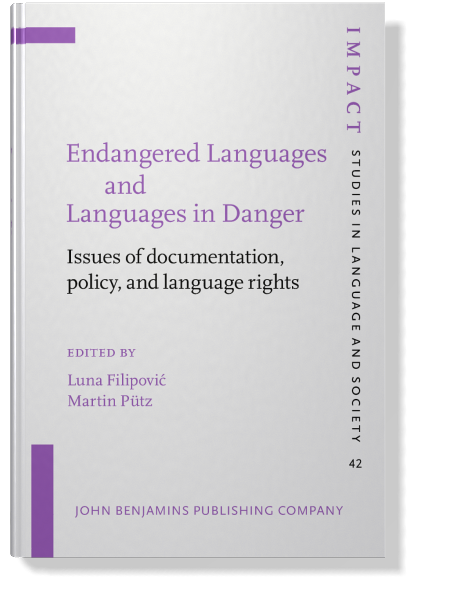
In:Endangered Languages and Languages in Danger: Issues of documentation, policy, and language rights
Edited by Luna Filipović and Martin Pütz
[IMPACT: Studies in Language, Culture and Society 42] 2016
► pp. 115–143
Get fulltext
A cost-and-benefit approach to language loss
Available under the Creative Commons Attribution-NonCommercial-NoDerivatives (CC BY-NC-ND) 4.0 license.
For any use beyond this license, please contact the publisher at rights@benjamins.nl.
Published online: 3 October 2016
https://doi.org/10.1075/impact.42.06muf
https://doi.org/10.1075/impact.42.06muf
The linguistics discourse on language endangerment and loss has been marked by a number of disputable assumptions about what languages are and about the terrible price humanity incurs in losing linguistic and cultural diversity as some of them die. I dispute some of those assumptions, including the claim that there are language rights. I also raise issues about the notions heritage and ancestral languages, which should not be confused with mother tongue. I argue that language loss is a consequence of the communicative habits of speakers, influenced in the here and now by their particular socioeconomic ecologies. The notion of population structure, which has to do with whether a population is integrated or segregated, who gets to interact regularly with whom, and who has to accommodate whom linguistically, plays an important role in my arguments.

References (47)
Austin, P.K. & Sallabank, J. (eds). 2011. The Cambridge Handbook of Endangered Languages. Cambridge: CUP.
. (eds). 2015. Endangered Languages: Beliefs and Ideologies in Language Documentation and Revitalization. Oxford: OUP.
Banner, S. 2005. How the Indians Lost their Land: Law and Power on the Frontier. Cambridge: Belknab Press.
Broeder, P., Extra, G. & Maartens, J. 2002. Multilingualism in South Africa with a Focus on KwaZulu Natal and Metropolitan Durban [Occasional Papers 7]. Cape Town: PRAESA.
Chanda, N. 2007. Bound Together: How Traders, Preachers, Adventurers, and Warriors shaped Globalization. New Haven CT: Yale University Press.
Chaudenson, R. 2008. On the futurology of linguistic development. In Globalization and Language Vitality: Perspectives from Africa, C.B. Vigouroux & S.S. Mufwene (eds), 171–190. London: Continuum.
Crosby, A.W. 1992. Ills. In Atlantic American Societies: From Columbus through Abolition 1492–1888, A.L. Karras & J.R. McNeill (eds), 19–39. London: Routledge.
Cunningham, D., Ingram, D.E. & Sumbuk, K. (eds). 2006. Language Diversity in the Pacific: Endangerment and Survival. Clevedon: Multilingual Matters.
Grenoble, L.A. & Whaley, L.J. 2006. Saving Languages: An Introduction to Language Revitalization. Cambridge: CUP.
Hagège, C. 2014. La confrontation entre l’anglais et le français dans le monde contemporain (début du XXe siècle). In Colonisation, globalisation et vitalité du français, S.S. Mufwene & C.B. Vigouroux (eds), 47–74. Paris: Odile Jacob.
Harbert, W. 2010. Endangered languages and economic development. In Austin & Sallabank (eds), 403–445.
Logan, R.K. 2007. The Extended Mind: The Emergence of Language, the Human Mind, and Culture. Toronto: University of Toronto Press.
. 2000. Languages do not kill languages, speakers do. The University of Chicago Magazine 93(2): 30–31.
. 2006. Language endangerment: An embarrassment for linguistics. In
The Panels: Papers from the 42nd Annual Meeting of the Chicago Linguistic Society
, J. Bunting, S. Desai, R. Peachey, C. Straughn & Z. Tomkova (eds), 111–140. Chicago IL: CLS.
. 2007. How languages die. In Combat pour les langues du monde – Fighting for the World’s Languages: Hommage à Claude Hagège, J. Fernandez-Vest (ed.), 377–388. Paris: L’Harmattan.
. 2009. The indigenization of English in North America. In World Englishes: Problems, Properties, Prospects. Selected Papers from the 13th IAWE Conference [Varieties of English around the World G40], T. Hoffmann & L. Siebers (eds), 353–368. Amsterdam: John Benjamins.
. 2013a. Language as technology: Some questions that evolutionary linguistics should address. In In Search of Universal Grammar: From Norse to Zoque [Linguistik Aktuell/Linguistics Today 202], T. Lohndal (ed.), 327–358. Amsterdam: John Benjamins.
. 2013b. What African linguistics can contribute to evolutionary linguistics. In Selected Proceedings of the 43rd Annual Conference on African Linguistics: Linguistic Interfaces in African Languages, O.O. Orie & K. Wu (eds), 52–67. Somerville MA: Casadilla Press.
. In press. Language evolution, by exaptation, with the mind leading. In Essays in Evolutionary Linguistics, G. Peng (ed.). Hong Kong: Chinese University of Hong Kong Press.
Mufwene, S.S. & Vigouroux, C.B. 2008. Colonization, globalization and language vitality in Africa: An introduction. In Globalization and Language Vitality: Perspectives from Africa, C.B. Vigouroux & S.S. Mufwene (eds), 1–31. London: Continuum.
Mühlhäusler, P. 1996. Linguistic Ecology: Language Change and Linguistic Imperialism in the Pacific Region. London: Routledge.
. 2003. Language of Environment: Environment of Language: A Course in Ecolinguistics. London: Battlebridge.
Nettle, D. & Romaine, S. 2002. Vanishing Languages: The Extinction of the World’s Languages. Oxford: OUP.
Odling-Smee, J.F., Laland, K.N. & Feldman, M.W. 2003. Niche Construction: The Neglected Process in Evolution. Princeton NJ: Princeton University Press.
Sapir, E. 1921. Language: An Introduction to the Study of Speech. New York NY: Harcourt, Brace & World.
de Saussure, F. 1916. Cours de linguistique générale, C. Bally & A. Sechehaye (eds) in collaboration with A. Riedlinger. Paris: Payot.
Skutnabb-Kangas, T. 2000. Linguistic Genocide in Education, or Worldwide Diversity and Human Rights? Mahwah NJ: Lawrence Erlbaum Associates.
Skutnabb-Kangas, T. & Dunbar, R. 2010. Indigenous children’s education as linguistic genocide and a crime against humanity? A global view. Gáldu Čála – Journal of Indigenous Peoples Rights 1.
Trudgill, P. 1972. Sex, covert prestige and linguistic change in the urban British English of Norwich. Language in Society 1: 175–195.
Tryon, D. 2006. Language endangerment and globalization in the Pacific. In Cunningham, Ingram & Sumbuk (eds), 97–111.
Cited by (12)
Cited by 12 other publications
Mayer, Elisabeth
Gurney, Laura
Muchena, Tambawoga & Ernest Jakaza
He, Agnes Weiyun
Mufwene, Salikoko S.
Mufwene, Salikoko S.
Mufwene, Salikoko S.
Mufwene, Salikoko S.
Pennycook, Alastair
Pennycook, Alastair
This list is based on CrossRef data as of 12 december 2025. Please note that it may not be complete. Sources presented here have been supplied by the respective publishers. Any errors therein should be reported to them.