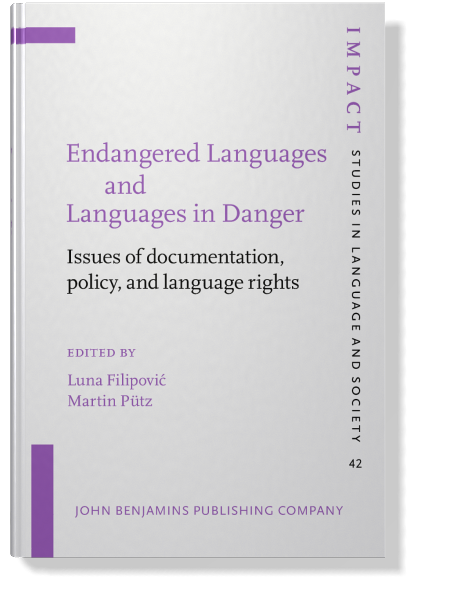
In:Endangered Languages and Languages in Danger: Issues of documentation, policy, and language rights
Edited by Luna Filipović and Martin Pütz
[IMPACT: Studies in Language, Culture and Society 42] 2016
► pp. 61–85
Get fulltext
Language rights in danger
Access to justice and linguistic (in)equality in multilingual judicial contexts
Available under the Creative Commons Attribution-NonCommercial-NoDerivatives (CC BY-NC-ND) 4.0 license.
For any use beyond this license, please contact the publisher at rights@benjamins.nl.
Published online: 3 October 2016
https://doi.org/10.1075/impact.42.04hal
https://doi.org/10.1075/impact.42.04hal
This chapter provides a discussion of communication problems that arise in a multilingual legal context. We analyse witness interview reports and interviews from both the UK and the US in order to assess the difficulties that non-English speakers can face in an English-speaking justice system. The problems encountered indicate the need for the provision of adequate language support and improved professional training that will focus on particularly problematic lexical and grammatical contrasts for translation. We argue that people’s language rights can be endangered as a result of the difficulties we discoverd, even for speakers of a major language (such as Spanish). We conclude that for the purpose of equality in access to justice these problems need to be addressed by both scientific and professional communities involved.
Keywords: access to justice, endangerment, English, interpreting, language rights, migrant, Spanish, translation

References (34)
Abad Vergara, S. & Filipović, L. Submitted. Separating investigation from interpretation: The issue of mixing the interviewer and interpreter role in police interviews.
Abad Vergara, S. 2014. A Study of Interpreter Training in the UK on a Legal Context: Issues of Language Contrasts, Policies and Practices. MA dissertation, University of East Anglia.
Berk-Seligson, S. 1990. The Bilingual Courtroom: Court Interpreters in Judicial Process. Chicago IL: University of Chicago Press.
. 2009. Coerced Confessions – The Discourse of Bilingual Police Interrogations. Berlin: Mouton de Gruyter.
Council of Europe Convention on Action against trafficking in Human Beings. May 2005. <[URL]>
Dingemanse, M. & Enfield, N.J. 2014. Let’s talk: Special report. Scientific American Mind, September/October: 64–69.
Fausey, C.M. & Boroditsky, L. 2010. Subtle linguistic cues influence perceived blame and financial liability. Psychonomic Bulletin and Review 17(5): 644–650.
. 2011. Who dunnit? Cross-linguistic differences in eye-witness memory. Psychonomic Bulletin and Review 18(1): 150–157.
Filipović, L. 2007. Language as a witness: Insights from cognitive linguistics. Speech, Language and the Law 14(2): 245–267.
. 2013a. The role of language in legal contexts: A forensic cross-linguistic viewpoint. In Freeman & Smith (eds), 328–343. Oxford: OUP.
. 2013b. Constructing causation in language and memory: Implications for access to justice in multilingual interactions. International Journal of Speech, Language and the Law 20(1): 1–19.
Filipović, L. & Ibarretxe-Antuñano, I. 2015. Motion. In Handbook of Cognitive Linguistics [Handbooks of Linguistics and Communication Science 39], E. Dabrowska & D. Divjak (eds), 527–545. Berlin: Mouton de Gruyter.
. 2011. Towards a framework for communication evidence. International Journal of Speech, Language and the Law 18(2): 233–260.
Hale, S.B. 2004. The Discourse of Court Interpreting [Benjamins Translation Library 52]. Amsterdam: John Benjamins.
Hales, L. & Gelsthorpe, L. 2012. The Criminalisation of Migrant Women. Cambridge: Institute of Criminology, University of Cambridge.
House of Commons Justice Committee. 2013. Interpreter and translation services and the Applied Language Solutions Contract.
Sixth Report of Session 2012–2013
. HC 245. London: House of Commons Stationary Office.
Ibarretxe-Antuñano, I. & Filipović, L. 2013. Lexicalization patterns and translation. In Cognitive Linguistics and Translation, A. Rojo & I. Ibarretxe-Antuñano (eds), 253–284. Berlin: Mouton de Gruyter.
Mendoza-Denton, R. 2010. Are we born racist? Inside the science of stigma, prejudice and intergroup relations. <[URL]>
Ministry of Justice. April 2016. Offender Management Statistics Bulletin, England and Wales. Quarterly October to December 2015. Annual January to December 2015. <[URL]>
Mulcahy, L. 2011. Legal Architecture. Justice, Due Process and the Place of Law. Abingdon: Routledge.
National Crime Agency (NRM) <[URL]>
Quernton (Section 3). 2012. A Gender Analysis of UK Asylum Law, Policy and Practice. London: Asylum Aid Publications.
Roberts, F., Margutti, P. & Takano, S. 2011. Judgments concerning valence of inter-turn silence across speakers of American English, Italian and Japanese. Discourse Processes 48(5): 331–354.
Slobin, D.I. 1996. Two ways to travel: Verbs of motion in English and Spanish. In Grammatical Constructions: Their Form and Meaning, M. Shibatani & S.A. Thompson (eds), 195– 317. Oxford: Clarendon Press.
. 1997. Mind, code, and text. In Essays on Language Function and Language Type: Dedicated to T. Givón, J. Bybee, J. Haiman & S.A. Thompson (eds), 437–467. Amsterdam: John Benjamins.
. 2000. Verbalized events: A dynamic approach to linguistic relativity and determinism. In Evidence for Linguistic Relativity, S. Niemeier & R. Dirven (eds), 107–138. Berlin: Mouton de Gruyter.
. 2004. The many ways to search for a frog. In Relating Events in Narrative: Typological and Contextual Perspectives S. Strömqvist & L. Verhoeven (eds), 219–257. Hillsdale NJ: Lawrence Erlbaum Associates.
. 2006. What makes manner of motion salient? Explorations in linguistic typology, discourse, and cognition. In Space in Languages: Linguistic Systems and Cognitive Categories [Typological Studies in Language 66], M. Hickmann & S. Robert (eds), 59–81. Amsterdam: John Benjamins.
Trujillo, J. 2003. The Difference in Resulting Judgments when Descriptions Use High-manner Versus Neutral-manner Verbs. Senior dissertation, University of California at Berkeley.
U.S. Federal Bureau of Prisons. 2014. Inmate Citizenship 30th August 2014. <[URL]>
Cited by (5)
Cited by five other publications
Huynh, Jennifer
Filipović, Luna
Filipović, Luna
Filipović, Luna
2021. Evidence-gathering in police interviews. In Police Interviews [Benjamins Current Topics, 118], ► pp. 9 ff.
Filipović, Luna
2022. The tale of two countries. Interpreting. International Journal of Research and Practice in Interpreting 24:2 ► pp. 254 ff.
This list is based on CrossRef data as of 12 december 2025. Please note that it may not be complete. Sources presented here have been supplied by the respective publishers. Any errors therein should be reported to them.