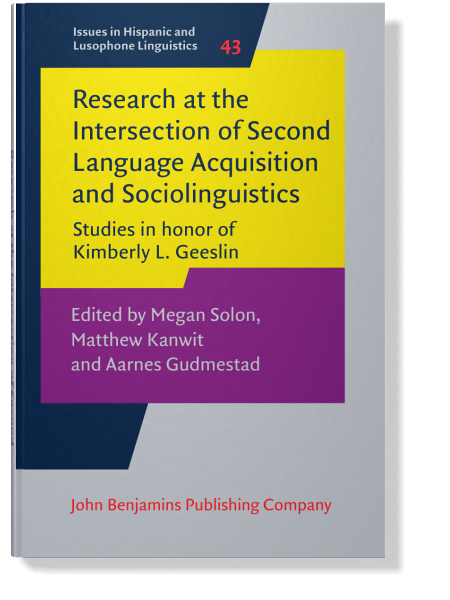
In:Research at the Intersection of Second Language Acquisition and Sociolinguistics: Studies in honor of Kimberly L. Geeslin
Edited by Megan Solon, Matthew Kanwit and Aarnes Gudmestad
[Issues in Hispanic and Lusophone Linguistics 43] 2025
► pp. 1–7
Introduction
The acquisition of variation and the legacy of Kimberly L. Geeslin
Published online: 26 June 2025
https://doi.org/10.1075/ihll.43.int
https://doi.org/10.1075/ihll.43.int

References (21)
Bayley, R., Greer, K. A., & Holland, C. L. (2017). Lexical
frequency and morphosyntactic variation: Evidence from U.S. Spanish. Spanish in
Context, 14, 413–439.
Cameron, R. (1995). The
scope and limits of switch reference as a constraint on pronominal subject
expression. Hispanic
Linguistics, 6(7), 1–28.
Fafulas, S. (2015). Progressive
constructions in native-speaker and adult-acquired Spanish. Studies in Hispanic and
Lusophone
Linguistics, 8(1), 85–133.
Flores-Ferrán, N. (2004). Spanish
subject personal pronoun use in New York City Puerto Ricans: Can we rest the case of English
contact? Language Variation and
Change, 16, 49–73.
Geeslin, K., & Fafulas, S. (2012). Variation
of the simple present and present progressive forms: A comparison of native and non-native
speakers. In K. Geeslin & M. Díaz-Campos (Eds.), Selected
proceedings of the 14th Hispanic Linguistics
Symposium (pp. 179–196). Cascadilla Proceedings Project.
(2022). Linguistic
variation and second language Spanish: A study of progressive and habitual marking by English-speaking
learners. In R. Bayley, D. R. Preston, & X. Li (Eds.), Variation
in second and heritage languages: Crosslinguistic
perspectives (pp. 159–198). John Benjamins.
Geeslin, K. L., & Gudmestad, A. (2008a). The
acquisition of variation in second-language Spanish: An agenda for integrating studies of the L2 sound
system. Journal of Applied
Linguistics, 5(2), 137–157.
(2008b). Variable
subject expression in second-language Spanish: A comparison of native and non-native
speakers. In M. Bowles, R. Foote, & S. Perpiñán (Eds.), Selected
proceedings of the 2007 Second Language Research
Forum (pp. 69–85). Cascadilla Proceedings Project.
George, A. (2014). Study
abroad in central Spain: The development of regional phonological features. Foreign
Language
Annals, 47(1), 97–114.
Grammon, D. (2021). Consequential
choices: A language ideological perspective on learners’ (non-)adoption of a dialectal
variant. Foreign Language
Annals, 54(3), 607–625.
Guy, G. R., Adli, A., Bayley, R., Beaman, K. V., Erker, D., Orozco, R., & Zhang, X. (forthcoming). Subject
pronoun expression: A cross-linguistic variationist sociolinguistic study. Cambridge University Press.
Knouse, S. M. (2012). The
acquisition of dialectal phonemes in a study abroad context: The case of the Castilian
theta. Foreign Language
Annals, 45(4), 512–542.
Linford, B., & Geeslin, K. L. (2022). The
role of referent cohesiveness in variable subject expression in L2 Spanish. Spanish in
Context, 19(3), 508–536.
Long, A. Y. (2021). Korean
learners’ acquisition and use of variable first-person subject forms in
Spanish. Languages, 6(4), 208.
Otheguy, R., & Zentella, A. C. (2012). Spanish
in New York: Language contact, dialectal leveling, and structural continuity. Oxford University Press.
Ringer-Hilfinger, K. (2012). Learner
acquisition of dialectal variation in a study abroad context: The case of the Spanish
[θ]. Foreign Language
Annals, 45(3), 430–446.
Ryan, J. M., & Lafford, B. A. (1992). Acquisition
of lexical meaning in a study abroad environment: Ser and estar and the Granada
experience. Hispania, 75(3), 714–722.
Silva-Corvalán, C. (1986). Bilingualism
and language change: The extension of estar in Los Angeles
Spanish. Language, 62(3), 587–608.