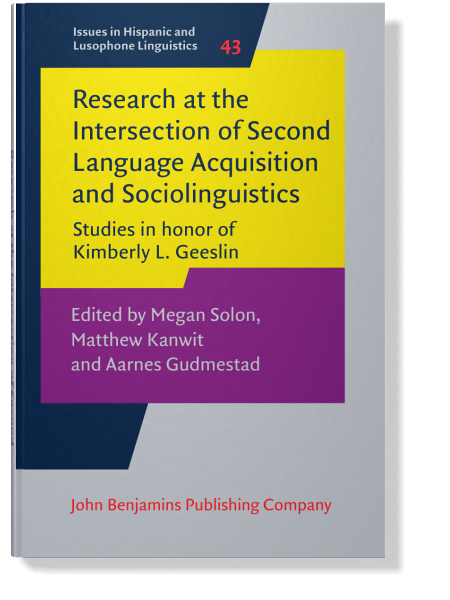
In:Research at the Intersection of Second Language Acquisition and Sociolinguistics: Studies in honor of Kimberly L. Geeslin
Edited by Megan Solon, Matthew Kanwit and Aarnes Gudmestad
[Issues in Hispanic and Lusophone Linguistics 43] 2025
► pp. 344–368
EpilogueKimberly Geeslin’s contributions to second language acquisition, sociolinguistics, and Hispanic linguistics and her
role as a mentor and academic leader
Published online: 26 June 2025
https://doi.org/10.1075/ihll.43.epi
https://doi.org/10.1075/ihll.43.epi
Abstract
This epilogue reviews the extraordinary career of Kimberly Geeslin as a scholar, mentor, and academic
leader. The chapter first examines her numerous contributions to the fields of second language acquisition, sociolinguistics,
and Hispanic linguistics. We then discuss her role as a mentor, not only to numerous students at her home institution of
Indiana University but to many early-career scholars whose professional development she fostered. Finally, the chapter
examines Professor Geeslin’s contributions as an academic leader, including her role in building the graduate program in
Hispanic Linguistics and her overall contributions to her university, with particular attention to her role in promoting the
careers of women in academia.
Article outline
- Contributions to the interdisciplinary study
of second language acquisition and sociolinguistics- Kimberly Geeslin’s contributions to SLA and sociolinguistics
- Kimberly Geeslin as an editor and book author
- Kimberly Geeslin as a mentor
- Kimberly L. Geeslin as an administrator and colleague
Acknowledgements References

References (91)
Adamson, H. D., & Kovac, C. (1981). Variation
theory and second language acquisition. In D. Sankoff & C. Cedergren (Eds.), Variation
omnibus (pp. 285–293). Linguistic Research Inc.
Alonso, R. A. (Ed.). (2018). Speaking
in a second language. John Benjamins.
Announcing the 2024 Susan Gass Award for Impact in
SLA. (2024). Studies in Second Language
Acquisition, 46(1), 1.
Barrenechea, A. M., & Alonso, A. (1973). Los
pronombres personales sujetos en el español de Buenos
Aires. In K. Karl-Hermann, & K. Rühl (Eds.), Studia
Iberica: Festschrift für Hans
Flasche (pp. 75–91). Francke.
Bayley, R. (1994). Interlanguage
variation and the quantitative paradigm: Past tense marking in
Chinese-English. In E. Tarone, S. M. Gass, & A. Cohen (Eds.), Research
methodology in second-language
acquisition (pp. 157–181). Lawrence Erlbaum.
Bayley, R., & Preston, D. R. (Eds.). (1996). Second
language acquisition and linguistic variation. John Benjamins.
Carvalho, A. M., Orozco, R., & Shin, N. L. (Eds.). (2015). Subject
pronoun expression in Spanish: A cross-dialectal perspective. Georgetown University Press.
Chomsky, N. (1981). Principles
and parameters in syntactic theory. In N. Hornstein & D. Lightfoot (Eds.), Explanation
in linguistics: The logical problem of language
acquisition (pp. 32–75). Longman.
Díaz-Campos, M., & Geeslin, K. L. (2011). Copula
use in the Spanish of Venezuela: Is the pattern indicative of stable variation or an ongoing
change? Spanish in
Context, 8(1), 73–94.
Dickerson, L. (1975). The
learner’s interlanguage as a system of variable rules. TESOL
Quarterly, 9, 401–407.
Fasold, R. W., & Preston, D. R. (2007). A
psycholinguistic model of inherent variability: Old Occam whips out his
razor. In R. Bayley & C. Lucas (Eds.), Sociolinguistic
variation: Theories, methods, and
applications (pp. 45–69). Cambridge University Press.
File-Muriel, R. J., & Brown, E. K. (2011). The
gradient nature of s-lention in Caleño Spanish. Language Variation and
Change, 23, 223–243.
Geeslin, K. L. (1999). The
second language acquisition of copula choice in Spanish and its relationship to language
change [Unpublished doctoral
dissertation]. University of Arizona.
(2002). The
acquisition of Spanish copula choice and its relationship to language change. Studies
in Second Language
Acquisition, 24, 419–450.
(2003). A
comparison of copula choice: Native Spanish speakers and advanced learners. Language
Learning, 53(4), 703–764.
(2011). Variation
in L2 Spanish: The state of the discipline. Studies in Hispanic and Lusophone
Linguistics, 4(2), 461–517.
(2020). Variationist
perspective(s) on interlocutor individual
differences. In L. Gurzynski-Weiss (Ed.), Cross-theoretical
explorations of interlocutors and their individual
differences (pp. 129–195). John Benjamins.
(2021). Sophisticated
language use in context: The contributions of variationist research to the study of advanced learners of
Spanish. In M. R. Menke & P. Malovrh (Eds.), Advances
in second language Spanish: Definitions, challenges, and
possibilities (pp. 221–243). John Benjamins.
(Ed.). (2022). The
Routledge handbook of second language acquisition and
sociolinguistics. Routledge.
Geeslin, K. L., & Fafulas, S. (2022). Linguistic
variation and second language Spanish: A study of progression and habitual marking by English-speaking
learners. In R. Bayley, D. R. Preston, & X. Li (Eds.), Variation
in second and heritage languages: Crosslinguistic
perspectives (pp. 159–198). John Benjamins.
Geeslin, K. L., Fafulas, S., & Kanwit, M. (2013). Acquiring
geographically-variable norms of use: The case of the present perfect in Mexico and
Spain. In C. Howe, S. E. Blackwell, & M. Lubbers Quesada (Eds.), Selected
proceedings of the 15th Hispanic Linguistics
Symposium (pp. 205–220). Cascadilla Proceedings Project.
Geeslin, K. L., Goebel-Mahrle, T., Guo, J., & Linford, B. (2023). Variable
subject expression in second language acquisition: The role of
perseveration. In P. Posio & P. Herbeck (Eds.), Referring
to discourse participants in Ibero-Romance
languages (pp. 69–104). Language Sciences Press.
Geeslin, K. L., & Gudmestad, A. (2008a). Comparing
interview and written elicitation tasks in native and non-native data: Do speakers do what we think they
do? In J. Bruhn Garavito & E. Valenzuela (Eds.), Selected
proceedings of the 10th Hispanic Linguistics
Symposium (pp. 64–77). Cascadilla Proceedings Project.
(2008b). The
acquisition of variation in second-language Spanish: An agenda for integrating studies of the L2 sound
system. Journal of Applied
Linguistics, 5, 137–157.
(2008c). Variable
subject expression in second-language Spanish: A comparison of native and non-native
speakers. In M. Bowles, R. Foote, S. Perpiñán, & R. Bhatt (Eds.), Selected
proceedings of the second language research
forum (pp. 69–85). Cascadilla Proceedings Project.
(2010). An
exploration of the range and frequency of occurrence of forms in potentially variable structures in second-language
Spanish. Studies in Second Language
Acquisition, 32, 433–463.
(2011). Using
sociolinguistic analyses of discourse-level features to expand research on L2 variation: Native and non-native
contrasts in forms of Spanish subject expression. In L. Plonsky & M. Schierloh (Eds.), Selected
proceedings of the Second Language Research
Forum (pp. 16–30). Cascadilla Proceedings Project.
Geeslin, K. L., Gudmestad, A., Hasler-Barker, M., Kanwit, M., Long, A. Y., & Solon, M. (2021). Sociolinguistic
competence among heritage speakers of Spanish
abroad. In. R. Pozzi, T. Quan, & C. Escalante (Eds.), Heritage
speakers of Spanish and study
abroad (pp. 13–32). Routledge.
Geeslin, K. L., Gudmestad, A., Kanwit, M., Linford, B., Long, A. Y., Schmidt, L., & Solon, M. (2018). Sociolinguistic
competence and the acquisition of speaking. In R. Alonso Alonso (Ed.), Speaking
a second
language (pp. 1–25). John Benjamins.
Geeslin, K. L., & Guijarro-Fuentes, P. (2003). Age-related
factors in copula choice in steady state L2 Spanish grammars. Revista Española de la
Lingüística
Aplicada, 2, 83–110
(2006). Second
language acquisition of variable structures in Spanish by Portuguese speakers. Language
Learning, 56(1), 53–107.
(2008). Variation
in contemporary Spanish: Linguistic predictors of estar in four cases of language
contact. Bilingualism: Language and
Cognition, 11(3), 365–380.
Geeslin, K. L., Imhoff, S., James, T., Li, S., Liu, C., Marrone, M., Qi, W., & Widiss, D. (2019). Campus
Assessment Committee on Gender and Faculty Satisfaction. Office of the Vice Provost for Faculty and Academic Affairs,
Indiana University Bloomington. [URL] ([URL]).
Geeslin, K. L., Linford, B., & Fafulas, S. (2015). Variable
subject expression in second language Spanish: Uncovering the developmental sequence and predictive linguistic
factors. In A. M. Carvalho, R. Orozco, & N. L. Shin (Eds.), Subject
pronoun expression in Spanish: A cross-dialectal
perspective (pp. 169–190). Georgetown University Press.
Geeslin, K. L., & Long, A. Y. (2014). Sociolinguistics
and second language acquisition: Learning to use language in
context. Routledge.
Geeslin, K. L., Long, A. Y., & Solon. (2021). The
acquisition of Spanish as a second
language. Routledge.
Gudmestad, A. (2022). Eliciting
variable structures across tasks. In K. Geeslin (Ed.), The
Routledge handbook of second language acquisition and
sociolinguistics (pp. 224–236). Routledge.
Gudmestad, A., & Geeslin, K. L. (2010). Exploring
the roles of redundancy and ambiguity in variable subject expression: A comparison of native and non-native
speakers. In C. Borgonovo, M. Español-Echevarría, & P. Prévost (Eds.), Selected
proceedings of the 12th Hispanic Linguistics
Symposium (pp. 270–283). Cascadilla Proceedings Project.
Gudmestad, A., & Geeslin, K. (2011). Assessing
the use of multiple forms in variable contexts: The relationship between linguistic factors and future-time reference
in Spanish. Studies in Hispanic and Lusophone
Linguistics, 4, 3–33.
Gudmestad, A., & Geeslin, K. L. (2021). Overlapping
envelopes of variation: The case of lexical noun phrases and subject expression in
Spanish. In M. Díaz-Campos (Ed.), The
Routledge handbook of variationist approaches to
Spanish (pp. 437–449). Routledge
Gudmestad, A., House, L., & Geeslin, K. L. (2013). What
a Bayesian analysis can do for SLA: New tools for the sociolinguistic study of subject expression in L2
Spanish. Language
Learning, 63, 372–399.
Guijarro-Fuentes, P., & Geeslin, K. L. (2006). Copula
choice in the Spanish of Galicia: The effects of bilingualism on language use. Spanish
in
Context, 6(1), 63–83.
Gurzynski-Weiss, L., Geeslin, K. L., Daidone, D., Linford, B., Long, A. Y., Michalski, I., & Solon, M. (2018). Examining
multifaceted sources of input. In A. E. Tyler, L. Ortega, M. Uno, & H. I. Park (Eds.), Usage-inspired
L2 instruction: Researched
pedagogy (pp. 291–311). John Benjamins.
Guy, G. R. (1980). Variation
in the group and the individual: The case of final stop
deletion. In W. Labov (Ed.), Locating
language in time and
space (pp. 1–36). Academic Press.
Guy, G. R., Adli, A., Bayley, R., Beaman, K. V., Erker, D., Orozco, R., & Zhang, X. (forthcoming). Subject
pronoun expression: A cross-linguistic variationist sociolinguistic study. Cambridge University Press.
Kanwit, M. (2022). Sociolinguistic
competence: What we know so far and where we’re
heading. In K. Geeslin (Ed.), The
Routledge handbook of second language acquisition and
sociolinguistics (pp. 30–44). Routledge.
Kanwit, M., & Geeslin, K. L. (2014). The
interpretation of the Spanish subjunctive and indicative forms in adverbial clauses: A cross-sectional
study. Studies in Second Language
Acquisition, 36, 487–533.
(2018). Exploring
lexical effects in second language interpretation: The case of mood in Spanish adverbial
clauses. Studies in Second Language
Acquisition, 40, 579–603.
(2020). Sociolinguistic
competence and interpreting variable structures in a second language: A study of the copula contrast in native and
second language Spanish. Studies in Second Language
Acquisition, 42, 775–799.
Kanwit, M., Geeslin, K. L., & Fafulas, S. (2015). Study
abroad and the SLA of variable structures: A look at the present perfect, copula contrast, and the present progressive
in Mexico and
Spain. Probus, 27, 308–348.
Kennedy Terry, K. (2017). Contact,
context, and collocation: The emergence of sociostylistic variation in L2 French learners during study
abroad. Studies in Second Language
Acquisition, 39(3), 553–578.
(2022). At
the intersection of SLA and sociolinguistics: The predictive power of social networks during study
abroad. The Modern Language
Journal, 106(1), 245–266.
Kennedy Terry, K., & Bayley, R. (2024). Social
network analysis in second language research: Theory and
methods. Routledge.
(1972). Language
in the inner city: Studies in the Black English vernacular. University of Pennsylvania Press.
(1984). Field
methods of the project on linguistic change and
variation. In J. Baugh & J. Sherzer (Eds.), Language
in use: Readings in
sociolinguistics (pp. 28–53). Prentice-Hall.
Li, X. (2010). Sociolinguistic
variation in the speech of learners of Chinese as a second language. Language
Learning, 60(2), 366–408.
(2014). Variation
of subject pronominal expression in L2 Chinese. Studies in Second Language
Acquisition, 36(1), 39–68.
Li, X., Bayley, R., Zhang, X., & Cui, Y. (2022). Sociolinguistic
investigation of LE use by L2 Mandarin Chinese
learners. In R. Bayley, D. Preston, & X. Li. (Eds.) Variation
and second language acquisition: Crosslinguistic
perspectives (pp. 15–41). John Benjamins.
Linford, B., & Geeslin, K. L. (2022). The
role of referent cohesiveness in variable subject expression in L2 Spanish. Spanish in
Context, 19(3), 508–536.
Linford, B., Long, A., Solon, M., & Geeslin, K. (2016). Measuring
lexical frequency: Comparison groups and subject expression in L2
Spanish. In L. Ortega, A. E. Tyler, H. I. Park, & M. Uno (Eds.), The
usage-based study of language learning and
multilingualism (pp. 137–154). Georgetown University Press.
Linford, B., Long, A. Y., Solon, M., Whatley, M., & Geeslin, K. L. (2016). Lexical
frequency and subject expression in native and non-native
Spanish. In S. Sessarego & F. Tejedo-Herrero (Eds.), Spanish
language and sociolinguistic
analysis (pp. 197–216). John Benjamins.
Lynch, A. (2009). A
sociolinguistic analysis of final /s/ in Miami Cuban Spanish. Language
Sciences, 31(6), 766–790.
Orozco, R. (2018). Spanish
in Colombia and New York City. John Benjamins.
Ortega, L., Tyler, A., Park, H. I., & Uno, M. (Eds.), The
usage-based study of language learning and multilingualism. Georgetown University Press.
Otheguy, R., & Zentella, A. C. (2012). Spanish
in New York: Language contact, dialect leveling, and structural continuity. Oxford University Press.
Pozzi, R., Quan, T., & Escalante, C. (Eds.). (2021). Heritage
speakers of Spanish and study
abroad. Routledge.
Preston, D. R. (1993). Variation
linguistics and L2 acquisition. Second Language
Research, 9(2), 153–172.
(1996). Variationist
perspectives on second language acquisition. In R. Bayley & D. R. Preston (Eds.), Second
language acquisition and linguistic
variation (pp. 1–45). John Benjamins.
(2000). Three
kinds of sociolinguistics and SLA: A psycholinguistic
perspective. In B. Swierzbin, M. Anderson, C. Klee, & E. Tarone (Eds.), Social
and cognitive factors in
SLA (pp. 3–30). Cascadilla.
Regan, V. (1996). Variation
in French interlanguage: A longitudinal study of sociolinguistic
competence. In R. Bayley & D. R. Preston (Eds.), Second
language acquisition and linguistic
variation (pp. 177–201). John Benjamins.
Rickford, J. R., & McNair-Knox, F. (1994). Addressee-
and topic- influenced style shift: A quantitative sociolinguistic
study. In D. Biber & E. Finegan (Eds.), Sociolinguistic
perspectives on
register (pp. 235–276). Oxford University Press.
Schilling-Estes, N. (2004). Constructing
identity in interaction. Journal of
Sociolinguistics, 8, 163–195.
Selinker, L. (1972). Interlanguage. International
Review of Applied Linguistics in Language
Teaching, 10(3), 209–231.
Sessarego, S., & Tejedo-Herrero, F. (Eds.). (2016). Spanish
language and sociolinguistic analysis. John Benjamins.
Silva-Corvalán, C. (1986). Bilingualism
and language contact: The extension of estar in Los Angeles
Spanish. Language, 62, 587–608.
Solon, M., Linford, B., & Geeslin, K. L. (2018). Acquisition
of sociophonetic variation. Revista Española de Lingüística Aplicada/Spanish Journal
of Applied
Linguistics, 31(1), 309–344.
Tarone, E. (1985). Variability
in interlanguage use: A study of style-shifting in morphology and syntax. Language
Learning, 35, 373–403.
Torres Cacoullos, R., & Travis, C. E. (2019). Bilingualism
in the community: Code-switching and grammars in contact. Cambridge University Press.
Tyler, A. E., Ortega, L., Uno, M., & Park, H. I. (Eds.). (2018). Usage-inspired
L2 instruction: Researched pedagogy. Georgetown University Press.
Weinreich, U., Labov, W., & Herzog, M. (1968). Empirical
foundations for a theory of language change. In W. F. Lehmann & Y. Malkiel (Eds.), Directions
in historical
linguistics (pp. 98–195). University of Texas Press.
Wolfram, W. (1985). Variability
in tense marking: A case for the obvious. Language
Learning, 35, 229–253.