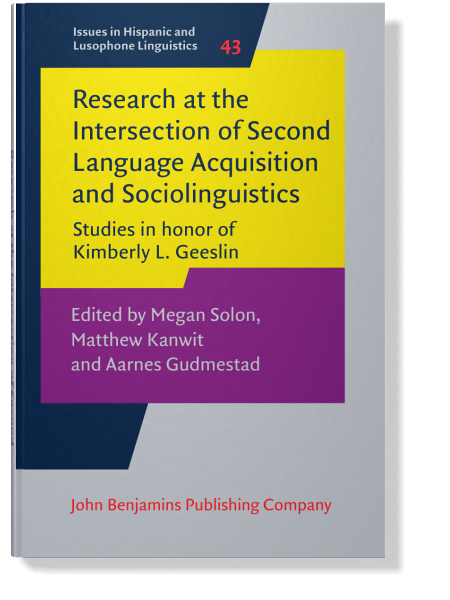
In:Research at the Intersection of Second Language Acquisition and Sociolinguistics: Studies in honor of Kimberly L. Geeslin
Edited by Megan Solon, Matthew Kanwit and Aarnes Gudmestad
[Issues in Hispanic and Lusophone Linguistics 43] 2025
► pp. 144–177
Chapter 6University Spanish instructors’ trill production within and outside of the language classroom
Published online: 26 June 2025
https://doi.org/10.1075/ihll.43.06zah
https://doi.org/10.1075/ihll.43.06zah
Abstract
In order to examine how a sociophonetic variable is realized in instructor input compared to speech
outside the classroom, this study analyzed the production of the Spanish trill by instructors in both contexts.
Different linguistic constraints conditioned the production of the multiple-occlusion variant across contexts.
Additionally, participants adjusted their speech towards a more formal, standard pronunciation in the classroom,
producing more canonical multiple-occlusion trills than in the conversations. However, each participant also produced
a range of other variants: between one and eight distinct noncanonical variants in the classroom and between three and
eight in the conversations. Thus, variation was still present in the classroom, indicating that students are exposed
to trill variation in their classroom input.
Article outline
- Background
- Connection between input and learner development
- Pronunciation instruction in the classroom
- Features of instructor input
- Native trill production in Spanish
- Second language trill production
- The current study
- Method
- Participants
- Recordings
- Coding of dependent variable
- Coding of independent variables
- Analysis
- Results
- Discussion
- Conclusion
Note References Appendix

References (50)
Arteaga, D. L. (2000). Articulatory
phonetics in the first-year Spanish classroom. The Modern Language
Journal, 84(3), 339–354.
Boersma, P., & Weenink, D. (2019). Praat:
Doing phonetics by computer [version
6.0.52]. Retrieved from: [URL]
Bradley, T. (2006). Phonetic
realizations of /sr/ clusters in Latin American
Spanish. In M. Díaz-Campos (Ed.), Selected
proceedings of the 2nd Conference on Laboratory Approaches to Spanish Phonetics and
Phonology (pp. 1–13). Cascadilla Proceedings Project.
Bybee, J. (2002). Word
frequency and context of use in the lexical diffusion of phonetically conditioned sound
change. Language Variation and
Change, 14(3), 261–290.
(2008). Usage-based
grammar and second language acquisition. In P. Robinson & N. C. Ellis (Eds.), Handbook
of cognitive linguistics and second language
acquisition (pp. 216–236). Rodopi.
Crystal, D. (2005). How
language works: How babies babble, words change meaning, and languages live or
die. Avery.
Daidone, D. (2019). Preterite
and imperfect in Spanish instructor oral input and Spanish language
corpora. Hispania, 102(1), 45–58.
Daidone, D., & Zahler, S. L. (2021). A
variationist analysis of second language Spanish trill production. Studies in
Hispanic and Lusophone
Linguistics, 14(1), 1–37.
Darcy, I. (2018). Powerful
and effective pronunciation instruction: How can we achieve it? CATESOL
Journal, 30(1), 13–45.
Díaz-Campos, M. (2008). Variable
production of the trill in spontaneous speech: Sociolinguistic
implications. In L. Colantoni & J. Steele (Eds.), Selected
proceedings of the 3rd Conference on Laboratory Approaches to Spanish
Phonology (pp. 47–58). Cascadilla Press.
Diez Canseco, S. (1997). Language
variation: The influence of speakers’ attitudes and gender on sociolinguistic variables in the Spanish of
Cusco, Perú [Unpublished doctoral
dissertation]. University of Pittsburgh.
Dracos, M. (2018). Teacher
talk and Spanish subject personal pronouns. Journal of Spanish Language
Teaching, 5(1), 1–15.
Duchon, A., Perea, M., Sebastián-Gallés, N., Martí, A. & Carreiras, M. (2013). EsPal:
One-stop shopping for Spanish word properties. Behavior Research
Methods, 45(4), 1246–1258.
Eckert, P. (2018). Meaning
and linguistic variation: The third wave in sociolinguistics. Cambridge University Press.
Face, T. (2006). Intervocalic
rhotic pronunciation by adult learners of Spanish as a second
language. In C. A. Klee & T. L. Face (Eds.), Selected
proceedings of the 7th Conference on the Acquisition of Spanish and Portuguese as First and Second
Languages (pp. 47–58). Cascadilla Proceedings Project.
Gallois, C., Ogay, T., & Giles, H. (2005). Communication
accommodation theory: A look back and a look
ahead. In W. Gudykunst (Ed.), Theorizing
about intercultural
communication (pp. 121–148). Sage.
Geeslin, K., Daidone, D., Long, A. Y., & Solon, M. (2023). Usage-based
models of second language acquisition: Language use in context and additional language
learning. In M. Díaz-Campos & S. Balasch (Eds.), The
handbook of usage-based
linguistics (pp. 345–361). Wiley-Blackwell.
Gerard, C., & Dahan, D. (1995). Durational
variations in speech and didactic accent during reading. Speech
Communication, 16(3), 293–311.
Gutiérrez, M. J., & Fairclough, M. (2006). Incorporating
linguistic variation into the classroom. In R. Salaberry & B. A. Lafford (Eds.), The
art of teaching
Spanish (pp. 173–191). Georgetown University Press.
Hamayan, E. V., & Tucker, G. R. (1980). Language
input in the bilingual classroom and its relationship to second language
achievement. TESOL
Quarterly, 14(4), 453–468.
Hayes-Harb, R., Barrios, S. L., & Tripp, A. (2022). Whose
input matters? The influence of socially-differentiated input sources in adult Lx phonetic
learning. Journal of Second Language
Pronunciation, 8(3), 363–388.
Henriksen, N. (2014). Sociophonetic
analysis of phonemic trill variation in two sub-varieties of Peninsular
Spanish. Journal of Linguistic
Geography, 2(1), 2–24.
Jones, R. H. (2005). Beyond
“listen and repeat”: Pronunciation teaching materials and the theories of second language
acquisition. In J. C. Richards & W. A. Renandya (Eds.), Methodology
in language teaching: An anthology of current
practice (pp. 178–187). Cambridge University Press.
(2020). Rhetorical
stress in Spanish second language classroom
instruction. Hispania, 103(2), 225–244.
Lamy, D. (2015). A
sociophonetic analysis of trill production in Panamanian
Spanish. In R. Klassen, J. M. Liceras, & E. Valenzuela (Eds.), Hispanic
linguistics at the crossroads: Theoretical linguistics, language acquisition and language
contact (pp. 313–336). John Benjamins.
Levis, J. M., & Echelberger, A. (2022). Integrating
pronunciation into language instruction. In J. M. Levis, T. M. Derwing, & S. Sonsaat-Hegelheimer (Eds.), Second
language pronunciation: Bridging the gap between research and
teaching (pp. 19–41). Wiley Blackwell.
Li, X. (2010). Sociolinguistic
variation in the speech of learners of Chinese as a second language. Language
Learning, 60(2), 366–408.
Melero García, F. (2015). Análisis
acústico de la vibrante múltiple en el español de Valencia (España). Studies in
Hispanic and Lusophone
Linguistics, 8(1), 183–206.
Mora, J. C., & Levkina, M. (2017). Task-based
pronunciation teaching and research: Key issues and future directions. Studies
in Second Language
Acquisition, 39(2), 381–399.
Mougeon, R., & Rehner, K. (2019). Patterns
of sociolinguistic variation in teacher classroom speech. Journal of
Sociolinguistics, 23(2), 163–185.
Offerman, H. (2024). The
current state of pronunciation in Spanish
textbooks. In D. Olson, J. Sturm, O. Dmitrieva, & J. Levis (Eds.), Proceedings
of 14th Pronunciation in Second Language Learning and Teaching
Conference (pp. 1–11). Iowa State University Digital Press.
Olsen, M. K. (2012). The
L2 acquisition of Spanish rhotics by L2 English speakers: The effect of L1 articulatory routines and phonetic
context for allophonic
variation. Hispania, 95(1), 65–82.
Rao, R. (2006). On
intonation’s relationship with pragmatic meaning in
Spanish. In T. L. Face & C. A. Klee (Eds.), Selected
proceedings of the 8th Hispanic Linguistics
Symposium (pp. 103–115). Cascadilla Proceedings Project.
(2011). Intonation
in Spanish classroom-style didactic speech. Journal of Language Teaching &
Research, 2(3), 31–75.
Reeder, J. T. (1998). English
speakers’ acquisition of voiceless stops and trills in L2 Spanish. Texas Papers
in Foreign Language
Education, 3(3), 101–108.
Rehner, R., & Mougeon, K. (2003). The
effect of education input on the development of sociolinguistic competence by French immersion students: The
case of expressions of consequence in spoken French. The Journal of Educational
Thought
(JET), 37(3), 259–281.
Rose, M. (2010). Intervocalic
tap and trill production in the acquisition of Spanish as a second
language. Studies in Hispanic and Lusophone
Linguistics, 3(2), 379–419.
Schilling, N. (2013). Investigating
stylistic variation. In J. K. Chambers, & N. Schilling (Eds.), The
handbook of language variation and change (2nd
ed., pp. 325–349). Wiley-Blackwell.
Stanley, P., & Stevenson, M. (2017). Making
sense of not making sense: Novice English language teacher talk. Linguistics
and
Education, 38, 1–10.
Trofimovich, P., Collins, L., Cardoso, W., White, J., & Horst, M. (2012). A
frequency-based approach to L2 phonological learning: Teacher input and student output in an intensive ESL
context. TESOL
Quarterly, 46(1), 176–187.
Willis, E. (2006). Trill
variation in Dominican Spanish: An acoustic examination and comparative
analysis. In N. Sagarra & A. J. Toribio (Eds.), Selected
proceedings of the 9th Hispanic Linguistics
Symposium (pp. 121–131). Cascadilla Proceedings Project.
(2007). An
acoustic study of the “pre-aspirated trill” in narrative Cibaeño Dominican
Spanish. Journal of the International Phonetic
Association, 37(1), 33–49.
Willis, J. (1992). Inner
and outer: Spoken discourse in the language
classroom. In M. Coulthard (Ed.), Advances
in spoken discourse
analysis (pp. 162–182). Routledge.
Zahler, S. L. & Daidone, D. (2014). A
variationist account of trill /r/ usage in the Spanish of Málaga. IULC Working
Papers, 14(2), 17–42.
(2023). Individual
differences do not affect trill variation by advanced learners of
Spanish. In S. Fernández Cuenca, T. Judy, & L. Miller (Eds.), Innovative
approaches to research in Hispanic linguistics: Regional, diachronic, and learner profile
variation (pp. 196–224). John Benjamins.