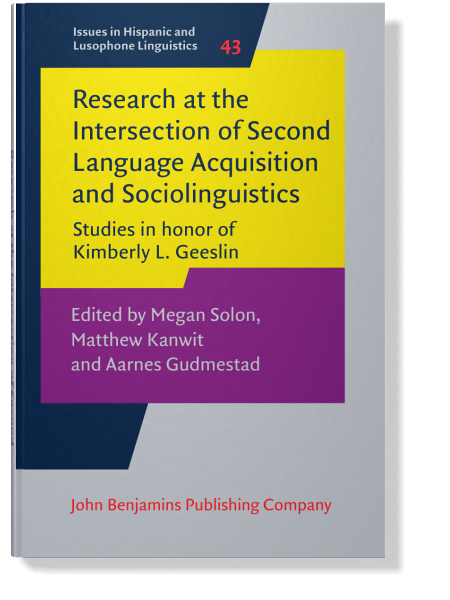
In:Research at the Intersection of Second Language Acquisition and Sociolinguistics: Studies in honor of Kimberly L. Geeslin
Edited by Megan Solon, Matthew Kanwit and Aarnes Gudmestad
[Issues in Hispanic and Lusophone Linguistics 43] 2025
► pp. 116–142
Chapter 5Acquiring sociolinguistic competence
A comparison of subject pronoun expression in L2 and L3 Spanish
Published online: 26 June 2025
https://doi.org/10.1075/ihll.43.05esc
https://doi.org/10.1075/ihll.43.05esc
Abstract
This paper compares the acquisition of subject pronoun expression in written Spanish by
first-language (L1) speakers of English learning Spanish as a second language and L1 speakers of Chinese learning
Spanish as a third language. A mixed-effects regression indicated that learners’ choices between null and overt forms
are constrained by many of the factors that affect native (i.e., expert) Spanish speakers: switch reference,
reflexivity, person/number, and verb type. Although both groups of speakers decreased their rates of overt pronouns
over time, Chinese L1 speakers began to use significantly fewer pronouns after two quarters of Spanish study, but
English L1 participants did not demonstrate significant drops until quarter 5. We also noted more individual
variability in Chinese-speaking participants.
Keywords: subject pronoun expression, L2/L3 variation, Spanish, English, Mandarin
Article outline
- Literature review
- SPE in Spanish
- SPE in Mandarin Chinese
- Acquisition of SPE
- Acquisition of SPE in Spanish
- Acquisition of SPE in Mandarin Chinese
- Acquisition of SPE: Relationship between L1, L2, and L3
- Research questions
- Methods
- Corpus
- Participants
- Coding
- Switch reference
- Grammatical person/number
- Ambiguity of the verb
- Tense/Mood/Aspect (TMA)
- Semantic verb class
- Reflexivity
- Clause type
- First language
- Course level
- Analysis
- Results
- Discussion and implications
- Conclusion
Notes References

References (75)
Abreu, L. (2009). Spanish
subject personal pronoun use by monolinguals, bilinguals and second language
learners [Unpublished doctoral
dissertation. University of Florida.
Bardel, C., & Falk, Y. (2012). The
L2 status factor and the declarative/procedural
distinction. In J. A. Amaro, S. Flynn, & J. Rothman (Eds.), Third
language acquisition in
adulthood (pp. 165–194). John Benjamins.
Barrenechea, A. M., & Alonso, A. (1973). Los
pronombres personales sujetos en el español de Buenos
Aires. In K. Karl-Hermann & K. Rühl (Eds.), Studia
Iberica: Festschrift für Hans
Flasche (pp. 75–91). Francke.
Bates, D., Mächler, M., Bolker, B., & Walker, S. (2015). Fitting
linear mixed-effects models using lme4. Journal of Statistical
Software, 67(1), 1–48.
Bayley, R., Greer, K. A., & Holland, C. L. (2017). Lexical
frequency and morphosyntactic variation: Evidence from U.S. Spanish. Spanish in
Context, 14, 413–439.
Bayley, R., Holland, C., Rud, J. A., & Méndez Kline, T. (2023, October 12–14). Variation
in heritage Spanish writing: The case of subject personal pronouns [Conference
presentation]. Hispanic Linguistics Symposium, Provo,
UT, United States.
Bayley, R., & Pease-Alvarez, L. (1997). Null
pronoun variation in Mexican-descent children’s narrative discourse. Language
Variation and
Change, 9, 349–371.
Beaman, K. (1982). Coordination
and subordination revisited: Syntactic complexity in spoken and written
discourse. In D. Tannen (Ed.), Coherence
in spoken and written
discourse (pp. 45–80). Ablex.
Bentivoglio, P. (1987). Los
sujetos pronominales de primera persona en el habla de Caracas. Universidad Central de Venezuela, Consejo de Desarrollo Científico y Humanístico.
Biber, D., & Conrad, S. (2001). Quantitative
corpus-based research: Much more than bean counting. TESOL
Quarterly, 35, 331–336.
Cameron, R. (1992). Pronominal
and null subject variation in Spanish: Constraints, dialects, and functional
compensation [Unpublished doctoral
dissertation]. University of Pennsylvania.
(1995). The
scope and limits of switch reference as a constraint on pronominal subject
expression. Hispanic
Linguistics, 6(7), 1–28.
Carvalho, A. M., & Child, M. (2011). Subject
pronoun expression in a variety of Spanish in contact with
Portuguese. In J. Michnowicz & R. Dodsworth (Eds.), Selected
proceedings of the 5th Workshop on Spanish
Sociolinguistics (pp. 14–25). Cascadilla Proceedings Project.
Carvalho, A., Orozco, R. & Shin, N. (2015). Introduction. In A. Carvalho, R. Orozco, & N. Shin (Eds.), Subject
pronoun expression in Spanish: A cross-dialectal
perspective (pp. xiii–xxvi). Georgetown University Press.
Cenoz, J. (2003). The
additive effect of bilingualism on third language acquisition: A
review. International Journal of
Bilingualism, 7(1), 71–87.
Cerrón-Palomino, A., Loza, S., & Vana, R. (2023). A
historical-variationist analysis of subject pronoun expression in 19th and early 20th century Arizonan
Spanish. Languages, 8(1), 25.
Chafe, W. L. (1982). Integration
and involvement in speaking, writing, and oral
literature. In D. Tannen (Ed.), Spoken
and written language: Exploring orality and
literacy (pp. 35–53). Ablex.
Cherici, A. (2021). The
role of L1 and L2 in the acquisition of null subjects by Chinese learners in L3
Italian. International Journal of
Multilingualism, 20(3), 735–752.
Christensen, M. B. (2000). Anaphoric
reference in spoken and written Chinese narrative discourse. Journal of Chinese
Linguistics, 28(2), 303–336.
Clements, M., & Domínguez, L. (2018). Testing
the predictions of the Scalpel Model in L3/Ln acquisition: The acquisition of null and overt subjects in L3
Chinese. In J. C. Cho, M. Iverson, T. Judy, T. Leal, & E. Shimanskaya (Eds.), Meaning
and structure in second language
acquisition (pp. 181–202). John Benjamins.
Dewaele, J.-M. (1998). Lexical
inventions: French interlanguage as L2 versus L3. Applied
Linguistics, 19, 471–490.
(1999). Word
order variation in interrogative structures of native and non-native
French. International Review of Applied
Linguistics, 123–124, 161–180.
Enríquez, E. V. (1984). El
pronombre personal sujeto en la lengua española hablada en Madrid. Instituto Miguel de Cervantes.
Erker, D., & Guy, G. R. (2012). The
role of lexical frequency in syntactic variability: Variable subject personal pronoun expression in
Spanish. Language, 88(3), 526–557.
Fernández Flórez, C. (2023). Written
subject pronoun expression among Spanish heritage language learners. Estudios
Humanísticos.
Filología, 45(2023), 165–190.
Flores-Ferrán, N. (2004). Spanish
subject personal pronoun use in New York City Puerto Ricans: Can we rest the case of English
contact? Language Variation and
Change, 16, 49–73.
(2007). A
bend in the road: Subject personal pronoun expression in Spanish after 30 years of sociolinguistic
research. Language and Linguistics
Compass, 1, 624–652.
Geeslin, K. L., Goebel-Mahrle, T., Guo, J., & Linford, B. (2023). Variable
subject expression in second language acquisition: The role of
perseveration. In P. Posio & P. Herbeck (Eds.), Referring
to discourse participants in Ibero-Romance
languages (pp. 69–104). Language Science Press.
Geeslin, K. L., & Gudmestad, A. (2008). Variable
subject expression in second-language Spanish: A comparison of native and non-native
speakers. In M. Bowles, R. Foote, & S. Perpiñán (Eds.), Selected
proceedings of the 2007 Second Language Research
Forum (pp. 69–85). Cascadilla Proceedings Project.
Geeslin, K. L., & Gudmestad, A. (2011). Using
sociolinguistic analyses of discourse-level features to expand research on L2 variation: Native and non-native
contrasts in forms of Spanish subject
expression. In L. Plonsky & M. Schierloh (Eds.), Selected
proceedings of the Second Language Research
Forum (pp. 16-30). Cascadilla Proceedings Project.
Geeslin, K., & Linford, B. (2012, April). A
cross-sectional study of the effects of discourse cohesiveness and perseveration on subject
expression [Conference presentation]. 6th
International Workshop on Spanish Sociolinguistics, Tucson, AZ, United
States.
Geeslin, K. L., Linford, B., & Fafulas, S. (2015). Variable
subject expression in second language Spanish: Uncovering the developmental sequence and predictive linguistic
factors. In A. M. Carvalho, R. Orozco, & N. Lapidus Shin (Eds.), Subject
pronoun expression in Spanish: A cross dialectal
perspective (pp. 191–210). Georgetown University Press.
Gudmestad, A., & Geeslin, K. L. (2010). Exploring
the roles of redundancy and ambiguity in variable subject expression: A comparison of native and non-native
speakers. In C. Borgonovo, M. Español-Echevarría & P. Prévost (Eds.), Selected
proceedings of the 12th Hispanic Linguistics
Symposium (pp. 270-283). Cascadilla Proceedings Project.
Gudmestad, A., & Geeslin, K. L. (2011). Assessing
the use of multiple forms in variable contexts: the relationship between linguistic factors and future-time
reference. Studies in Hispanic and Lusophone
Linguistics, 4(1), 3–33.
Guy, G. R., Adli, A., Bayley, R., Beaman, K., Erker, D., Orozco, R., & Zhang, X. (forthcoming). Subject
pronoun expression: A cross-linguistic variationist sociolinguistic
study. Cambridge.
Holmquist, J. (2012). Frequency
rates and constraints on subject personal pronoun expression: Findings from the Puerto Rican
highlands. Language Variation and
Change, 24, 203–220.
Huang, T., Steinkrauss, R., & Verspoor, M. (2021). Variability
as predictor in L2 writing proficiency. Journal of Second Language
Writing, 52, Article
100787.
Jarvis, S. (2016). The
scope of transfer research. In L. Yu & T. Odlin (Eds.), New
perspectives on transfer in second language
learning (pp. 17–47). Multilingual Matters.
Jia, L., & Bayley, R. (2002). Null
pronoun variation in Mandarin Chinese. University of Pennsylvania Working
Papers in
Linguistics, 8, 103–116.
Kuznetsova, A., Brockhoff, P. B., & Christensen, R. H. B. (2017). lmerTest
Package: Tests in Linear Mixed Effects Models. Journal of Statistical
Software, 82(13), 1–26.
Li, X. (2010). Sociolinguistic
variation in the speech of learners of Chinese as a second language. Language
Learning, 60, 1–42.
(2014). Variation
of subject pronominal expression in L2 Chinese. Studies in Second Language
Acquisition, 36(1), 39–68.
(2017). Stylistic
variation in L1 and L2 Chinese. Chinese as a Second
Language, 52, 55–76.
Li, X., & Bayley, R. (2018). Lexical
frequency and syntactic variation: Subject pronoun use in Mandarin
Chinese. Asia-Pacific Language
Variation, 4, 133–160.
Li, X., Chen, X., & Chen, W.-H. (2012). Variation
of subject pronominal expression in Mandarin Chinese. Sociolinguistic
Studies, 6, 91–119.
Linford, B., & Geeslin, K. L. (2022). The
role of referent cohesiveness in variable subject expression in L2
Spanish. Spanish in
Context, 19(3), 508–536.
Liu, H., & Van Dongen, E. (2013). The
Chinese diaspora. Oxford Bibliographies. [URL]
Long, A. Y. (2021). Korean
learners’ acquisition and use of variable first-person subject forms in
Spanish. Languages, 6(4), 208.
Maher, J. C. (2017). Multilingualism:
A very short
introduction (Vol. 525). Oxford University Press.
Marian, V., & Shook, A. (2012). The
cognitive benefits of being bilingual. Cerebrum: the Dana forum on brain
science (Vol. 2012). Dana Foundation.
Michnowicz, J. (2015). Subject
pronoun expression in contact with Maya in Yucatan
Spanish. In A. M. Carvalho, R. Orozco & N. Shin (Eds.), Subject
pronoun expression in Spanish: A cross-dialectal
perspective (pp. 103–122). Georgetown University Press.
Mougeon, R., Rehner, K., & Nadasdi, T. (2004). The
learning of spoken French variation by immersion students from Toronto,
Canada. Journal of
Sociolinguistics, 8, 408–432.
Orozco, R., & Guy, G. (2008). El
uso variable de los pronombres sujetos: ¿Qué pasa en la costa Caribe
colombiana? In M. Westmoreland & J. A. Thomas (Eds.), Selected
proceedings of the 4th Workshop on Spanish
Sociolinguistics (pp. 70–80). Cascadilla Proceedings Project
Otheguy, R., & Zentella, A. C. (2012). Spanish
in New York: Language contact, dialectal leveling, and structural
continuity. Oxford University Press.
Park, M., & Starr, R. L. (2016). The
role of formal L2 learning experience in L3 acquisition among early
bilinguals. International Journal of
Multilingualism, 13(3), 274–291.
Ramos, M. (2016). Continuity
and change. First person singular subject pronoun expression in earlier
Spanish. Spanish in
Context, 13, 103–127.
Rothman, J. (2011). L3
syntactic transfer selectivity and typological determinacy: The typological primacy
model. Second Language
Research, 27(1), 107–127.
(2015). Linguistic
and cognitive motivations for the Typological Primacy Model (TPM) of third language (L3) transfer: Timing of
acquisition and proficiency considered. Bilingualism: Language and
Cognition, 18(2), 179–190.
Schwartz, B. D., & Sprouse, R. A. (1996). L2
cognitive states and the full transfer/full access model. Second Language
Research, 12(1), 40–72.
Shin, N. L. & Erker, D. (2015). The
emergence of structured variability in morphosyntax: Childhood acquisition of Spanish subject
pronouns. In A. M. Carvalho, R. Orozco, & N. L. Shin (Eds.) Subject
expression in Spanish: A cross-dialectal
perspective (pp. 169–189). Georgetown University Press.
Shin, N. L. & Montes-Alcalá, C. (2014). El
uso contextual del pronombre sujeto como factor predictivo de la influencia del inglés en el español en Nueva
York. Sociolinguistic
Studies, 8(1). 85–110.
Simons, G. F., & Fennig, C. D. (2018). Ethnologue:
Languages of the world (21st ed). SIL International.
Slabakova, R. (2017). The
Scalpel Model of third language acquisition. International Journal of
Bilingualism, 21(6), 651–665.
Travis, C. (2007). Genre
effects on subject expression in Spanish: Priming in narrative and
conversation. Language Variation and
Change, 19, 101–36.
Trevise, A., & Noyau, C. (1984). Adult
Spanish speakers and the acquisition of French negation forms: Individual variation and linguistic
awareness. In R. Andersen (Ed.), Second
languages: A cross-linguistic
perspective (pp. 165–189). Newbury House.
Wagner, S. (2016). Never
saw one — first person null subjects in spoken English. English Language and
Linguistics, 22(1), 1–34.
Westergaard, M., Mitrofanova, N., Mykhaylyk, R., & Rodina, Y. (2017). Crosslinguistic
influence in the acquisition of a third language: The linguistic proximity
model. International Journal of
Bilingualism, 21(6), 666–682.
Yamada, A., Davidson, S., Fernández-Mira, P., Carando, A., Sagae, K., & Sánchez-Gutiérrez, C. (2020). COWS-L2H:
A corpus of Spanish learner writing. Research in Corpus
Linguistics, 8, 17–32.
Zahler, S. (2018). The
relationship between working memory and sociolinguistic variation in first and second languages: The case of
Spanish subject pronouns [Unpublished doctoral
dissertation]. Indiana University.