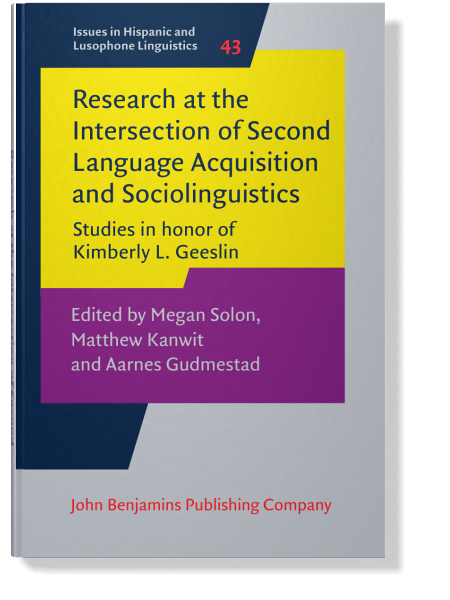
In:Research at the Intersection of Second Language Acquisition and Sociolinguistics: Studies in honor of Kimberly L. Geeslin
Edited by Megan Solon, Matthew Kanwit and Aarnes Gudmestad
[Issues in Hispanic and Lusophone Linguistics 43] 2025
► pp. 10–34
Chapter 1A study of lexical bases and variation of progressive constructions in the Spanish of English-speaking
learners
Published online: 26 June 2025
https://doi.org/10.1075/ihll.43.01faf
https://doi.org/10.1075/ihll.43.01faf
Abstract
We investigated allowance of five common lexical bases used to form Spanish progressive
constructions: estar, andar, ir, venir, and seguir. In a written contextualized
acceptability task, five identical sentences appeared after a given context, the only difference being the lexical
base used. Participants evaluated each sentence as possible or not possible. There
were 80 sentences (4 verbal aspectual categories × 4 adverbial types × 5 lexical bases), producing a corpus of 7,600
responses. We compared learners from four different proficiency levels (n = 75), and a first-language
Spanish (n = 20) baseline. Results indicate that estar was the most accepted lexical
base, and learners allowed all five lexical bases from the lowest Spanish proficiency level. Relevant pedagogical
implications are discussed.
Article outline
- Previous studies
- Spanish progressive constructions
- L2 Spanish progressive research
- Current study
- Method
- Participants
- Tasks
- Analysis
- Results
- Rates of form selection by group
- GLM results
- Developmental trends
- Discussion
- Answers to research questions
- Implications for pedagogy
- Conclusion and future directions
Acknowledgements Note References

References (43)
Andersen, R. W. (2002). Dimensions
of “pastness”. In M. R. Salaberry & Y. Shirai (Eds.), Tense-aspect
morphology in L2
acquisition (pp. 79–105). John Benjamins.
Andersen, R. W., & Shirai, Y. (1996). The
primacy of aspect in first and second language acquisition: The pidgin-creole
connection. In W. C. Ritchie & T. K. Bhatia (Eds.), Handbook
of second language
acquisition (pp. 527–570). Academic Press.
Bardovi-Harlig, K. (2000). Tense
and aspect in second language acquisition: Form, meaning, and
use. Oxford: Blackwell.
(2017). Beyond
individual form-meaning associations in L2 Tense-Mood-Aspect
research. In M. Howard & P. Leclercq (Eds.), Tense-Aspect-Modality
in a Second
Language (pp. 27–52). John Benjamins.
Bates, D., Mächler, M., Bolker, B., & Walker, S. (2015). Fitting
linear mixed-effects models using lme4. Journal of Statistical
Software, 67(1), 1–48.
Berríos, J., & Kanwit, M. (2024). Progressive
aspect across temporalities: Variation between synthetic and analytic forms in L1 and L2
Spanish. Studies in Hispanic and Lusophone
Linguistics 17(2), 1–35.
Berry, G. M. (2017). Structural
autonomy and aspectual import: A new(er) Spanish
progressive. Probus, 29(2), 205–232.
Brown, A. V. & Thompson, G. L. (2018). The
changing landscape of Spanish language curricula: Designing higher education programs for diverse
students. Georgetown University Press.
Bybee, J., Perkins, R., & Pagliuca, W. (1994). The
evolution of grammar: Tense, aspect, and modality in the languages of the
world. University of Chicago Press.
Canale, M., & Swain, M. (1980). Theoretical
bases of communicative approaches to second language teaching and
testing. Applied
Linguistics, 1, 1–47.
Davis, M. (2000). Using
multi-million word corpora of historical and dialectal Spanish texts to teach advanced courses in Spanish
linguistics. In L. Burnard & T. McEnery (Eds.), Rethinking
language pedagogy from a corpus
perspective (pp. 173–85). Peter Lang.
Davies, M. (2016–). Corpus
del Español: Web/Dialects. [URL]
Deo, A. (2015). The
semantic and pragmatic underpinnings of grammaticalization paths: The progressive to imperfective
shift. DeSemantics and
Pragmatics, 8, 1–52.
Domínguez, L., N. Tracy-Ventura, M. J. Arche, R. Mitchell, and F. Myles. (2013). The
Role of Dynamic Contrasts in the L2 Acquisition of Spanish Past Tense
Morphology. Bilingualism: Language and
Cognition, 16, 558–577.
Dumont, J., & Wilson, D. V. (2016). Using
the variationist comparative method to examine the role of language contact in synthetic and periphrastic
verbs in Spanish. Spanish in
Context, 13(3), 394–419.
Egbert, J., & Baker, P. (Eds.). (2019). Using
corpus methods to triangulate linguistic
analysis. Routledge.
Fafulas, S. (2012). Nuevas
perspectivas sobre la variación de las formas presente simple y presente progresivo en español y en
inglés. Spanish in
Context, 9(1), 58–87.
(2015). Progressive
constructions in native-speaker and adult-acquired Spanish. Studies in Hispanic
and Lusophone
Linguistics, 8(1), 85–133.
(2021). Variation
of the simple present and present progressive: Peruvian Spanish, ‘Pear Story,’ and language contact, oh
my! In M. Díaz-Campos (Ed.), The
Routledge handbook of variationist approaches to
Spanish (pp. 328–344). Routledge.
Fafulas, S., Geeslin, K., & Guo, J. (2022, October 13–15). A
study of lexical bases and variation of progressive constructions in the Spanish of English-speaking
learners [Conference presentation]. New Ways of Analyzing
Variation 50, Stanford, CA, United States.
Geeslin, K. (Ed.). (2022). The
Routledge handbook of second language acquisition and
sociolinguistics. Routledge.
Geeslin, K., & Fafulas, S. (2012). Variation
of the simple present and present progressive forms: A comparison of native and non-native
speakers. In K. Geeslin & M. Díaz-Campos (Eds.), Selected
proceedings of the 14th Hispanic Linguistics
Symposium (pp. 179–196). Cascadilla Proceedings Project.
(2022). Linguistic
variation and second language Spanish: A study of progressive and habitual marking by English-speaking
learners. In R. Bayley, D. R. Preston, & X. Li (Eds.), Variation
in second and heritage languages: Crosslinguistic
perspectives (pp. 159–198). John Benjamins.
Geeslin, K. L., & Gudmestad, A. (2010). An
exploration of the range and frequency of occurrence of forms in potentially variable structures in
second-language Spanish. Studies in Second Language
Acquisition, 32(3), 433–463.
Gudmestad, A. (2022). Development
of grammar, vocabulary, and pragmatics in an additional language: Insights from Spanish learner corpus
research. Journal of Spanish Language
Teaching, 9, 161–173.
Gudmestad, A., House, L., & Geeslin, K. L. (2013). What
a Bayesian analysis can do for SLA: New tools for the sociolinguistic study of subject expression in L2
Spanish. Language
Learning, 63(3), 371–399.
Kanwit, M., & Geeslin, K. (2020). Sociolinguistic
competence and interpreting variable structures in a second language: A study of the copula contrast in native
and second-language Spanish. Studies in Second Language
Acquisition, 42(4), 775–799.
Klein, F. (1980). A
quantitative study of syntactic and pragmatic indications of change in the Spanish of bilinguals in the
U.S. In W. Labov (Ed.), Locating
language in time and
space (pp. 69–82). Academic Press.
LeLoup, J. W., & Schmidt-Rinehart, B. C. (2018). Forms
of address in the Spanish language curriculum in the United States: Actualities and
Aspirations. Hispania, 101(1), 10–24.
Mattson-Prieto, R., & Showstack, R. (2022). “Are
there any Mexicans listening?” Stancetaking and language ideologies in a Spanish L2
classroom. Language
Learning, 72(s1), 240–274.
Ortega, L. (2013). SLA
for the 21st century: Disciplinary progress, transdisciplinary relevance, and the bi/multilingual
Turn. Language
Learning, 63(s1), 1–24.
(2016). Multi-competence
in second language acquisition: inroads into the
mainstream? In V. Cook & L. Wei (Eds.), The
Cambridge handbook of linguistic
multi-competence (pp. 50–76). Cambridge University Press.
R Core
Team. (2023). R: A language and environment for statistical
computing, vers. 4.3.0. [URL]
Schoonmaker-Gates, E. (2017). Regional
variation in the language classroom and beyond: Mapping learners’ developing dialectal
competence. Foreign Language
Annals, 50(1), 177–194.
Sedano, M. (2000). La
perífrasis de gerundio en Caracas y otras ciudades hispanohablantes. Nueva
Revista de Filología
Hispánica, 48(2), 253–274.
Shin, N. L., & Hudgens Henderson, M. (2017). A
sociolinguistic approach to teaching Spanish grammatical structures. Foreign
Language
Annals, 50(1), 195–213.
Swain, A., Berríos, J., & Kanwit, M. (2023). Exploring
future-in-the-past variation in Seville and Caracas: ¿Cambiaría o Iba a
Cambiar? In S. Fernández Cuenca, T. Judy, & L. Miller (Eds.), Innovative
approaches to research in Hispanic linguistics: Regional, diachronic, and learner profile
variation (pp. 58–80). John Benjamins.
Torres Cacoullos, R. (2000). Grammaticization,
synchronic variation, and language contact: A study of Spanish progressive-ndo
constructions. John Benjamins.
(2011). Variation
and grammaticalization. In M. Díaz-Campos (Ed.), The
handbook of Hispanic
sociolinguistics (pp. 148–167). Wiley-Blackwell.
(2012). Grammaticalization
through inherent variability. Studies in
Language, 36(1), 73–122.
Wood, S. N. (2021). mgcv:
Mixed GAM Computation Vehicle with Automatic Smoothness Estimation. R package version
1.8–33. Retrieved from [URL]