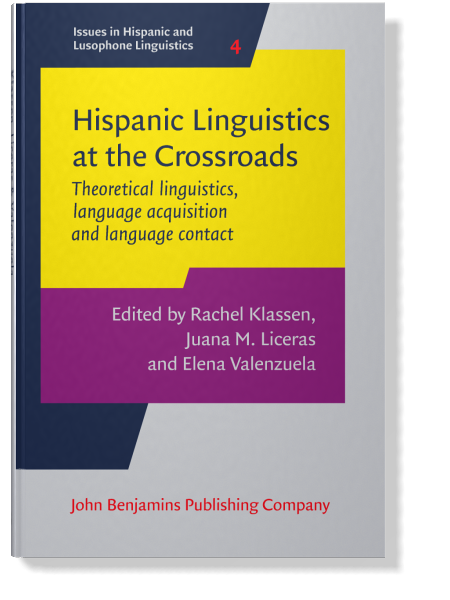
In:Hispanic Linguistics at the Crossroads: Theoretical linguistics, language acquisition and language contact
Edited by Rachel Klassen, Juana M. Liceras and Elena Valenzuela
[Issues in Hispanic and Lusophone Linguistics 4] 2015
► pp. v–vi
Get fulltext
This article is available free of charge.
Published online: 30 July 2015
https://doi.org/10.1075/ihll.4.toc
https://doi.org/10.1075/ihll.4.toc
Table of contents
Preface
Introduction
Part I. Theoretical and descriptive approaches
No superiority, no intervention effects: The Spanish puzzle
Overt PRO in Romance: Towards a unification of PRO and pro
The semantics and pragmatics of andar and venir + gerund
Sequence of tenses in complementation structures: Lexical restrictions and effects on language acquisition
Fue muerto: Suppletion in Spanish analytic passives
Temporal and spectral dependencies in the processing of Spanish and English stop consonant voicing
Segmental and prosodic conditionings on gradient voicing assimilation in Spanish
Part II. Language acquisition
The sum is more than its parts: Acquisition of clitic clusters in Spanish
Does agreement affect the syntax of bare nominal subjects in Russian–Spanish bilinguals?
Perfecting the past
The protracted acquisition of past tense aspectual values in child heritage Spanish
Part III. Language contact and language variation
Morphological adjectival intensifier variation in Lima, Peru
An experimental approach to hypercorrection in Dominican Spanish
Dialect identification and listener attributes: Do you hear la tonada?
Sociophonetic analysis of young Peninsular Spanish women’s voice quality
A sociophonetic analysis of trill production in Panamanian Spanish
Index
