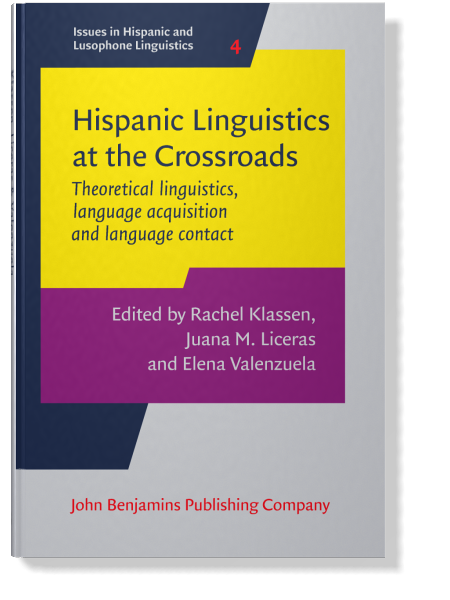
In:Hispanic Linguistics at the Crossroads: Theoretical linguistics, language acquisition and language contact
Edited by Rachel Klassen, Juana M. Liceras and Elena Valenzuela
[Issues in Hispanic and Lusophone Linguistics 4] 2015
► pp. 191–210
Perfecting the past
Published online: 30 July 2015
https://doi.org/10.1075/ihll.4.10mar
https://doi.org/10.1075/ihll.4.10mar
Studies on Spanish first language (L1) acquisition have shown that the Present Perfect (PP) appears together with the Present tense, or immediately after, and Peninsular Spanish children use it productively before the Preterit. Though the PP has become the default form of past reference in many varieties of Peninsular Spanish, this finding is surprising given the Perfect’s morphological and semantic complexity. In a corpus study of longitudinal spontaneous data of two L1 Peninsular Spanish children (María, 1;09–3;11; Emilio, 1;09–3;10), we explore the emergence and distribution of tenses, and the types of uses of the PP. Results are consistent with the absence of a complex, indirect referential meaning for the PP and suggest that children have a simpler meaning for it, and thus having the form does not necessarily imply having the meaning.
Keywords: L1 acquisition, Peninsular Spanish, Present Perfect, tense and aspect.

References (33)
Aguado, G. (1995). El desarrollo del lenguaje de 0 a 3 años. Madrid: Ciencias de la educación preescolar y especial.
Bel, A. (2002). Early verbs and the acquisition of tense feature in Spanish and Catalan. In A.-T. Pérez-Leroux & J.M. Liceras (Eds.), The acquisition of Spanish morphosyntax: The L1/L2 connection. (pp. 1–34). Dordrecht: Kluwer.
Bello, Andrés. (1847). Gramática de la lengua castellana destinada al uso de los americanos. Madrid: Edaf (1984 edition).
Berman, R. & Slobin, D. (1994). Relating events in narrative: A crosslinguistic developmental study. Hillsdale, NJ: Lawarence Erlbaum Associates.
Binnick, R. (1991). Time and the verb: A guide to tense and aspect. Oxford: Oxford University Press.
. (2005). The geometry of interpretable features: INFL in English and Spanish. Language, 81(1), 10–46.
Gathercole, V.C. (1986). The acquisition of the present perfect: Explaining differences in the speech of Scottish and American children. Journal of Child Language, 13, 537–560.
Giorgi, A., & Pianesi, F. (1998). Tense and aspect: From semantics to morphosyntax. Oxford: Oxford University Press.
Hernández Pina, F. (1984). Teorías psicosociolingüísticas y su aplicación a la adquisición del español como lengua materna. Madrid: Siglo veintiuno editores.
Howe, C. (2013). The Spanish perfects. Pathways of emergent meaning. Houndmills: Palgrave MacMillan.
Iatridou, S. (2003). A little bit more on the English perfect. In A. Alexiadou, M. Rathert, & A. von Stechow (Eds.), Perfect Explorations (pp. 133–152). Berlin: Mouton de Gruyter.
Iatridou, S., Anagnostopoulou, E., & Pancheva, R. (2003). Observations about the form and meaning of the perfect. In A. Alexiadou, M. Rathert, & A. von Stechow (Eds.), Perfect explorations (pp. 153–204). Berlin: Mouton de Gruyter.
MacWhinney, B. (2000). The CHILDES project: Tools for analyzing talk (Third Edition). Mahwah, NJ: Lawrence Erlbaum Associates.
Mayer, M. (1969). Frog, where are you? New York, NY: Dial Press.
McCawley, J. (1971). Tense and time reference in English. In C. Fillmore & T. Langendoen (Eds.), Studies in linguistic semantics (pp. 97–113). New York, NY: Holt, Rinehart and Winston.
McCoard, R. (1978). The English perfect: Tense choice and pragmatic inferences. Amsterdam: North-Holland.
Parsons, T. (1990). Events in the semantics of English: A study of subatomic semantics. Cambridge, MA: The MIT Press.
Pérez-Leroux, A.T. (2008). Subjuntivo y conciencia de la subjetividad en la adquisición infantil del lenguaje y la teoría de la mente. Revista de Logopedia, Foniatría y Audiología, 28, 90–98.
Portner, P. (2003). The (temporal) semantics and (modal) pragmatics of the perfect. Linguists and Philosophy, 26, 459–510.
Rojo, G., & Veiga, A. (1999). El tiempo verbal: Los tiempos simples. In I. Bosque & V. Demonte (Eds.), Gramática descriptiva de la lengua española (pp. 2867–2934). Madrid: Espasa.
Schwenter, S., & Torres Cacoullos, R. (2008). Defaults and indeterminacy in temporal grammaticalization: The ‘perfect’ road to perfective. Language Variation and Change, 20, 1–39.
Vlach, F. (1993). Temporal adverbials, tenses, and the perfect. Linguistics and Philosophy, 16, 231–283.
von Fintel, K., & Iatridou, S. (2005). Since Since. Ms. MIT.
Cited by (1)
Cited by one other publication
LaMontagne, Joanne Markle & Ana Teresa Pérez-Leroux
2016. In search of the perfect tense. In Language Acquisition Beyond Parameters [Studies in Bilingualism, 51], ► pp. 213 ff.
This list is based on CrossRef data as of 12 december 2025. Please note that it may not be complete. Sources presented here have been supplied by the respective publishers. Any errors therein should be reported to them.