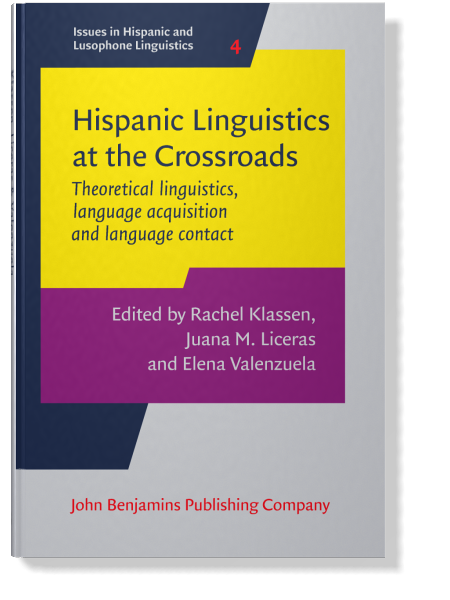
In:Hispanic Linguistics at the Crossroads: Theoretical linguistics, language acquisition and language contact
Edited by Rachel Klassen, Juana M. Liceras and Elena Valenzuela
[Issues in Hispanic and Lusophone Linguistics 4] 2015
► pp. 49–68
The semantics and pragmatics of andar and venir + gerund
Published online: 30 July 2015
https://doi.org/10.1075/ihll.4.03sai
https://doi.org/10.1075/ihll.4.03sai
This study builds on existing research regarding the characterization of Spanish aspectual periphrases, such as vivir + gerund or ir + gerund, and explores and compares the distribution of the periphrases andar + gerund and venir + gerund in Peninsular Spanish. We propose that a complete analysis requires both semantic and pragmatic considerations. First, although both andar + gerund and venir + gerund behave as frequentative pluractional operators, we show that they differ with respect to the nature of the frequency of event repetitions. Second, we posit that these periphrastic constructions differ pragmatically as a result of two generalized conversational implicatures from which differing meanings involving the agent’s intention towards the accomplishment of a goal and the agent’s level of engagement arise.

References (13)
Abeillé, A., & Danièle, G. (2010). Complex predicates in the Romance languages. In A. Abeillé & G. Danièle (Eds.), Fundamental issues in the Romance languages (pp. 107–170). Stanford, CA: CSLI.
Amaral, P. (2013a). The pragmatics of number: The evaluative properties of vivir + V[Gerund]. Journal of Pragmatics, 51, 105–121.
. (2013b). On how to live and keep dying. In C. Howe, S. Blackwell, & M. Quesada (Eds.), Selected proceedings of the 15th Hispanic Linguistics Symposium, (pp. 269–280). Somerville, MA: Cascadilla Proceedings Project.
Fernández de Castro, F. (1990). Las perífrasis verbales en español: Comportamiento sintáctico e historia de su caracterización. Oviedo: Departamento de Filología española.
Grice, H.P. (1975). The logic of conversation. In P. Cole & J.L. Morgan (Eds.), Syntax and semantics 3: Speech acts (pp. 41–58). New York, NY: Academic Press.
Laca, B. (2002). Romance “aspectual” periphrases: Eventuality modification versus “syntactic” aspect. In J. Guéron & J. Lecarme (Eds.), The syntax of time (pp. 425–440). Cambridge, MA: The MIT Press.
. (2004). Progressive, pluractionals and the domains of aspect. In O. Crouzet, H. Demidache, & S. Wauquier (Eds.), Domain(e)s, Proceedings of the Journée de Linguistique de Nantes (pp. 87–92).
. (2006). Indefinites, quantifiers, and pluractionals. What scope effects tell us about event pluralities. In S. Vogeleer & L. Tasmowski (Eds.), Non-definiteness and Plurality (pp. 191–217). Amsterdam: John Benjamins.