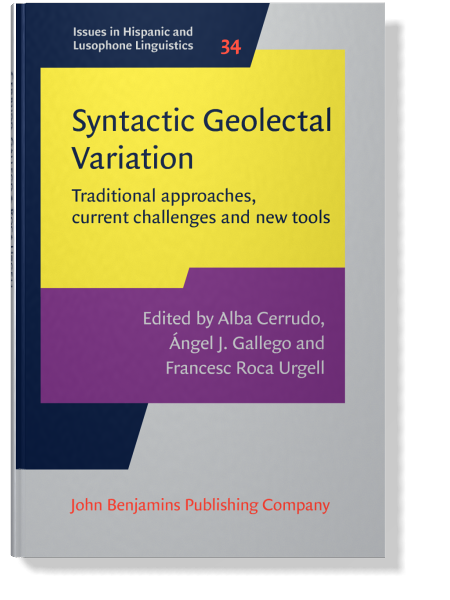
In:Syntactic Geolectal Variation: Traditional approaches, current challenges and new tools
Edited by Alba Cerrudo, Ángel J. Gallego and Francesc Roca Urgell
[Issues in Hispanic and Lusophone Linguistics 34] 2021
► pp. 319–346
Chapter 11The Corpus del español del siglo XXI
(CORPES XXI)
A tool for the study of syntactic variation in Spanish
Published online: 26 November 2021
https://doi.org/10.1075/ihll.34.11bue
https://doi.org/10.1075/ihll.34.11bue
Abstract
In this work we review the multiple uses of the
Corpus del español del siglo XXI
(CORPES XXI) to facilitate the study of
syntactic variation in Spanish. We present different kinds of
searches and data sorting available from the corpus and we provide
some examples of syntactic phenomena, most of them characteristic of
American Spanish areas. In sum, we show that CORPES
XXI can become an extremely useful tool to describe the
syntactic variation of Spanish.
Article outline
- 1.Introduction
- 2.Structural parameters of CORPES XXI
- 3.Description and possibilities of CORPES XXI in
the analysis of syntactic variation in Spanish
- 3.1Simple search
- 3.2Complex search
- 3.2.1Subcorpus search
- 3.2.2Proximity search
- 3.2.3Combination of searches
- 3.3Processing the result
- 3.3.1Sorting the results
- 3.3.2Statistics
- 4.Conclusion
Notes References

References (20)
Company Company, C. (1992). Un cambio en proceso: “el libro ¿quién se
los prestó?”. In E. Traill (Ed.), Scripta philologica in honorem Juan M. Lope
Blanch (pp. 349–363). México: UNAM.
(1998). The interplay between form and meaning in
language change. Grammaticalization of cannibalistic datives
in Spanish. Studies in Language, 22(3), 529–565.
Demonte, V. (1999). El adjetivo: Clases y usos. La posición del
adjetivo en el sintagma nominal. In I. Bosque & V. Demonte (Eds.), Gramática descriptiva de la lengua española (pp. 129–216). Madrid: Espasa Calpe.
Espinosa, R. Mª. (2014). Adverbios de cantidad, foco, polaridad y
modalidad. In C. Company Company (Ed.), Sintaxis histórica de la lengua española. Tercera parte:
Adverbios, preposiciones y conjunciones. Relaciones
interoracionales (Vol. 1, pp. 939–1117). México: Fondo de Cultura Económica-Universidad Nacional Autónoma de México.
Fernández Soriano, O. (1999). El pronombre personal. Formas y distribuciones.
Pronombres átonos y tónicos. In I. Bosque & V. Demonte (Eds.), Gramática descriptiva de la lengua española (pp. 1209–1273). Madrid: Espasa Calpe.
Hummel, M. (2014). Adjetivos adverbiales. In C. Company Company (Ed.), Sintaxis histórica de la lengua española. Tercera parte:
Adverbios, preposiciones y conjunciones. Relaciones
interoracionales (Vol. 1, pp. 615–733). México: Fondo de Cultura Económica-Universidad Nacional Autónoma de México.
Koch, P., & Oesterreicher, W. (2007). Lengua hablada en la Romania: español, francés,
italiano. Madrid: Gredos.
Mello, G. de (1992).
Se los for se lo in the
spoken cultured Spanish of eleven cities. Hispanic Journal, 13(1), 165–179.
Pato, E. (2016). Cuestiones de gramaticalización: harto,
cierto, adverbios en -mente y
adverbio y en documentos colombianos del
siglo XVI. Cuadernos de la ALFAL, 8, 202–218.
PRESEEA (2017, July). Corpus del Proyecto para el estudio
sociolingüístico del español de España y de
América. Retrieved on 16 December,
2020 from: [URL]
RAE (2017, July). Corpus del Español del Siglo XXI (CORPES
XXI). Retrieved on 16 December,
2020 from: [URL] (Beta version 0.83 of June 2016).
Rojo, G. (2014). Hispanic Corpus Linguistics. In M. Lacorte (Ed.), The Routledge handbook of hispanic applied
linguistics (pp. 371–387). New York, NY: Routledge.
(2016a). Los corpus textuales del español. In J. Gutiérrez-Rexach (Ed.), Enciclopedia lingüística hispánica (pp. 285–296). New York, NY: Routledge.