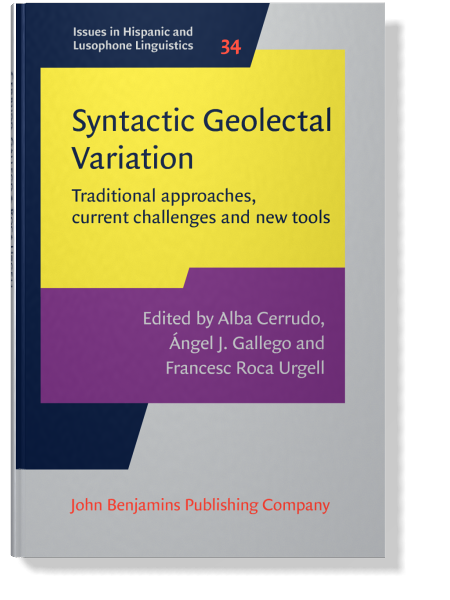
In:Syntactic Geolectal Variation: Traditional approaches, current challenges and new tools
Edited by Alba Cerrudo, Ángel J. Gallego and Francesc Roca Urgell
[Issues in Hispanic and Lusophone Linguistics 34] 2021
► pp. 297–318
Chapter 10
ASinEs
An interactive atlas for the study of syntactic variation of Spanish
Published online: 26 November 2021
https://doi.org/10.1075/ihll.34.10cer
https://doi.org/10.1075/ihll.34.10cer
Abstract
In this chapter we present the
ASinEs project (Atlas Sintáctico del
Español, http://www.asines.org
), an unprecedented tool for the study of dialectal
variation in the syntax of Spanish. After an introductory
presentation (Section 1),
we set the ASinEs in the context of the study of
dialectal syntax and outline the reasons for its creation (Section 2). Next, we explain the goals the atlas is intended to achieve and how it is structured
(Section 3). We go on
to show how information is entered in the atlas (from both manager
and user perspectives) (Section 4), and finally explain how to use the search
engine and other resources available on the website (Section 5).
Article outline
- 1.Introduction
- 2.Motivations for the ASinEs project
- 2.1The general scarcity of studies on syntactic variation
- 2.2The rise of a new tendency
- 2.3 The ASinEs project in this context
- 3.Goals and configuration of the ASinEs project
- 4.The structure of the atlas
- 4.1Data
- 4.2Grammatical description
- 4.3Distribution
- 4.4Analysis
- 4.5Other information and ID
- 4.6The file as a working unit
- 5.How to use the ASinEs
- 5.1The ASinES search engine
- 5.1.1 Maps
- 5.1.2 Cross-browsing
- 5.2Other resources
- 5.1The ASinES search engine
- 6.Challenges for the ASinEs
- 7.Conclusion
Acknowledgements Notes References

References (42)
Bosque, I. (1999). El nombre común. In I. Bosque & V. Demonte, Gramática descriptiva de la lengua española (pp. 3–76). Madrid: Espasa Calpe.
Brucart, J. M. (1994). Syntactic variation and grammatical primitives in generative grammar. Lynx: Panorámica de estudios lingüísticos, (4), 145–176.
Chambers, Jack K., & Schilling-Estes, N. (Eds.). (2013). The handbook of language variation and change. Malden, MA: Wiley-Blackwell.
Company Company, C. (Ed.) (2006). Sintaxis histórica de la lengua española. Primera parte:
La frase verbal. México: Fondo de Cultura Económica-Universidad Nacional Autónoma de México.
(Ed.) (2009). Sintaxis histórica de la lengua española. Segunda parte:
La frase nominal. México: Fondo de Cultura Económica-Universidad Nacional Autónoma de México.
(Ed.) (2014). Sintaxis histórica de la lengua española. Tercera parte:
Adverbios, preposiciones y conjunciones. Relaciones
interoracionales. México: Fondo de Cultura Económica-Universidad Nacional Autónoma de México.
CORDE = Real Academia Española. Banco de datos (CORDE). Corpus diacrónico del español. [URL]
CORPES XXI = Real Academia Española. Banco de datos
(CORPES XX1). Corpus del Español del Siglo XXI. [[URL]]
COSER = Fernández-Ordóñez, I. (Ed.) (2005–). Corpus Oral y Sonoro del Español Rural. [[URL]]
CREA = Real Academia Española. Banco de datos (CREA). Corpus de referencia del español actual. [[URL]]
Davies, Mark. (2016). Corpus del español: Web/dialects. [[URL]]
De Kock, J., & DeMello, G. (1997). Lengua escrita y habla culta en América y España: Diez
casos. Salamanca: Universidad de Salamanca.
Demonte, V. & O. Fernández-Soriano. (2005). Features in comp and syntactic variation: The case of ‘(de)queísmo’ in Spanish, Lingua 115(8), 1063–1082.
Eguren, L., Fernández-Soriano, O., & Mendikoetxea, A. (Eds.) (2016). Rethinking parameters. Oxford: Oxford University Press.
Fernández-Ordoñez, I. (2009). Los orígenes de la dialectología hispánica y Ramón Menéndez Pidal. In Cien Años de Filoloxía Asturiana (1906–2006): Actes del Congresu Internacional (pp. 11–41). Departamento de Filología española. Seminariu de Filoloxía Asturiana.
Fernández-Ordóñez, I. (2011). La lengua de Castilla y la formación del español.
Discurso leído el 13 de febrero de (2011 en su recepción
pública por la Excma. Sra. D.ª Inés Fernández-Ordóñez y
contestación del Excmo. Sr. D. José Antonio
Pascual). Madrid: Real Academia Española.
Gómez Torrego, L. (1999). La variación en las subordinadas sustantivas:
Dequeísmo y queísmo. In I. Bosque & V. Demonte (Eds.), Gramática descriptiva de la lengua española (pp. 2105–2148). Madrid: Espasa Calpe.
Greenberg, J. (1963). Some universals of grammar with particular
reference to the order of meaningful
elements. In J. Greenberg (Ed.), Universals of human language (pp. 73–113). Cambridge, MA: The MIT Press.
Halle, M., & Marantz, A. (1993). Distributed morphology and the pieces of
inflection. In K. Hale & S. J. Keyser (Eds.), The view from building 20. Essays in Linguistics in
honor of Sylvain Bromberger (pp. 111–176). Cambridge, MA: The MIT Press.
Kabatek, J. (2012). Nuevos rumbos de la sintaxis histórica del
español. In Actas del VIII Congreso de la AHLE (pp. 77–100). Santiago de Compostela: AHLE/Meubook.
Labov, W., Ash, S., & Boberg, C. (2006). The atlas of North American English: Phonetics,
phonology and sound change. Berlin: Mouton de Gruyter.
Navarro Tomás, T. (1975). Noticia histórica del ALPI. In T. Navarro Tomás, Capítulos de geografía lingüística de la Península
Ibérica (pp. 9–21). Bogotá: Instituto Caro y Cuervo.
Ordóñez, F., & Olarrea, A. (2006). Microvariation in caribbean/non caribbean spanish interrogatives. Probus 18, 59–96.
Petyt, K. M. (1980). The study of dialect: An introduction to
dialectology. London: The language library.
Picallo, M. C. (Ed.). (2014). Linguistic variation in the minimalist
framework. Oxford: Oxford University Press.
PRESEEA = PRESEEA (2014–). Corpus del Proyecto para el estudio sociolingüístico del
español de España y de América. Alcalá de Henares: Universidad de Alcalá. [[URL]]
VARIGRAMA = Takagaki, T. (Ed.). Varigrama: Variación gramatical del español en el
mundo. Retrieved on 16 December
2020 from: [URL]