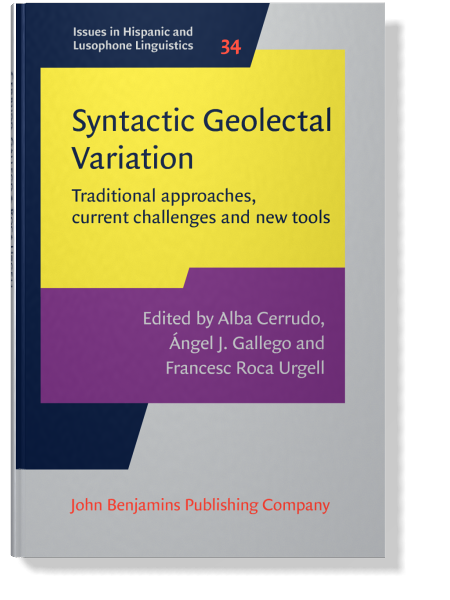
In:Syntactic Geolectal Variation: Traditional approaches, current challenges and new tools
Edited by Alba Cerrudo, Ángel J. Gallego and Francesc Roca Urgell
[Issues in Hispanic and Lusophone Linguistics 34] 2021
► pp. 263–294
Chapter 9On the role of prosody in wh-in-situ
Cross-linguistic comparison and experimental evidence from Basque
Published online: 26 November 2021
https://doi.org/10.1075/ihll.34.09dug
https://doi.org/10.1075/ihll.34.09dug
Abstract
A growing number of works propose a direct role
of PF in the generation of wh-in-situ. Relying
mainly on data from Basque, we critically evaluate two such
proposals (Richards,
2010; Mathieu,
2016) and argue that they face a range of empirical and
conceptual shortcomings. We contrast these with the more
“syntactocentric” proposal of Cheng & Rooryck (2000) for French, based on an
intonational Q-morpheme that surfaces as a final rise in polar and
wh-in-situ questions. We report the outcome of
a production experiment providing evidence that the final rises of
polar and wh-in-situ questions in Navarro-Labourdin
Basque do not differ substantially, thus suggesting that Cheng & Rooryck’s
(2000) proposal may be extended to this variety
cohabiting with French.
Keywords:
wh-in-situ,
wh-movement, prosody, variation, Basque
Article outline
- 1.Introduction
- 2.Basque interrogative strategies: The emergence of wh-in-situ
- 2.1Interrogatives in Basque
- 2.2The new wh-in-situ strategy of Navarro-Labourdin Basque
- 3.Interface approaches to wh-in-situ
- 3.1 Cheng & Rooryck (2000) : An intonation morpheme licensing wh-in-situ and yes/no questions
- 3.2Richards (2010, 2016)
- 3.3 Mathieu (2016)
- 4.Problems with prosody-based analyses
- 4.1Stress patterns and interrogative strategies
- 4.2Prosodic phrasing and interrogative strategies
- 5.Assessing the prosodic patterns of interrogatives in
Basque: An experiment
- 5.1Extending Cheng & Rooryck’s (2000) analysis to Basque
- 5.2The experiment
- 5.2.1The questionnaire
- 5.2.2Measurements
- 5.2.3Results
- 5.3Discussion
- 6.Conclusions
Acknowledgements Notes References

References (81)
Aurrekoetxea, G., Gaminde, I., & Iglesias, A. (2011). Corpus based prosodic variation in Basque: Y/N
questions marked with the particle al
. Estudios de Fonética Experimental, XX, 11–31.
Beckman, M. E., & Pierrehumbert, J. B. (1986). Intonational structure in Japanese and
English. Phonology Yearbook, 3, 255–309.
Chen, Y., & Gussenhoven, C. (2008). Emphasis and tonal implementation in Standard
Chinese. Journal of Phonetics, 36, 724–746.
Cheng, L. L-S., & Downing, L. J. (2011). Mapping phonology to syntax: Evidence from two
wh-in-situ languages. Paper presented at
GLOW 34, University of Vienna.
Dahan, D., & Bernard, J-M. (1996). Interspeaker variability in emphatic accent
production in French. Language & Speech, 39(4), 341–374.
Dayal, V. (1996). Locality in wh-quantification: Questions and relative
clauses in Hindi. Dordrecht: Kluwer.
Delais-Roussarie, E., Post, B., Avanzi, M., Buthke, C., Di Cristo, A., Feldhausen, I., et al. (2015). Intonational phonology of French: Developing a
ToBI system for French. In S. Frota & P. Prieto (Eds.), Intonation in Romance (pp. 63–100). Oxford: Oxford University Press.
Déprez, V., Syrett, K., & Kawahara, S. (2013). The interaction of syntax, prosody, and discourse
in licensing French wh-in-situ
questions. Lingua, 124, 4–19.
Dhongde, R. V., & Wali, K. (2009). Marathi. Amsterdam: John Benjamins.
Dohen, M., & Lœvenbruck, H. (2004). Pre-focal rephrasing, focal enhancement and
postfocal deaccentuation in French. INTERSPEECH 2004: 8th International Conference on
Spoken Language Processing (pp. 785–788).
Duguine, M., & Irurtzun, A. (2014). From obligatory wh-movement to
optional wh-in-situ in Labourdin
Basque. Language, 90(1), e1–e30.
Eguzkitza, A. (1987). Topics on the syntax of Basque and Romance (Unpublished doctoral dissertation). UCLA.
Eilam, A. (2008). Intervention effects: Why Amharic patterns
differently. In N. Abner & J. Bishop (Eds.), Proceedings of the 27th West Coast Conference on Formal
Linguistics (pp. 141–149). Somerville, MA: Cascadilla Proceedings Project.
Elordieta, G. (1997). Accent, tone, and intonation in Lekeitio
Basque. In F. Martínez-Gil & A. Morales-Front (Eds.), Issues in the phonology and morphology of the major
Iberian languages (pp. 3–78). Washington, DC: Georgetown University Press.
(1998). Intonation in a pitch accent variety of
Basque. ASJU: International Journal of Basque Linguistics and
Philology, XXXII(2), 511–569.
(2003). Intonation. In J. I. Hualde & J. Ortiz de Urbina (Eds.), A grammar of Basque (pp. 72–112). Berlin: Mouton de Gruyter.
(2007a). Constraints on intonational prominence of
focalized constituents. In C. Lee, M. Gordon, & D. Büring (Eds.), Topic and focus: Cross-linguistic perspectives on
meaning and intonation (pp. 1–22). Dordrecht: Springer.
(2007b). A constraint-based analysis of the intonational
realization of focus in Northern Bizkaian
Basque. In T. Riad & C. Gussenhoven (Eds.), Tones and tunes, Vol. I: Typological studies in word and
sentence prosody (pp. 199–232). Berlin: Mouton de Gruyter.
Elordieta, G., & J. I. Hualde. (2015). Intonation in Basque. In S. A. Jun (Ed.), Prosodic typology, II: The phonology of intonation and
phrasing (pp. 405–463). Oxford: Oxford University Press.
Erdocia, K., Laka, I., Mestres-Missé, A., & Rodriguez-Fornells, A. (2009). Syntactic complexity and ambiguity resolution in
a free word order language: Behavioral and
electrophysiological evidences from Basque. Brain and Language, 109, 1–17.
Etxepare, R., & Ortiz de Urbina, J. (2003). Focalization. In J. I. Hualde & J. Ortiz de Urbina (Eds.), A grammar of Basque (pp. 465–522). Berlin: Mouton de Gruyter.
Fujisaki, H., & Kawai, H. (1988). Realization of linguistic information in the
voice fundamental frequency contour of the spoken
Japanese. Acoustics, Speech Signal and Processing, 88, 663–666.
Gaminde, I., & Salaberria, J. (1997). Ezpeleta, Lekorne eta Makeako
azentu-ereduez. Uztaro, 20, 93–103.
Gryllia, S., Cheng, L. L-S., & Doetjes, J. (2016). On the intonation of French
wh-in-situ questions: What happens before
the wh-word is reached? Proceedings of Speech Prosody 2016, 611–614.
Gu, Z., Mori, H., & Kasuya, H. (2003). Analysis of vowel formant frequency variations
between focus and neutral speech in Mandarin
Chinese. Acoustical Science and Technology, 24(4), 192–193.
Gussenhoven, C. (2004). The phonology of tone and intonation. Cambridge: Cambridge University Press.
Hintz, D. M. (2006). Stress in South Conchucos Quechua: A phonetic and
phonological study. International Journal of American Linguistics, 72(4), 477–521.
Hualde, J. I. (1999). Basque accentuation. In H. van der Hulst (Ed.), Word prosodic systems in the languages of
Europe (pp. 947–993). Berlin: Mouton de Gruyter.
(2003). Accentuation. In J. I. Hualde & J. Ortiz de Urbina (Eds.), A grammar of Basque (pp. 65–72). Berlin: Mouton de Gruyter.
Hualde, J. I., Elordieta, G., & Elordieta, A. (1994). The Basque dialect of Lekeitio. Donostia: Gipuzkoako Foru Aldundia & UPV/EHU.
Hualde, J. I., Elordieta, G., Gaminde, I., & Smiljanić, R. (2002). From pitch-accent to stress-accent in
Basque. In C. Gussenhoven & N. Warner (Eds.), Laboratory Phonology 7, 547–584. Berlin: Mouton de Gruyter.
Hwang, H. K. (2006). Intonation patterns of
wh-interrogatives in South Kyungsang Korean
and Fukuoka Japanese. Eoneohak, 45, 39–59.
(2011). Distinct types of focus and
wh-question intonation. In W. S. Lee & E. Zee (Eds.), Proceedings of the 17th International Congress of
Phonetic Sciences (ICPhS XVII) (pp. 922–925). Hong Kong: City University of Hong Kong.
Hyman, L. M. (2009). How (not) to do phonological typology: The case
of pitch-accent. Language Sciences, 31, 213–238.
Irurtzun, A. (2007). The grammar of focus at the interfaces (Unpublished doctoral dissertation). University of the Basque Country UPV/EHU, Vitoria-Gasteiz.
(2008). A derivational approach to the
focus-structure. Canadian Journal of Linguistics/Revue Canadienne de
Linguistique, 53(2/3), 327–354.
(2016). Strategies for argument and adjunct focalization
in Basque. In B. Fernández & J. Ortiz de Urbina (Eds.), Microparameters in the grammar of Basque (pp. 243–263). Amsterdam: John Benjamins.
Ishihara, S. (2011). Japanese focus prosody revisited: Freeing focus
from prosodic phrasing. Lingua, 121(13), 1870–1889.
(2015). Syntax-phonology interface. In H. Kubozono (Ed.), Handbook of Japanese phonetics and phonology (pp. 569–618). Berlin: Mouton de Gruyter.
Ito, K. (2002). The interaction of focus and lexical pitch accent
in speech production and dialogue comprehension: Evidence
from Japanese and Basque (Unpublished doctoral dissertation). University of Illinois, Urbana-Champaign.
Jun, S. A., & Fougeron, C. (2000). A phonological model of French
intonation. In A. Botinis (Ed.), Intonation: Analysis, modelling and technology (pp. 209–242). Dordrecht: Kluwer.
Kim, J., & Jun, S. A. (2009). Prosodic structure and focus prosody of South
Kyungsang Korean. Language Research, 45(1), 43–66.
Kruschke, J. K. (2013). Bayesian estimation supersedes the
t test. Journal of Experimental Psychology, 142, 573–603.
(2015). Doing Bayesian data analysis: A tutorial with R, JAGS,
and Stan (2nd ed.). London: Academic Press.
Kubozono, H. (1987). The organization of Japanese
prosody (Unpublished doctoral dissertation). University of Edinburgh.
(2007). Focus and intonation in Japanese: Does focus
trigger pitch reset? In S. Ishihara (Ed.), Interdisciplinary Studies on Information
Structure, 9, 1–27.
Lee, Hye-Sook. (2007). Interrogative intonation in North Kyungsang
Korean: Language-specificity and universality of acoustic
and perceptual cues. Working Papers of the Cornell Phonetics
Laboratory, 16, 57–100.
Lee, Y-C., Wang, T., & Liberman, M. (2016). Production and perception of Tone 3 focus in
Mandarin Chinese. Frontiers in Psychology, 7:1058.
Liu, F., & Xu, Y. (2005). Parallel encoding of focus and interrogative
meaning in Mandarin intonation. Phonetica, 62, 70–87.
Maekawa, K. (1999). Effects of focus on duration and vowel formant
frequency in Japanese. In Y. Sagisaka, N. Campbell, & N. Higuchi (Eds.), Computing prosody: Computational models for processing
spontaneous speech (pp. 129–145). New York, NY: Springer.
Mathieu, E. (2016). The wh-parameter and radical
externatization. In L. Eguren, O. Fernández-Soriano, & A. Mendikoetxea (Eds.), Rethinking parameters (pp. 252–290). Oxford: Oxford University Press.
Ménard, L., Lœvenbruck, H., & Savariaux, C. (2006). Articulatory and acoustic correlates of
contrastive focus in French: A developmental
study. In J. Harrington & M. Tabain (Eds), Speech production: Models, phonetic processes and
techniques (pp. 227–251). New York, NY: Psychology Press.
(1999). Force phrases, focus phrases and left heads in
Basque. In J. A. Franco, A. Landa & J. Martín (Eds), Grammatical analyses in Basque and Romance linguistics:
Papers in honor of Mario Saltarelli (pp. 179–194). Amsterdam: John Benjamins.
Patil, U., Kentner, G., Gollrad, A., Kügler, F., Féry, C., & Vasishth, S. (2008). Focus, word order and intonation in
Hindi. Journal of South Asian Linguistics, 1(1), 55–72.
Perrone-Bertolotti, M. D., Lœvenbruck, H., Sato, M., Pichat, C., & Baciu, M. (2013). Neural correlates of the perception of
contrastive prosodic focus in French: A functional magnetic
resonance imaging study. Human Brain Mapping, 34, 2574–2592.
Pierrehumbert, J. B., & Beckman, M. E. (1988). Japanese tone structure. Cambridge, MA: The MIT Press.
Rebuschi, G. (1997). A note on focalization in Basque. In Essais de linguistique basque. Supplements of
ASJU XXXV, 31–42.
Rietveld, T. C. M., & Gussenhoven, C. (1985). On the relation between pitch excursion size and
prominence. Journal of Phonetics, 13, 299–308.
(1978). Topic fronting, focus positioning, and the nature
of the verb phrase in Basque. In F. Jansen (Ed.), Studies on fronting (pp. 81–112). Lisse: Peter de Ridder Press.
Tegey, H., & Robson, B. (1996). A reference grammar of Pashto. Washington, DC: Center for Applied Linguistics.
t’Hart, J. (1981). Differential sensitivity to pitch distance,
particularly in speech. The Journal of the Acoustical Society of
America, 69.3, 811–821.
Venditti, J. J., Maekawa, K., & Beckman, M. E. (2008). Prominence marking in the Japanese intonation
system. In S. Miyagawa & M. Saito (Eds.), Handbook of Japanese linguistics (pp. 456–512). Oxford: Oxford University Press.
Xu, Yi. (1999). Effects of tone and focus on the formation and
alignment of f0 contours. Journal of Phonetics, 27, 55–105.
Yokoyama, S. (1979). Jisho midashigo no
akusento no seikaku ni tsuite [On the nature of the accent of
dictionary-listed words]. Conference handbook, The Acoustical Society of
Japan.