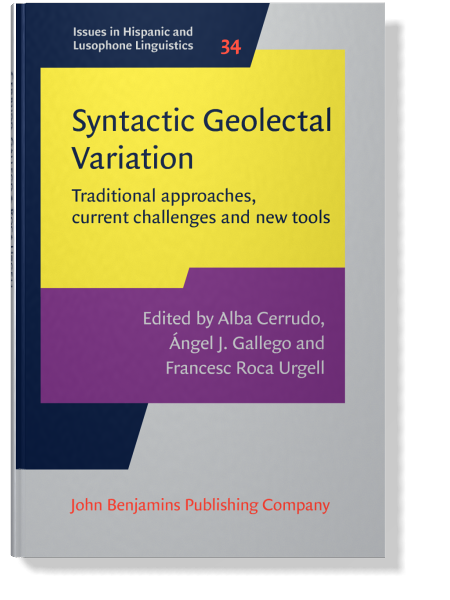
In:Syntactic Geolectal Variation: Traditional approaches, current challenges and new tools
Edited by Alba Cerrudo, Ángel J. Gallego and Francesc Roca Urgell
[Issues in Hispanic and Lusophone Linguistics 34] 2021
► pp. 225–262
Chapter 8Gerund structures in Ecuadorian Spanish
Published online: 26 November 2021
https://doi.org/10.1075/ihll.34.08bat
https://doi.org/10.1075/ihll.34.08bat
Abstract
In this chapter we study non-prototypical values
of gerunds in Ecuadorian and Andean Spanish. Apart from the standard
aspectual simultaneity reading, gerunds in Andean Spanish encode an
anteriority reading that has been associated to contact with
Quechua. The chapter focuses on this value and claims that there are
two patterns of gerund verbal complexes that exhibit it: an
embedding and a periphrastic one. We provide a syntactic analysis to
account for both and we draw the connection between Ecuadorian
gerunds and converbs in Quechua. Finally, we offer relevant
diachronic evidence that the aspectual values of Andean gerunds are
also attested in the history of Spanish, which supports our
explanation in terms of contact-induced linguistic change.
Article outline
- 1.Introduction
- 2.Methodology
- 2.1Surveys
- 2.2Corpora analysis
- 3.Two patterns of gerunds of anteriority
- 3.1Adverbial gerunds
- 3.2Pseudo-periphrases
- 4.Towards an analysis of Ecuadorian gerunds
- 4.1Adverbial gerunds
- 4.2Pseudo-periphrases
- 5.Converbs in Quechua and their Spanish equivalents
- 5.1Morphemes of simultaneity/progressive tense
- 5.2Morphemes of adverbial subordination
- 6.Gerunds in Old Spanish and their interaction with Quechua
structures that express anteriority
- 6.1General overview of the diachronic evolution and the linguistic change
- 6.2Diachronic evolution of Spanish adverbial gerund constructions
- 7.Linguistic contact, transfer, second language acquisition, and
convergence
- Contact-induced change
- Functional convergence hypothesis
- 8.Conclusion
Acknowledgements Notes Abbreviations in glosses References Sources

References (38)
Avellana, A. M. (2012). Las categorías funcionales en el español en
contacto con lenguas indígenas en la argentina: Tiempo,
aspecto y modo (Unpublished doctoral dissertation). University of Buenos Aires.
Batllori, M., Hernanz, M. L., & Rubio-Alcalá, C. (2019). Análisis de algunos complejos verbales del
ecuatoriano. In M. Haboud (Ed.) Lenguas en contacto: Desafíos en la diversidad (pp. 163–199). Quito: Centro de Publicaciones PUCE (Pontificia Universidad Católica de Ecuador).
Bruil, M. (2008). Innovations in the Ecuadorian Converb Systems:
Grammatical change in language contact
situations (Unpublished master’s thesis). Leiden University.
Cardinaletti, A., & Giusti, G. 2001. Semi-lexical’ motion verbs in Romance and
Germanic. In N. Corver & H. van Riemsdijk (Eds.), Semi-lexical categories: The function of content words
and the content of function words (pp. 371–414). Berlin: Walter de Gruyter.
Cinque, G. (1999). Adverbs and functional heads: A cross-linguistic
perspective. Oxford: Oxford University Press.
(2003). The interaction of passive, causative, and
restructuring in
Romance. In C. Tortora (Ed.), The syntax of Italian dialects (pp. 50–66). Oxford: Oxford University Press.
(2004).
Restructuring and functional
structure. In A. Belletti (Ed.), Structures and beyond (pp. 132–191). Oxford: Oxford University Press.
Courthès, Eric (1999). Calques syntaxiques du quichua de Santiago del Estero sur l'espagnol local. Crisol, Nouvelle Série, 3, 75–91.
Fernández Lagunilla, M. (1999). Las construcciones de gerundio. In I. Bosque & V. Demonte (Eds.), Gramática descriptiva de la lengua española (pp. 3443–3503). Madrid: Espasa Calpe.
Haboud, M. (2005). El gerundio de anterioridad entre bilingües
quichua-castellano y monolingües hispanohablantes de la
Sierra ecuatoriana. UniverSOS, 2, 9–38.
Haegeman, L. (2007). Operator movement and topicalización in adverbial
clauses. Folia Linguistica, 41(3–4), 279–325.
(2012). Adverbial clauses, main clause phenomena, and the
composition of the left periphery. Oxford: Oxford University Press.
Heine, B., & Kuteva, T. (2005). Language Contact and Grammatical Change. Cambridge: Cambridge University Press.
Jaeggli, O., & Hyams, N. (1993). On the independence and interdependence of
syntactic and morphological properties: English aspectual
come and go
. Natural Language and Linguistic Theory, 11, 313–346.
Lipsky, J. M. (2013). ¿Qué diciendo nomás? Tracing the sources of the
Andean Spanish Gerund. Spanish in Context, 10(2), 227–260.
McEnery, A. M., & Wilson, A. (2001). Corpus linguistics: An introduction. Edinburgh: Edinburgh University Press.
Merma Molina, G. (2007). Contacto lingüístico entre el español y el quechua: un enfoque cognitivo-pragmático de las transferencias morfosintácticas en el español andino peruano (Unpublished doctoral dissertation). Universidad de Alicante.
Muysken, P. (2005). A modular approach to sociolinguistic variation
in syntax. The gerund in Ecuadorian Spanish. In L. Cornips & K. Corrigan (Eds.), Syntax and variation: Reconciling the biological and the
social (pp. 31–53). Amsterdam: John Benjamins.
Pato, E. (2014). En llegando los datos la intuición se matiza. El
gerundio preposicional en la historia de la lengua
española. RILCE, 30(3), 833–860.
Rizzi, L. (1997). The fine structure of the left
periphery. In L. Haegeman (Ed.), Elements of grammar: A handbook of generative
syntax (pp. 281–337). Dordrecht: Kluwer.
Rodríguez-Ramalle, T. M. (2016). Gerundio y participio. In J. Gutiérrez-Rexach (Ed.), Enciclopedia de lingüística hispánica (Vol. 1, pp. 640–651). London: Routledge.
Rubio-Alcalá, C. (2016). Topic extraction from adverbial
clauses. Borealis: An International Journal of Hispanic
Linguistics, 5(1), 1–30.
Sánchez, L. (2003). Quechua-Spanish bilingualism. Interference and
convergence in functional categories. Amsterdam: John Benjamins.
Suñer, A. (2017). Orden de palabras y periferia izquierda en las
construcciones adjuntas de gerundio del castellano
medieval. Invited talk in the Seminário Internacional sobre a ordem de palavras nas
línguas ibero-românicas, Salvador de Bahia (Brasil), 31 July, 2017.
Tsimpli, T., Sorace, A., Heycock, C., & Filiaci, F. (2004). First language attrition and syntactic subjects:
A study of Greek and Italian near-native speakers of
English. International Journal of Bilingualism, 8, 257–277.
Weerman, F. P. (1993). The diachronic consequences of first and second
language acquisition: The change from OV to
VO. Linguistics, 31(5), 903–931.
CORDE. Corpus Diacrónico del Español. [URL]
CORDIAM. Corpus Diacrónico y Diatópico del Español de
América. [URL]
CREA. Corpus de Referencia del Español Actual. [URL]