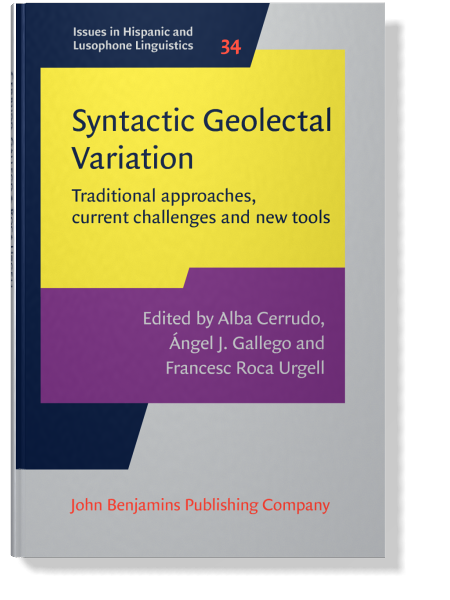
In:Syntactic Geolectal Variation: Traditional approaches, current challenges and new tools
Edited by Alba Cerrudo, Ángel J. Gallego and Francesc Roca Urgell
[Issues in Hispanic and Lusophone Linguistics 34] 2021
► pp. 203–224
Chapter 7Parameters of clitic combination
A case study in Eastern Iberian
Published online: 26 November 2021
https://doi.org/10.1075/ihll.34.07col
https://doi.org/10.1075/ihll.34.07col
Abstract
This chapter presents the restrictions and
alterations that object clitics show when they are combined (forming
a ‘clitic cluster’) in different varieties of Spanish, Catalan and
Aragonese. As it is well-known, the combination of a third person
accusative clitic and a third person dative clitic is rejected [in
these varieties]. The relevant point that I will explore is that
there is, in fact, variation in the way that languages avoid these
ungrammatical sequences. To show this, I consulted different
databases that describe this combination (grammars, atlases and
corpora). Furthermore, I offer a proposal that accounts for these
restrictions, building on the conclusions presented in Colomina (2020).
Keywords: clitic clusters, Aragonese, Catalan, Spanish, dative clitic, accusative clitic
Article outline
- 1.Introduction
- 2.Clitic combinations in Eastern Iberian
- 2.1Geographic distribution
- 2.2Clitic combinations
- 2.3Interim conclusions
- 3.The distinctness condition
- 3.1Combinatorial restrictions
- 3.2Cross-linguistic variation
- 4.Conclusion
Acknowledgements Notes References

References (42)
Alvar, M. (1979–1983). Atlas Lingüístico y Etnográfico de Aragón, Navarra y La
Rioja. Madrid: La Muralla.
Arnal, M. L. (1998). El habla de la Baja Ribagorza occidental. Zaragoza: Institución Fernando el Católico.
Atlas Sintáctico del Español [online]. Retrieved on 12 October
2016 from: [URL]
Bonet, E. (1991). Morphology after syntax: Pronominal clitics in
Romance (Unpublished doctoral dissertation). MIT.
Camus, B. (2017). Hablar sin clíticos: Una muestra del español
aprendido del País Vasco. In A. Palacios (Ed.), Variación y cambio lingüístico en situacions de
contacto (pp. 127–142). Madrid: Iberoamericana.
Colomina, M. P. (2020). A distinctness approach to clitic combinations in Romance. Studies on Hispanic and Lusophone Linguistics, 13(2), 277–308.
Cuervo, M. C. 2013. Spanish Clitic Clusters: three of a perfect pair. Borealis: An International Journal of Hispanic Linguistics, 2, 191–220.
Fernández-Ordóñez, I. (1994). Isoglosas internas del castellano. El sistema
referencial del pronombre átono de tercera
persona. Revista de Filología Española, LXXIV, 71–125.
(1999). Leísmo, laísmo y loísmo. In I. Bosque & V. Demonte (Eds.), Gramática Descriptiva de la Lengua Española (pp. 1317–1397). Madrid: Espasa Calpe.
(2005–). Corpus oral y sonoro del español rural (COSER). Autonomous University of Madrid. Accessed on 15 December
2020 from: [URL]
(2016). Dialectos del español peninsular. In J. Gutiérrez Rexach (Ed.), Enciclopedia de lingüística hispànica (Vol 2, pp. 387–404). London: Routledge.
Franco, J., & Landa, A. (1992). Objetos nulos en el castellano del País Vasco:
dos estatus para dos interpretaciones. Anuario del Seminario de Filología Vasca “Julio de
Urquijo” 26(3), 777–792.
Gallego, Á. J. (2016). A phase-theoretic approach to cliticization in
Romance. Studies in Hispanic and Lusophone Linguistics, 9(1), 67–94.
Gallego, Á. J., & Uriagereka, J. (2017). Condiciones de ensamble en las combinaciones de
clíticos. In Á. J. Gallego, Y. Rodríguez, & J. Fernández (Eds.), Relaciones sintácticas (pp. 663–681). Bellaterra: Servei Publicacions, UAB.
Giralt, J. (1998). Aspectos gramaticales de las hablas de La Litera
(Huesca). Zaragoza: Institución Fernando el Católico.
Hiraiwa, K. (2010). The syntactic OCP. In Y. Otsu (Ed.), The proceedings of the 11th Tokyo Conference on
Psycholinguistics (pp. 35–56). Tokyo: Hituzi.
(2002). Pronouns and their antecedents. In S. D. Epstein & T. D. Seely (Eds.), Derivation and explanation in the minimalist
program (pp. 133–166). Malden, MA: Blackwell.
Landa, A. (1995). Conditions on null objects in Basque Spanish and their relation to ‘leísmo’ and clitic doubling. (Unpublished doctoral dissertation) University of Southern California.
Longa, V., Lorenzo, G., & Rigau, G. (1996). Expressing modality by recycling
clitics. Catalan Working Papers in Linguistics 5(1), 67–79.
López, J. I. (coord.). (2012). El aragonés: Una lengua románica. Zaragoza: Consello d’a Fabla Aragonesa; Rolde de Estudios Aragoneses.
Nevins, A. (2007). The representation of third person and its
consequences for person-case effects. Natural Language & Linguistic Theory, 25(2), 273–313.
Ordóñez, F. (2002). Some clitic combinations in the syntax of
Romance. Catalan Journal of Linguistics, 1, 201–224.
Ortiz de Urbina, J. (1989). Parameters in the grammar of Basque: A GB approach to
Basque syntax. Dordrecht: Foris.
Perlmutter, D. (1971). Deep and surface structure constraints in
syntax. New York, NY: Holt, Rinehart & Winston.
Pescarini, D. (2010). Elsewhere in Romance: Evidence from clitic
clusters. Linguistic Inquiry, 41(3), 427–444.
Roca, F. (1992). On the licensing of pronominal clitics: The
properties of object clitics in Spanish and
Catalan (Unpublished master’s thesis). Autonomous University of Barcelona.
Sistac, R. (1993). El Ribagorçà a l’alta Llitera: Els parlars de la vall de
la Sosa de Peralta. Barcelona: Institut d’Estudis Catalans.
Suñer, M., & Yépez, M. (1988). Null definite objects in Quiteño. Linguistic Inquiry, 19(3), 511–519.
Uriagereka, J. (1995). Aspects of the syntax of clitic placement in
Western Romance. Linguistic Inquiry, 26(1), 79–123.