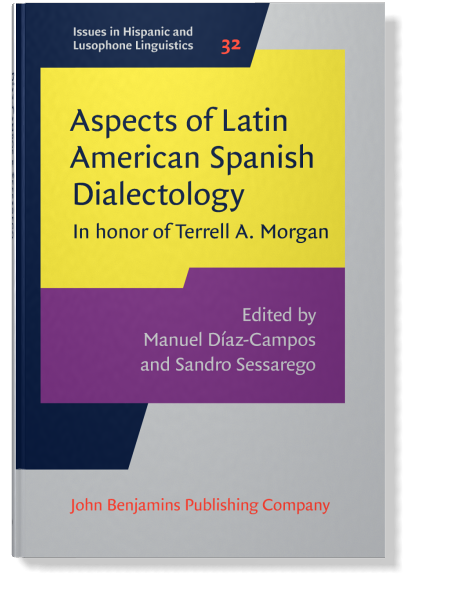
In:Aspects of Latin American Spanish Dialectology: In honor of Terrell A. Morgan
Edited by Manuel Díaz-Campos and Sandro Sessarego
[Issues in Hispanic and Lusophone Linguistics 32] 2021
► pp. 207–226
Chapter 9
Español neutro and marketing in Latin American
and U.S. audiovisual media
Published online: 12 January 2021
https://doi.org/10.1075/ihll.32.09cip
https://doi.org/10.1075/ihll.32.09cip
Abstract
This chapter has a descriptive and a theoretical
aim. The descriptive aim involves elucidation of the term
neutro in different contexts and analysis of
phonetic/phonological features usually associated with the type of
“neutral” Spanish as marketed by global media conglomerates. The
theoretical aim is to link this Spanish “from nowhere” with issues
of standardization and with globalization-related concepts such as
anonymity, commodification, agency, and disembedding. Data come from
publicly available interviews of dubbing professionals, coaching
videos on “neutralization” of a local accent, and excerpts of TV
show dubbings previously outsourced by Miami-based conglomerates, in
tandem with Bogotá and Mexico DF, to other Latin American
countries.
Keywords: neutral Spanish, global media conglomerates, dubbing, Miami, Latin America
Article outline
- 1.Introduction
- 2.Phonetic variation in Latin America and the ideology of the
standard
- 2.1Phonetic variation
- 2.2Speed and clarity of speech
- 2.3Ideology of the standard: Correctness, authority and uniformity
- 3.The three types of neutro
- 3.1 Folk neutro
- 3.2 Broadcast neutro
- 4.The marketing neutro (MN)
- 4.1Phonetic and phonological elements
- 4.1.1Rate of speech
- 4.1.2Non-Spanish phonotactics
- 4.1.3Other sounds
- 4.1Phonetic and phonological elements
- 5.U.S. Latino and Latin American multimedia networks
- 5.1The dubbing journey
- 5.2Latino TV networks in the United States
- 5.2.1Linguistic profile of each of Gomez’s circles and representative channels
- 6.MN and globalization
- 7.Further research directions
Notes References

References (44)
Ahrens, F. (2004, August 2). Accent
on higher TV ratings: Spanish-language network
Telemundo coaches actors to use Mexican
dialect. The Washington
Post, p.
A01.
Alfaraz, G. (2014). Dialect
perceptions in real time: A restudy of Miami-Cuban
perceptions. Journal of
Linguistic
Geography, 2(2), 74–86.
Appadurai, A. (1996). Modernity
al large: Cultural dimensions of
globalization (Vol. 1). Minneapolis, MN: University of Minnesota Press.
Boomershine, A. (2006). Perceiving
and processing dialectal variation in Spanish: An exemplar
theory
approach. In T. L. Face & C. A. Klee (Eds.), Selected
proceedings of the 8th Hispanic Linguistics
Symposium (pp. 58–72). Somerville, MA: Cascadilla Proceedings Project.
Carricaburo, N. (2013). El
voseo argentino: Un fenómeno con abordajes
múltiples. In L. Colantoni & C. Rodríguez Louro (Eds.), Perspectivas
teóricas y experimentales en el español de
Argentina (pp.133–142). Madrid, Spain/Frankfurt, Germany: Iberoamericana/Vervuert.
Carter, P., & Callesano, S. (2018). The
social meaning of Spanish in Miami: Dialect perceptions and
implications for socioeconomic class, income, and
employment. Latino
Studies, 16(1), 65–90.
Colantoni, L., & Hualde, J. I. (2013). Introducción:
Variación fonológica en el español de
Argentina. In L. Colantoni & C. Rodríguez Louro (Eds.), Perspectivas
teóricas y experimentales en el español de
Argentina (pp.21–35). Madrid, Spain/Frankfurt, Germany: Iberoamericana/Vervuert.
Dávila, A. (2000). Talking
back: Hispanic media and U.S.
latinidad. Centro
Journal, XII(1), 37–47. Available in [URL]
Díaz-Campos, M., & Killam, J. (2012). Assessing
language attitudes through a matched guise experiment: The
case of consonantal deletion in Venezuelan
Spanish. Hispania, 95(1), 83–102.
Díaz-Campos, M., & I Navarro-Galisteo, I. (2009). Perceptual
categorization of dialect variation in
Spanish. In L. Collentine, M. García, B. Lafford & F. Marcos Marín (Eds.), Selected
Proceedings of the 11th Hispanic Linguistics
Symposium (pp. 179–195). Somerville, MA: Cascadilla Proceedings Project.
Del Valle, J. (2014). The
politics of normativity and globalization: Which Spanish in
the classroom? The Modern
Language
Journal, 98(1), 358–372.
Doblaje
Wiki (n.d.). Retrieved from the
Doblajes Wiki: <[URL]> (30 March,
2017).
(n.d.). Retrieved from the
Doblajes Wiki: <[URL]> (19 September,
2018).
File-Muriel, R., & Brown, E. (2011). The
gradient nature of s-lenition in Caleño
Spanish. Language Variation
and
Change, 23(2), 223–243.
Fontanella de Weinberg, M. B. (1977). La
constitución del paradigma pronominal de
voseo. Thesaurus: Boletín del
Instituto Caro y
Cuervo, 32(2), 227–241.
Gabriel, C., Pešková, A., Labastía, L., & Blásquez, B. A. (2013). La
entonación en el español de Buenos
Aires. In L. Colantoni & C. Rodríguez Louro (Eds.), Perspectivas
teóricas y experimentales en el español de
Argentina (pp.99–115). Madrid, Spain: Iberoamericana Vervuert.
Gómez, R. (2016). Latino
television in the United States and Latin America:
Addressing networks, dynamics, and
alliances. International
Journal of
Communication, 10, 2811–2830.
Guitart, J. (1978). Conservative
versus radical dialects in Spanish: Implications for
language
instruction. Bilingual
Review/La Revista
Bilingüe, 5(1/2), 57–64.
Hualde, J. I., Olarrea, A., Escobar, A. M., & Travis, C. (2010). Introducción
a la lingüística
hispánica. Cambridge, UK: Cambridge University Press.
Kendall, T. (2013). Speech
rate, pause and sociolinguistic variation: studies in corpus
sociophonetics. New York, NY: Palgrave Macmillan.
Korn, D. (2015, September 11). The
Cisneros Group has reached an agreement with The Kitchen to
offer dubbing services
jointly. NextvNews: Latin
America.
Lansberg-Rodríguez, D. (2015). The
key thing missing from
Narcos
. The
Atlantic, November. Retrieved
from <[URL]> (21 July,
2020).
Linguistic Society of
America. (n.d.). Linguistics
and the news media: An LSA guide for
linguists. Retrieved
from <[URL]> (21 July,
2020).
(2011a). Socio-phonological
variation in Latin American
Spanish. In M. Díaz-Campos (Ed.), The
handbook of Hispanic
sociolinguistics (pp.72–97). Oxford, UK: Wiley Blackwell.
Lipski, J. M. (2011b). Dialects
and borders: Face-to-face and back-to-back in Latin American
Spanish. Southwest Journal of
Linguistics, 30(2), 33–54.
Mar-Molinero, C., & Paffey, D. (2011). Linguistic
imperialism: Who owns global
Spanish? In M. Díaz-Campos (Ed.), The
handbook of Hispanic
sociolinguistics (pp. 747–764). Oxford, UK: Wiley Blackwell.
Melia, M. (2005). American
Spanish? U.S. coaches performers from Latin America to speak
with “neutral”
accents. Retrieved
from <[URL]> (21 July,
2020).
Milroy, J., & Milroy, L. (2012). Authority
in language: Investigating standard
English (4th
ed.). Oxford, UK: Routledge.
Milroy, J. (2001). Language
ideologies and the consequences of
standardization. Journal of
Sociolinguistics, 5(4), 530–555.
Montes-Alcalá, C. (2011). ¿Mejor
o peor español? Actitudes lingüísticas de universitarios
hispanohablantes en Estados
Unidos. Studies in Hispanic
and Lusophone
Linguistics, 4(1), 35–54.
Petrella, L. (1998). El
español “neutro” de los doblajes: Intenciones y
realidades. I Congreso
Internacional de la Lengua
Española. In [URL]. Retrieved
from <[URL]> (21 July,
2020).
Preston, D. (2002). Language
with an
attitude. In J. K. Chambers, P. Trudgill, & N. Schilling-Estes (Eds.), The
handbook of language variation and
change (pp. 40–66). Oxford, UK: Blackwell.
Quesada Pacheco, M. Á. (2014). División
dialectal del español de América según sus hablantes:
Análisis dialectológico
perceptual. Boletín de
Filología, 49(2), 257–309.
Rohena-Madrazo, M. (2013). Variación
y cambio de sonoridad de la fricativa postalveolar en el
español de Buenos
Aires. In L. Colantoni & C. Rodríguez Louro (Eds.), Perspectivas
teóricas y experimentales en el español de
Argentina (pp. 37–47). Madrid, Spain/Frankfurt, Germany: Iberoamericana/Vervuert.
Sinclair, J. (2005). De
latinoamericanos a latinos: La televisión en español y sus
audiencias en Estados
Unidos. Telos: Cuadernos de
Comunicación e
Innovación, 64, 19–27.
Smiljanic, R., & Bradlow, A. (2007). Clear
speech intelligibility: Listener and talker
effects. In J. Trouvain & W. J. Barry (Eds.), Proceedings
of the XVI International Congress of Phonetic
Sciences (pp. 661–4). Saarbrucken, Germany: Universität des Saarlandes.
Torres Cacoullos, R., & Ferreira, F. (2000). Lexical frequency and voice labiodental-bilabial variation in New Mexican Spanish. Southwest Journal of Linguistics, 19(2), 1–17.
Trovato, A. M. (2018). A
sociophonetic analysis of contact Spanish in the United
States: Labiodentalization and labial consonant
variation (Unpublished
doctoral dissertation). The University of Texas at Austin. Retrieved
from <[URL]> (21 July,
2020)