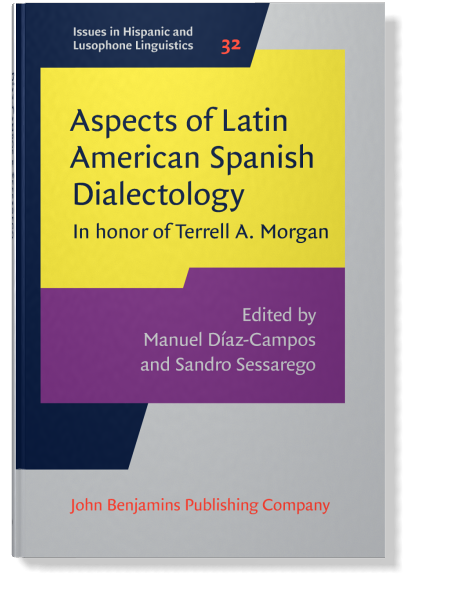
In:Aspects of Latin American Spanish Dialectology: In honor of Terrell A. Morgan
Edited by Manuel Díaz-Campos and Sandro Sessarego
[Issues in Hispanic and Lusophone Linguistics 32] 2021
► pp. 47–68
Chapter 3Variable constraints on se lo(s) in Mexican
Spanish
Published online: 12 January 2021
https://doi.org/10.1075/ihll.32.03sch
https://doi.org/10.1075/ihll.32.03sch
Abstract
We examine the alternation between normative
se lo/la and se los/las to
express a plural indirect object and singular direct object. Using
corpus data from Mexico City and Monterrey, we find that significant
predictors of the more frequent variant, se los,
are number of the verb, referential distance, and presence of a
dative prepositional phrase. Contra previous claims that se
los marks plurality in ambiguous dative referents, we
argue that it serves as an accessibility marker that makes a plural
referent more salient if not recently mentioned. Se
los is used most frequently with first-person singular
verbs, resulting in (near-)fixed expressions. These findings
demonstrate the sensitivity of Spanish clitics to
discourse-pragmatic context and highlight limitations of
sentence-level analysis of morphosyntactic variants.
Keywords: datives, object clitics, Mexican Spanish, discourse accessibility
Article outline
- 1.Introduction
- 2.Previous literature
- 3.Research questions and hypotheses
- 4.Methodology
- 4.1The corpora
- 4.2Variable context
- 4.3Coding of predictors
- 4.4Statistical methods
- 5.Results
- 6.Discussion
- 7.Conclusion
Notes References

References (33)
Alvar, M. (2010). El
español en México. Estudios, mapas,
textos. Madrid, Spain: Universidad de Alcalá.
Belloro, V. (2004). A
role and reference grammar account for third-person clitic
clusters in
Spanish (Unpublished MA
Thesis). The State University of New York at Buffalo.
Bonet, E. (1995). Feature
structure of Romance
clitics. Natural Language
& Linguistic
Theory, 13, 607–647.
Company, C. (1992). Un
cambio en proceso: “El libro, ¿Quién se los
prestó?” In E. L. Traill (Ed.), Scripta
philologica in honorem Juan M. Lope
Blanch (Vol. 2, pp. 349–362). México, DF: UNAM.
(1998). The
interplay between form and meaning in language change.
Grammaticalization of cannibalistic datives in
Spanish. Studies in
Language, 22, 529–566.
(2001). Multiple
dative-marking grammaticalization. Spanish as a special kind
of primary object
language. Studies in
Language, 25, 1–47.
(2006). El
objeto
indirecto. In C. Company (Ed.), Sintaxis
histórica de la lengua española. Primera parte: La frase
verbal, (Vol. 1, pp. 479–574). México, DF: UNAM/Fondo de Cultura Económica.
DeMello, G. (1992).
Se
los for se lo in the spoken
cultural Spanish of eleven
cities. Hispanic
Journal, 13, 165–179.
Gili y Gaya, S. (1993
[1943]). Curso superior de sintaxis
española (15th
ed.). Barcelona, Spain: Biblograf.
Givón, T. (1983). Topic
continuity in discourse: An
introduction. In T. Givón (Ed.), Topic
continuity in discourse: A quantitative cross-language
study (pp. 1–42). Amsterdam, The Netherlands: John Benjamins.
Gustafson, G. (2017). Variable
number agreement in the Spanish dative pronoun
le(s). Ms. The Ohio State University.
Harris, J. (1996). The
morphology of Spanish
clitics. In H. Campos & P. Kempchinsky (Eds.), Evolution
and revolution in linguistic
theory (pp. 168–197). Washington, DC: Georgetown University Press.
Hothorn, T., Hornik, K., & Zeileis, A. (2006). Unbiased
recursive partitioning: A conditional inference
framework. Journal of
Computational and Graphical
Statistics, 15(3), 651–674.
Kailuweit, R. (2006). “Floating
plurals,” prodrop and agreement – an optimality-based RRG
approach. In R. D. Van Valin, Jr. (Ed.), Investigations
of the syntax-semantics-pragmatics
interface (pp. 179–202). Amsterdam, The Netherlands: John Benjamins.
Kuznetsova, A., Brockhoff, P. B., & Christensen, R. H. B. (2017). lmerTest
Package: Tests in linear mixed effects
models. Journal of
Statistical
Software, 82(13), 1–26.
Menéndez Pidal, R. (1965). Manual
de gramática histórica
española (12th
ed.). Madrid, Spain: Espasa Calpe.
Moreno de Alba, J. G. (2013a). ‘Se
los dije [a ellos]’ por ‘se lo dije [a
ellos].’ El Atlas Lingüístico
de México. Anuario de Letras. Lingüística y
Filología, 1(1), 147–182.
Ordóñez, F. (2011). Clitics
in
Spanish. In J. I. Hualde, A. Olarrea, & E. O’Rourke (Eds.), The
handbook of Hispanic
linguistics (pp. 423–451). Oxford: Blackwell.
Real Academia
Española: Banco de datos (CREA) [en
línea]. Corpus de referencia del
español actual. <[URL]> (17 July,
2020).
Reig Alamillo, A. (2009). Cross-dialectal
variation in propositional anaphora: Null objects and
propositional lo in Mexican and Peninsular
Spanish. Language Variation
&
Change, 21, 381–412.
Revilla, M. (1910). Provincialismos
de expresión en
Méjico. In Memorias
de la Academia Mexicana de la
Lengua VI (pp. 352–367). Mexico, DF: Ediciones del centenario de la Academia Mexicana.
Sankoff, D. (1988). Sociolinguistics
and syntactic
variation. In F. Newmeyer (Ed.), Linguistics:
The Cambridge Survey, IV: The socio-cultural
context (pp. 140–161). Cambridge, UK: Cambridge University Press.
Schwenter, S. A. (2006). Null
objects across South
America. In T. L. Face & C. Klee (Eds.), Selected
Proceedings of the 8th Hispanic Linguistics
Symposium (pp. 23–36). Somerville, MA: Cascadilla Proceedings Project.
Tippets, I. & Schwenter, S. A. (2007). Relative
animacy and differential object marking in
Spanish. Paper presented
at New Ways of Analyzing
Variation (NWAV)
36, Philadelphia,
PA.
Cited by (1)
Cited by one other publication
This list is based on CrossRef data as of 12 december 2025. Please note that it may not be complete. Sources presented here have been supplied by the respective publishers. Any errors therein should be reported to them.