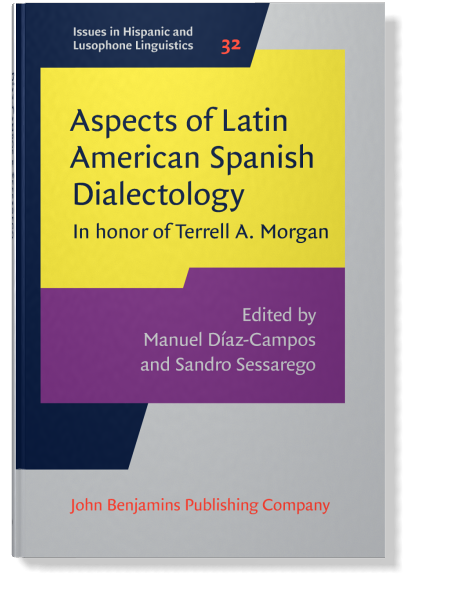
In:Aspects of Latin American Spanish Dialectology: In honor of Terrell A. Morgan
Edited by Manuel Díaz-Campos and Sandro Sessarego
[Issues in Hispanic and Lusophone Linguistics 32] 2021
► pp. 29–46
Chapter 2“Feel really Uruguayan”
Group unity, stance, respect and politeness. Forms of address in advertisements and commercial documents in the Spanish of Montevideo
Published online: 12 January 2021
https://doi.org/10.1075/ihll.32.02ube
https://doi.org/10.1075/ihll.32.02ube
Abstract
This chapter considers second-person singular
forms of address (tú, vos, usted) in advertisements and business
documents in the Spanish of Montevideo, Uruguay. Tú is considered
the standard-Spanish familiar address and usted the standard respectful
address, while vos is used as an familiar form of address among
Uruguayans. Norms of politeness dictate that speakers should
accommodate to the hearer using usted. However, familiar vos can
indicate politeness for speakers with a similar social status, or to
show solidarity. Using examples from marketing and advertising to
illustrate usage, we find that over 70% of examples used vos, almost
19% employed usted, and less than 7% used tú. This supports claims
that tuteo (whether verbal or pronominal) is disappearing from
Montevideo.
Article outline
- 1.Introduction
- 2.Theoretical considerations
- 3.Methodology
- 4.Respect
- 5.Politeness
- 6.Results
- 6.1Examples of usted usage
- 6.2Examples of tú usage
- 6.3Examples of vos usage
- 6.4Examples of alternation
- 7.Conclusions
Acknowledgements References

References (18)
Brown, P., & Levinson, S. C. (1987). Politeness:
Some universals in language
usage (Studies in Interactional
Sociolinguistics
4). Cambridge, UK: Cambridge University Press.
Brown, R., & Gilman, A. (1960). The
pronouns of power and
solidarity. In T. A. Sebeok (Ed.), Style
in
language (pp. 253–276). Cambridge, MA: The MIT Press.
García, C. (1992). Refusing
an invitation: A case study of Peruvian
style. Hispanic
Linguistics, 5, 207–243.
Kaul de Marlangeon, S. (2010). Voseo,
ustedeo y cortesía verbal en folletos de propaganda
argentinos. In M. Hummel, B. Kluge, & M. E. Vázquez Laslop (Eds.), Formas
y fórmulas de tratamiento en el mundo
hispánico (pp. 993–1011). México, DF: El Colegio de México.
Raymond, C. W. (2016a). Reconceptualizing
identity and context in the deployment of forms of
address. In M. I. Moyna & S. Rivera-Mills (Eds.), Forms
of address in the Spanish of the
Americas (pp. 267–288). Amsterdam, The Netherlands: John Benjamins.
(2016b). Linguistic
reference in the negotiation of identity and action:
Revisiting the T/V
distinction. Language, 92, 636–670.
Sidnell, J., & Stivers, T. (Eds.). (2013). The
handbook of conversation
analysis. Oxford, UK: Blackwell.
(2000). ‘Addressing’
business in Puerto Rico: Tú vs.
usted. In A. Roca (Ed.), Research
on Spanish in the United States: Linguistic issues and
challenges (pp. 310–318). Somerville, MA: Cascadilla Press.
(2008). Creo
que entiendo el uso de tú, usted, ustedes,
y vosotros. Pero, ¿qué hago con
vos? In J. Ewald & A. Edstrom (Eds.), El
español a través de la lingüística: Preguntas y
respuestas (pp. 50–60). Somerville, MA: Cascadilla Press.
(2010). Formas
y fórmulas de trato en situaciones laborales en Santiago de
Chile y Buenos
Aires. In M. Hummel, B. Kluge, & M. E. Vázquez Laslop (Eds.), Formas
y fórmulas de tratamiento en el mundo
hispánico (pp. 1051–1080). México, DF: El Colegio de México.
(2011). Forms
of address: The effect of the
context. In M. Díaz-Campos (Ed.), The
handbook of hispanic
sociolinguistics (pp. 244–262). Oxford: Blackwell.
(2012). La
unidad grupal, el respeto y la cortesía: Fórmulas de
tratamiento en los negocios en el español
porteño. In A. M. Cestero Mancera, I. Molina Martos, & F. Paredes García (Eds.), La
lengua, lugar de encuentro. Actas del XVI Congreso
Internacional de la
ALFAL (pp. 1783–1792). Alcalá de Henares, Spain: Servicio de Publicaciones de la Universidad de Alcalá.
(2014). Spanish
forms of address in advertising and marketing documents in
Madrid: Respect and
politeness. In Proceedings
of the 2014 Hawaii University International Conference on
Arts, Humanities and Social
Sciences. Retrieved
from <[URL]> (16 July,
2020).
(2015). Formas
de
tratamiento. In J. Gutiérrez-Rexach (Ed.), Enciclopedia
de lingüística
hispánica (Vol. 1, pp. 620–629). London, UK: Routledge.
(2018). Respect
and politeness in marketing and advertising documents in
Mayagüez, Puerto
Rico. In M. González-Rivera (Ed.), Current
Research in Puerto Rican
Linguistics. (pp. 184–198). London, UK: Routledge.
(2016). Making
the case for increased prestige of the vernacular:
Medellín’s
voseo
. In M. I. Moyna & S. Rivera-Mills (Eds.), Forms
of address in the Spanish of the
Americas (pp. 289–304). Amsterdam, The Netherlands: John Benjamins.
Cited by (1)
Cited by one other publication
Guarin, Daniel
2024. Pronominal address in the linguistic landscape of Hispanic Philadelphia. Language, Culture and Society 6:2 ► pp. 250 ff.
This list is based on CrossRef data as of 12 december 2025. Please note that it may not be complete. Sources presented here have been supplied by the respective publishers. Any errors therein should be reported to them.