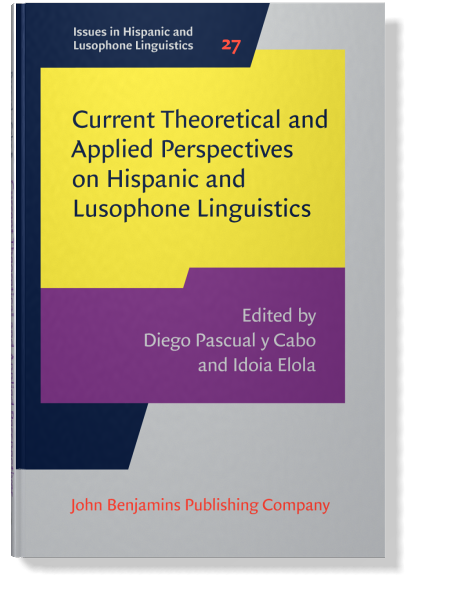
In:Current Theoretical and Applied Perspectives on Hispanic and Lusophone Linguistics
Edited by Diego Pascual y Cabo and Idoia Elola
[Issues in Hispanic and Lusophone Linguistics 27] 2020
► pp. 189–214
Chapter 9On the origins of Portuguese para form variation
Acoustic evidence from reading style
Published online: 4 June 2020
https://doi.org/10.1075/ihll.27.09gra
https://doi.org/10.1075/ihll.27.09gra
Abstract
This study explores the origins of Brazilian Portuguese para ‘to, for’ form variation using sociophonetic analytic techniques to test various properties of the unreduced para variant. While the pra variant was suggested to have originated from an intertonic syncope process, the finding in this study that unreduced para is produced with lexical stress calls such an origin into question. Since unreduced para o tends to be produced lacking the second /a/, para + Article’s low reduction rate to pra in previous studies may be a consequence of its participation in a word-boundary reduction process. Reduction of para to pra therefore appears to be a case of special reduction that emerged for para to reduce a syllable in other contexts.
Article outline
- 1.Introduction
- 2.Brazilian Portuguese para form variation
- 3.Oral vowels in Brazilian Portuguese
- 4.Acoustic correlates of the speech sounds under study
- 5.Research questions
- 6.Methodology
- 6.1Participants and data
- 6.2Measurement procedure
- 6.3Variables
- 6.3.1Response variables
- 6.3.2Moderator
- 6.3.3Predictors
- 6.4Data analysis and exclusions
- 7.Results
- 7.1Overall reduction of para
- 7.2Comparative vowel articulations
- 8.Discussion
- 9.Conclusion
Notes References

References (40)
Alba, M. C. (2006). Accounting for variability in the production of Spanish vowel sequences. In N. Sagarra & A. J. Toribio (Eds.), Selected proceedings of the 9th Hispanic Linguistics Symposium (pp. 273–285). Somerville, MA: Cascadilla Proceedings Project.
Barbosa, P. A., & Albano, E. C. (2004). Brazilian Portuguese. Journal of the International Phonetic Association, 34(2), 227–232.
Barbosa, P. A., & Madureira, S. (2015). Manual de fonética acústica experimental. Aplicações a dados do português. São Paulo: Cortez Editora.
Bates, D., Maechler, M., Bolker, B., & Walker, S. (2015). Fitting linear mixed-effects models using lme4. Journal of Statistical Software, 67(1), 1–48.
Bauman, J., & Torres Cacoullos, R. (2016). The generalization of preposition para via fusion and ensuing loss of compositionality. In C. Tortora, M. den Dikken, I. L. Montoya, & T. O’Neill (Eds.), Romance Linguistics 2013. Selected papers from the 43rd Linguistic Symposium of Romance Languages (LSRL), New York, 17–19 April, 2013 (pp. 39–58). Amsterdam: John Benjamins.
Boersma, P., & Weenink, D. (2004). Configuring the intensity contour. Retrieved from <[URL]> (16 August, 2018).
(2017). Praat. Doing phonetics by computer [Computer program] (Version 6.0.25), Retrieved from <[URL]> (11 February, 2017).
Bush, N. (2001). Frequency effects and word-boundary palatalization in English. In J. Bybee & P. Hopper (Eds.), Frequency and the emergence of linguistic structure (pp. 255–280). Amsterdam: John Benjamins.
Bybee, J., File-Muriel, R. J., & Napoleão de Souza, R. (2016). Special reduction. A usage-based approach. Language and Cognition, 8, 421–446.
Davies, M., & Ferreira, M. (2006). Corpus do português. Available online at <[URL]> (12 November, 2019).
Eddington, D. (2011). What are the contextual phonetic variants of /β,ð,γ/ in colloquial Spanish? Probus, 23, 1–19.
Felgueiras, C. M. (1993). Análise da variação no uso da preposição para (Unpublished master’s thesis). Universidade Federal do Rio de Janeiro.
Ferreira, M. O. (2014). A variação da preposição para na fala de Londrina pelos dados do Varsul (Unpublished master’s thesis). Universidade Federal do Rio de Janeiro.
Gazola, A. (2008). A estrutura prosódica da preposição para do português do Brasil. Uniletras, 30(2), 367–396.
Gradoville, M. (2011). Validity in measurements of fricative voicing. Evidence from Argentine Spanish. In S. Alvord (Ed.), Selected proceedings of the 5th Conference on Laboratory Approaches to Romance Phonology (pp. 59–74). Somerville, MA: Cascadilla Proceedings Project.
(2012). Task effects in /t/ and /d/ palatalization in Várzea Alegre Portuguese. In M. Díaz-Campos & K. L. Geeslin (Eds.), Selected proceedings of the 14th Hispanic Linguistics Symposium (pp. 88–101). Somerville, MA: Cascadilla Proceedings Project.
(2015). Social and stylistic variation in the use of phonetic variants of Fortalezense Portuguese para. Sociolinguistic Studies, 9(4), 373–398.
(2017). The cognitive representation of multi-word sequences. A usage-based approach to the reduction of Fortalezense Portuguese para. Lingua, 199, 94–116.
Hualde, J. I., Simonet, M., & Nadeu, M. (2011). Consonant lenition and phonological recategorization. Laboratory Phonology, 2(2), 301–329.
Huback, A. P. (2012). Chunking and the reduction of the preposition para ‘to, for’ in Brazilian Portuguese. Studies in Hispanic and Lusophone Linguistics, 5(2), 277–296.
Ilari, R., de Castilho, A., de Almeira, M. L. L, Kleppa, L., & Basso, R. (2008). A preposição. In R. Ilari & M. H. de M. Neves (Eds.), Gramática do português culto falado no Brasil (pp. 623–808). Campinas: Editora Unicamp.
Kewitz, V. (2006). Gramaticalização e semantização das preposições A e PARA no português brasileiro (séculos XIX e XX) (Unpublished doctoral dissertation). Universidade de Brazil, São Paulo.
Ladefoged, P. (2003). Phonetic data analysis. An introduction to fieldwork and instrumental techniques. Malden, MA: Blackwell.
Lucena, R. M. de (2001). Comportamento sociolinguístico da preposição PARA na fala da Paraíba (Unpublished master’s thesis). Universidade Federal da Paraíba.
Maya, L. Z. (2004). A variação da preposição para na fala de Porto Alegre (Unpublished master’s thesis). Pontifícia Universidade Católica do Rio Grande do Sul.
Napoleão de Souza, R. (2014). Extreme high frequency, segment deletion and chunking. A study of emerging inflected pronouns in Brazilian Portuguese. Presentation at the 3rd Biennial Workshop on Sound Change.
Noll, V. (2008). O português brasileiro. Formação e contrastes (M. E. Viaro, Trans.). São Paulo: Editora Globo.
Pagliuca, W., & Mowrey, R. (1987). Articulatory evolution. In A. G. Ramat, O. Carruba, & G. Bernini (Eds.), Papers from the 7th International Conference on Historical Linguistics (pp. 459–472). Amsterdam: John Benjamins.
R Core Team. (2018). R. A language and environment for statistical computing. Vienna, Austria: R Foundation for Statistical Computing.
Silva, N. de A. (2010). A preposição para e suas variantes no falar araguatinense (Unpublished master’s thesis). Universidade Federal da Paraíba.
Silva, T. C. (2001). Fonética e fonologia do português. Roteiro de estudos e guia de exercícios (5th ed.). São Paulo: Editora Contexto.
Thomas, E. W. (1969). The syntax of spoken Brazilian Portuguese. Nashville, TN: Vanderbilt University Press.
Cited by (1)
Cited by one other publication
Gradoville, Michael, Mark Waltermire, Audrey Chery, Sofía Fernandez & Avizia Long
2023. Intervocalic /ɡ/ realization in Border Uruguayan Spanish. Spanish in Context 20:3 ► pp. 490 ff.
This list is based on CrossRef data as of 12 december 2025. Please note that it may not be complete. Sources presented here have been supplied by the respective publishers. Any errors therein should be reported to them.