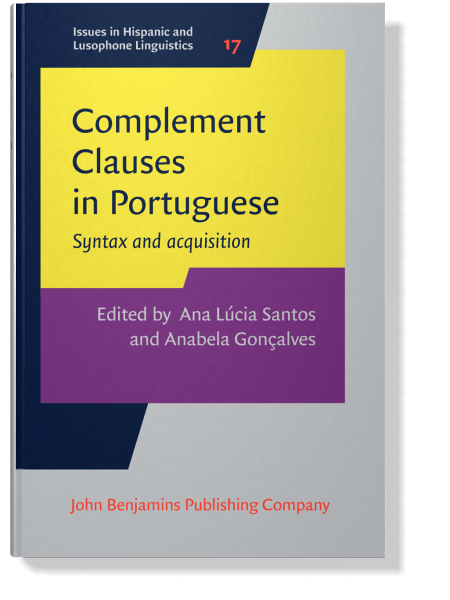
In:Complement Clauses in Portuguese: Syntax and acquisition
Edited by Ana Lúcia Santos and Anabela Gonçalves
[Issues in Hispanic and Lusophone Linguistics 17] 2018
► pp. 395–414
Comments on the acquisition of complementation in Portuguese
Published online: 16 August 2018
https://doi.org/10.1075/ihll.17.13hya
https://doi.org/10.1075/ihll.17.13hya
Article outline
- 1.Universal biases: SASH and the CFC in European and Mozambican Portuguese
- 2.What about frequency?
- 3.SASH and a verb-centric parser
- 4.Control in EP: Intervention vs. SASH
- 5.The CFC hypothesis and raising
- 6.Inflected infinitives in L2 acquisition
- 7.Obviation effects in subjunctive complements
- 8.The Interface Hypothesis: Evidence from Portuguese?
Acknowledgements Notes References

References (37)
Avrutin, S., & Wexler, K. (1999/2000). Children’s knowledge of subjunctive clauses: Obviation, binding and reference. Language Acquisition, 8(1), 69–102.
Belletti, A., Bennati, E., & Sorace, A. (2007). Theoretical and developmental issues in the syntax of subjects: Evidence from near-native Italian. Natural Language and Linguistic Theory, 25, 657–689.
Boland, J. E., Tanenhaus, M. K., & Garnsey, S. M. (1990). Evidence for the immediate use of verb control information in sentence processing. Journal of Memory and Language, 29, 413–432.
Cairns, H., McDaniel, D., Hsu, J. R., & Rapp, M. (1994). A longitudinal study of principles of control and pronominal reference in child English. Language, 70(2), 60–288.
Cardinaletti, A., & Starke, M. (1999). The typology of structural deficiency: A case study of the three classes of pronouns. In H. van Riemsdijk (Ed.), Clitics in the languages of the Europe (pp. 145–233). Berlin: Mouton de Gruyter.
Chien, Y-C., & Wexler, K. (1990). Children’s knowledge of locality conditions in binding as evidence for the modularity of syntax and pragmatics. Language Acquisition, 1(3), 225–295.
Goodluck, H., & Tavakolian, S. (1982). Competence and processing in children’s grammar of relative clauses. Cognition, 11, 1–27.
Grodzinsky, Y., & Reinhart, T. (1993). The innateness of binding and coreference. Linguistic Inquiry, 24, 41–54.
Hirsch, C., Orfitelli, R., & Wexler, K. (2007). When seem means think: The role of the experiencer-phrase in children’s comprehension of raising. In A. Belikova, L. Meroni, & M. Umeda (Eds.), Galana 2 – Proceedings of the conference on Generative Approaches to Language Acquisition North America 2 (pp. 135–146). Somerville, MA: Cascadilla Press.
Holmberg, A. (2005). Is there a little pro? Evidence from Finnish. Linguistic Inquiry, 36, 533- 564.
Kirby, S. (2011). Move over, control freaks: Syntactic raising as a cognitive default. In N. Danis, K. Mesh, & H. Sung (Eds.), Boston University Conference on Language Development 35 – Online supplement.
McDaniel, D., Cairns, H., & Hsu, J. (1990/1991). Control principles in the grammars of young children. Language Acquisition, 1(4), 297–335.
McWhinney, B., & Snow, C. (1985). The child language data exchange system. Journal of Child Language, 12, 271–296.
Mateu, V. (2016). Intervention effects in the acquisition of raising and control: evidence from English and Spanish (Unpublished PhD dissertation). UCLA.
Orfitelli, R. (2012). ‘Experiencing’ a slight delay: Intervening arguments and the acquisition of subject-to-subject raising. In N. Danis, K. Mesh, & H. Sung (Eds.), Proceedings of the 36th Boston University Conference on Language Development (Vol. 2, pp. 335–346). Somerville, MA: Cascadilla Press.
Pires, A. (2006). The minimalist syntax of defective domains: Gerunds and infinitives. Amsterdam: John Benjamins.
Reinhart, T. (2004). The processing cost of reference set computation: Acquisition of stress shift and focus. Language Acquisition, 12(2), 109–155.
Rothman, J. (2009). Knowledge of A/A’ dependencies on subject extraction with two types of infinitives in non-native Portuguese adult bilingualism. International Journal of Bilingualism, 13(1), 111–140.
Rothman, J., & Iverson, M. (2007). To inflect or not to inflect is the question indeed: infinitives in non-native Portuguese. Journal of Portuguese Linguistics, 6(2), 5–30.
Santos, A. L., Gonçalves, A., & Hyams, N. (2016). Aspects of the acquisition of object control and ECM-type verbs in European Portuguese. Language Acquisition, 23(3), 199–233. [2015].
Schwartz, B. D. (2003). Child L2 acquisition: Paving the way. In B. Beachley, A. Brown, & F. Conlin (Eds.), Proceedings of the 27th annual Boston University Conference on Language Development (pp. 26–50). Somerville, MA: Cascadilla Press.
Schwartz, B., & Sprouse, R. (1996). L2 cognitive state and the full transfer/full access model. Second Language Research, 12(1), 40–72.
(2013). Generative approaches and the poverty of the stimulus. In J. Hershensohn & M. Young-Scholten (Eds.), The Cambridge handbook of second language acquisition (pp. 137–158). Cambridge: Cambridge University Press.
Solan, L., & Roeper, T. (1978). Children’s use of syntactic structure in interpreting relative clauses. In H. Goodluck & L. Solan (Eds.), Papers in the structure and development of child language (University of Massachusetts Occasional Papers in Linguistics Vol. 4, pp. 105–127). Amherst, MA: GSLA.
Sorace, A. (2011). Pinning down the concept of “interface” in bilingualism. Linguistic Approaches to Bilingualism, 1(1), 1–33.
Sorace, A., & Filiaci, F. (2006). Anaphor resolution in near native speakers of Italian. Second Language Research, 22(3), 339–368.
Tavakolian, S. (1981). The conjoined clause analysis of relative clauses. In S. Tavakolian (Ed.), Language acquisition and linguistic theory (pp. 167–87). Cambridge, MA: The MIT Press.
Trueswell, J., Sekerina, I., Hill, N. M., & Logrip, M. L. (1999). The kindergarten path effect: Studying on-line processing in young children. Cognition, 73, 89–134.
Trueswell, J., & Gleitman, L. (2004). Children’s eye movements during listening: Developmental evidence for a constraint-based theory of sentence processing. In J. M. Henderson & F. Ferriera (Eds.), The interface of language, vision and action: Eye movements and the visual world (pp. 319–346). New York, NY: Psychology Press.
Trueswell, J., Papafragou, A., & Choi, S. (2011). Sytnactic and referential processes: What develops? In E. Gibson & N. Pearlmutter (Eds), The processing and acquisition of reference (pp. 65–108). Cambridge, MA: The MIT Press.