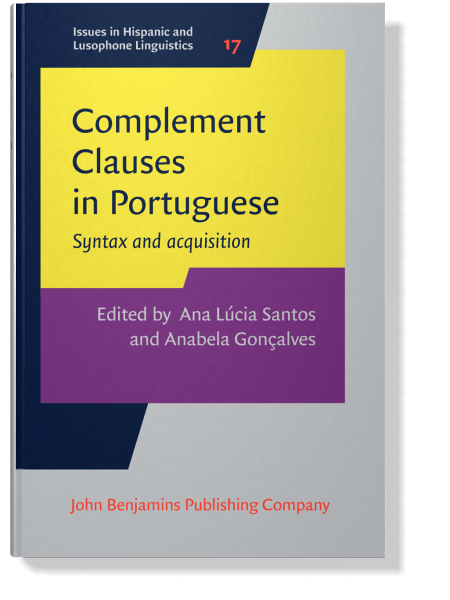
In:Complement Clauses in Portuguese: Syntax and acquisition
Edited by Ana Lúcia Santos and Anabela Gonçalves
[Issues in Hispanic and Lusophone Linguistics 17] 2018
► pp. 29–58
Control of inflected infinitives in European Portuguese
Published online: 16 August 2018
https://doi.org/10.1075/ihll.17.02she
https://doi.org/10.1075/ihll.17.02she
This chapter considers the distribution of inflected infinitives in European Portuguese (EP), with a particular emphasis on (exhaustive and partial) obligatory control (OC) contexts. It is shown, by means of large-scale survey data, that all EP speakers accept both inflected and uninflected infinitives in OC contexts but with substantial micro-parametric variation. An analysis is proposed whereby there are two distinct kinds of OC in EP, one derived via movement (Hornstein, 1999) and one resulting from Agree plus failed movement. Points of micro-parametric variation concern: the kind of non-finite clause selected for by various matrix predicates, patterns of obviation, and the precise way in which the thematic feature [D: ] is valued.
Keywords: partial control, exhaustive control, obviation, agree, phases
Article outline
- 1.Introduction
- 2.The distribution of inflection in control contexts
- 3.But is this really obligatory control?
- 4.Challenges for existing theories of control
- 5.Towards an analysis
- 5.1The proposal
- 5.2Covert comitatives
- 5.3Obviation
- 6.Conclusions
Acknowledgements Notes References

References (63)
Ambar, M. (1994). ‘Aux-to-Comp’ and lexical restrictions on verb movement. In G. Cinque, J. Koster, J.-Y. Pollock, L. Rizzi, & R. Zanuttini (Eds.), Paths towards universal grammar (pp. 1–24). Washington, DC: Georgetown University Press.
Andersson, L-G. (1975). Form and function of subordinate clauses (Unpublished PhD dissertation). Gothenburg University.
Andrews, A. D. (1971). Case agreement of predicate modifiers in Ancient Greek. Linguistic Inquiry, 2, 127–151.
(1976). The VP-complement analysis in Modern Icelandic. In J. Maling & A. Zaenen (Eds.), NELS 6 – Proceedings of the 6th meeting of the North Eastern Linguistic Society (pp. 1–21). Amherst, MA: GLSA.
Baker, M. C. (1988). Incorporation: A theory of grammatical function changing. Chicago: University of Chicago Press.
(1997). Thematic roles and syntactic structure. In L. Haegeman (Ed.), Elements of grammar (pp. 73–137). Dordrecht: Kluwer.
Barbosa, P. (2009). A case for an Agree-based theory of control.
11th Seoul International Conference on Generative Grammar Proceedings
, 101–123. Available at <[URL]>
Bobaljik, J., & Landau, I. (2009). Icelandic Control is not A-movement: The case from Case. Linguistic Inquiry, 40, 113–132.
Boeckx, C., Hornstein, N., & Nunes, J. (2010). Control as movement. Cambridge: Cambridge University Press.
(2000). Minimalist inquiries. In R. Martin, D. Michaels, & J. Uriagereka (Eds.), Step by step: Essays on minimalist syntax in honor of Howard Lasnik (pp. 89–155). Cambridge, MA: The MIT Press.
(2001). Derivation by phase. In M. Kenstowicz (Ed.), Ken Hale: A life in language (pp. 28–53). Cambridge, MA: The MIT Press.
Constantini, F. (2005). Subjunctive obviation: An interface perspective (Unpublished PhD dissertation). Università Ca’ Foscari Venezia.
Fiéis, A., & Madeira, A. (2012). Predicados de controlo na diacronia do português. In A. Costa, C. Flores, & N. Alexandre (Eds.), Textos selecionados do XXVII Encontro Nacional da Associação Portuguesa de Linguística (pp. 271–284). Lisboa: Associação Portuguesa de Linguística.
Gonçalves, A., Santos, A. L., & Duarte, I. (2014). (Pseudo-)Inflected infinitives and Control as Agree. In K. Lahousse & S. Marzo (Eds.), Romance languages and linguistic theory (pp. 161–180). Amsterdam: John Benjamins.
Grano, T. (2012). Control and restructuring at the syntax-semantics interface (Unpublished PhD dissertation). University of Chicago.
Kempchinsky, P. (2009). What can the subjunctive disjoint reference effect tell us about the subjunctive. Lingua, 119, 1788–1810.
Landau, I. (2000). Elements of control: Structure and meaning in infinitival constructions. Dordrecht: Kluwer.
(2004). The scale of finiteness and the calculus of Control. Natural Language and Linguistic Theory, 22, 811–877.
(2008). Two routes of control: Evidence from case transmission in Russian. Natural Language and Linguistic Theory, 26, 877–924.
Ledgeway, A. (1998). Variation in the Romance infinitive: The case of the Southern Calabrian inflected infinitive. Transactions of the Philological Society Volume, 96(1), 1–61.
Luján, M. (1978). Clitic promotion and mood in Spanish verbal complements. Montreal Working Papers in Linguistics, 10, 103–190.
Madeira, A. (1994). On the Portuguese inflected infinitive. UCL Working Papers in Linguistics, 6, 179–203.
Martins, A. M. (2000). A minimalist approach to clitic climbing. In J. Costa (Ed.), Portuguese syntax (pp. 169–190). Oxford: Oxford University Press.
Maurer Júnior, T. H. (1968). O infinito flexionado português. São Paulo: Companhia Editora Nacional.
McFadden, T., & Sundaresan, S. (2014). Finiteness in South Asian languages: An introduction. Natural Language and Linguistic Theory, 32, 1–28.
Modesto, M. (2010). What Brazilian Portuguese says about Control: Remarks on Boeckx & Hornstein. Syntax, 13, 78–96.
Picallo, C. (1985). Opaque domains (Unpublished PhD dissertation). City University of New York.
Pires, A. (2006). The minimalist syntax of defective domains: Gerunds and infinitives. Amsterdam: John Benjamins.
Quicoli, A. C. (1996). Inflection and parametric variation: Portuguese vs. Spanish. In R. Freidin (Ed.), Current issues in comparative grammar (pp. 46–80). Dordrecht: Kluwer.
Rabelo, P. C. (2010). Argumentos nulos no português do Brasil em contextos oracionais finitos e infinitivos (Unpublished PhD dissertation). Universidade de Brasília.
Raposo, E. (1985). Some asymmetries in the Binding Theory in Romance. The Linguistic Review, 5, 75–110.
(1987). Case Theory and Infl-to-Comp: The inflected infinitive in European Portuguese. Linguistic Inquiry, 18, 85–109.
(1989). Prepositional infinitival constructions in European Portuguese. In O. Jaeggli & K. Safir (Eds.), The null subject parameter (pp. 277–305). Dordrecht: Kluwer.
Rodrigues, C. (2007). Agreement and flotation in partial and inverse partial Control configurations. In W. D. Davies & S. Dubinsky (Eds.), New horizons in the analysis of control and raising (pp. 213–229). Dordrecht: Springer.
Rodrigues, C., & Hornstein, N. (2013). Epicene agreement and inflected infinitives when the data is “under control”: A reply to Modesto (2010). Syntax, 16(3), 292–309.
Schlenker, P. (2005). The Lazy Frenchman’s approach to the subjunctive (speculations on reference to worlds, presuppositions, and semantic defaults in the analysis of mood). In T. Geerts, I. van Ginneken, & H. Jacobs (Eds.), Romance Languages and Linguistic Theory 2003 (pp. 269–309). Amsterdam: John Benjamins.
Sheehan, M. (2012). A new take on partial control: Defective thematic intervention. Cambridge Occasional Papers in Linguistics, 6, 1–47.
(2014a). Partial Control in Romance Languages: The covert comitative analysis. In K. Lahousse & S. Marzo (Eds.), Romance languages and linguistic theory (pp. 181–198). Amsterdam: John Benjamins.
(2014b). Portuguese, Russian and the theory of control. In H. Huang, E. Poole, & A. Rysling (Eds.), Proceedings of the 43rd annual meeting of the North East Linguistic Society 43 (NELS 43) (Vol. 2, pp. 115–126). Amherst, MA: GLSA.
Sitaridou, I. (2002). The synchrony and diachrony of Romance infinitives with nominative subjects (Unpublished PhD dissertation). University of Manchester.
(2007). Romance infinitives with subjects, subjunctive obviation and Control Theory. In L. Eguren & O. Fernández Soriano (Eds.), Coreference, modality, and focus: Studies on the syntax-semantics interface (pp. 191–236). Amsterdam: John Benjamins.
Sundaresan, S. (2014). Making sense of silence: Finiteness and the (OC) pro vs. pro distinction. Natural Language and Linguistic Theory, 32(1), 59–85.
Sundaresan, S., & McFadden, T. (2009). Subject distribution in Tamil and other languages: Selection vs. case. Journal of South Asian Linguistics, 2(1), 5–34.
Suñer, M. (1980). Clitic promotion in Spanish revisited. In F. Neussel (Ed.), Contemporary studies in Romance languages (pp. 300–330). Bloomington, IN: Indiana University Linguistics Club.
(1986). On the referential properties of embedded finite clause subjects. In I. Bordelois, H. Contreras, & K. Zagona (Eds.), Generative studies in Spanish syntax (pp. 183–196). Dordrecht: Foris.
Szabolcsi, A. (2009). Overt nominative subjects in infinitival complements cross-linguistically: Data, diagnostics, and preliminary analyses. NYU Working Papers in Linguistics, 2, 1–54.
Tsoulas, G. (1996). The nature of the subjunctive and the formal grammar of obviation. In K. Zagona (Ed.), Grammatical theory and Romance languages (pp. 293–306). Amsterdam: John Benjamins.
Van Urk, C. (2010). On obligatory control: A movement and PRO approach (Unpublished manuscript). MIT.
Cited by (7)
Cited by seven other publications
Rastelli, Stefano, Giada Antonicelli, Beatrice Iaria, Pietro Mingardi & Francesca Pagliara
2025. Adult second language acquisition under negligible exposure and no instruction. Journal of Second Language Studies
Barbosa, Pilar
2021. Alleged obligatorily controlled inflected infinitives. In Non-canonical control in a cross-linguistic perspective [Linguistik Aktuell/Linguistics Today, 270], ► pp. 35 ff.
Ledgeway, Adam
2021. The syntactic distribution of raddoppiamento fonosinttatico in Cosentino. In Romance Languages and Linguistic Theory 2017 [Current Issues in Linguistic Theory, 355], ► pp. 205 ff.
Rivas, Javier & Esther L. Brown
Santos, Ana Lúcia
2021. Some thoughts on (the acquisition of) control. In L1 Acquisition and L2 Learning [Language Acquisition and Language Disorders, 65], ► pp. 83 ff.
Sheehan, Michelle, Jeffrey Blokzijl & M. Carmen Parafita Couto
2020. Inflected infinitives in Galician. In Romance Languages and Linguistic Theory 16 [Romance Languages and Linguistic Theory, 16], ► pp. 259 ff.
This list is based on CrossRef data as of 12 december 2025. Please note that it may not be complete. Sources presented here have been supplied by the respective publishers. Any errors therein should be reported to them.