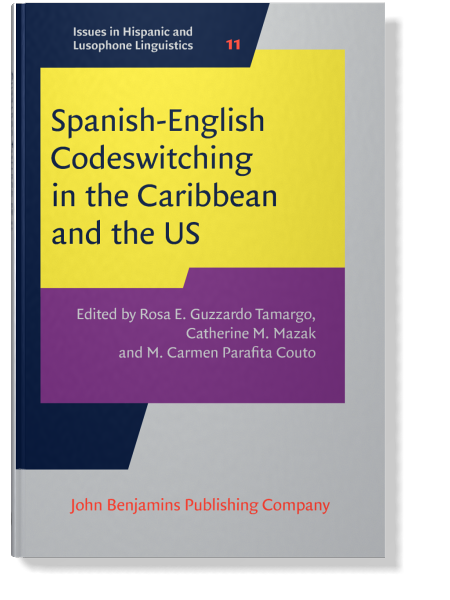
In:Spanish-English Codeswitching in the Caribbean and the US
Edited by Rosa E. Guzzardo Tamargo, Catherine M. Mazak and M. Carmen Parafita Couto
[Issues in Hispanic and Lusophone Linguistics 11] 2016
► pp. 11–35
Spanglish
Language politics vs el habla del pueblo
Published online: 7 September 2016
https://doi.org/10.1075/ihll.11.01zen
https://doi.org/10.1075/ihll.11.01zen
Puerto Rico has been linked to Spanglish – both the style of speaking and the label – since the term was coined by a famous island detractor in 1948. More recently, Puerto Rican poets and linguists have been in the vanguard against purported “friends” unaware of the linguistic facts, against the Real Academia Española’s definition of “espanglish”, and the damaging views of the North American Academy of the Spanish language. An anthro-political linguistic analysis explains how the racialization of Puerto Ricans and other Latin@s is at the root of these attacks, and why the Spanglish label itself must be defended; supporting data include the attitudes of 115 U.S. Spanish speakers. Implications for linguistic tolerance, language loss, and education are addressed.

References (65)
American Anthropological Association. (2011, May 2). American Anthropological Association spurs elimination of “linguistically isolated” as classification by the U.S. Census Bureau [Press release]. Retrieved from <[URL]>
Annie. (2011, August 26). [Blog comment]. Retrieved from <[URL]>
Baron, D. (1990). The English-only question: An official language for Americans? New Haven, CT: Yale University Press.
Baugh, J. (2000). Beyond Ebonics: Linguistic pride and racial prejudice. New York, NY: Oxford University Press.
Bilingual education. (n.d.). In Wikipedia. Retrieved from <[URL]>
Calduch, J. <[URL]> (10 September, 2014).
Ceruti, E. (2012). La heteroglosia en la poética bilingüe de la diáspora puertorriqueña. Macabéa Revista Eletrônica do Netlli, Crato, 1(2), 293–320.
CollectiveCheckup. (2012, January 25). Newt Gingrich: Spanish is language of the ghetto (… nd Ron Paul is supposed to be the racist?) [Video file]. Retrieved from <[URL]>
Crawford, J. (2012). Language legislation in the U.S.A. Retrieved from <[URL]>
Del Valle, J. (Ed.) (2014a). A political history of Spanish: The making of a language. Cambridge: Cambridge University Press.
. (Ed.) (2014b). Carta inútil a la RAE y Asale sobre “espanglish.” Retrieved from <[URL]>
Del Valle, J., & Zentella, A.C. (2014). Lengua, política y la RAE. Revista Cronopio, 55. Retrieved from <[URL]>
Dumitrescu, D. (2013). Lo que es y lo que no es: Una nota sobre el espanglish. RANLE, 2(4), 353–361.
El Nasser, H. (2003, June19). 39 million make Hispanics largest U.S. minority group. USA Today. Retrieved from <[URL]>
Espinosa, A. (1917). Speech mixture in New Mexico. In Panama-Pacific Historical Congress (1915): The Pacific Ocean in history. New York, NY: Macmillan.
Falcón, S. (2004). Spanish, English, and intellectuals in Puerto Rico (Unpublished doctoral dissertation). Georgetown University.
García, O., Kleifgen J.A., & Falchi, L. (2008). From English language learners to emergent bilinguals. Equity Matters: Research Review No. 1. New York, NY: Teachers College, Columbia University.
García, O., & Otheguy, R. (2014). Spanish and Hispanic bilingualism. In M. Lacorte (Ed.), The Routledge Handbook of Hispanic Applied Linguistics (pp. 639–658). New York, NY: Routledge.
Garsd, J. (2012, August 10). Puedes believe it? Spanglish gets in el dictionary. NPR. Retrieved from <[URL]>
Gonzalez Echevarría, R. (1997, March 28). Is “Spanglish” a language? The New York Times. Retrieved from <[URL]>
Heller, M. (1999). Linguistic minorities and modernity: A sociolinguistic ethnography. New York: Longman.
Lipski, J. (1985). Linguistic aspects of Spanish-English language switching. Tempe, AZ: Arizona State University, Center for Latin American Studies.
Lipski, J.M. (2007). The evolving interface of U.S. Spanish: Language mixing as hybrid vigor. Retrieved from <[URL]>
Lynch, A., & Potowski, K. (2014). La valoración del habla bilingüe en los Estados Unidos: Fundamentos sociolingüísticos y pedagógicos en Hablando bien se entiende la gente
. Hispania, 97(1), 32–46.
Lynch, G.C. (2013, October 22). Te llamo pa’trás: El español que están creando los “hispanounidenses.” Ñ. Retrieved from <[URL]>
McWilliams, C. (1948). North from Mexico: The Spanish-speaking people of the United States (2nd ed.). New York, NY: Greenwood Press.
Otheguy, R. (2008). El llamado espanglish. In H. López Morales (Ed.), Enciclopedia del español en los Estados Unidos (pp. 222–246). Madrid: Instituto Cervantes Santillana.
Otheguy, R., & Stern, N. (2010). On so-called Spanglish. International Journal of Bilingualism, 15(1), 85–100.
. (2013). Scholars and citizens: Judging the unfortunate term “Spanglish.” (Response to “Is Spanglish a bad term?”) Anthropology News, 54(12).
Pavlenko, A. (2002). “We have room for but one language here”: Language and national identity in the U.S. at the turn of the 20th century. Multilingua, 21, 163–196.
Payazaro (2011, February 13). Parkear (parquear) vs. estacionar [Blog]. Spanglish Blog. Retrieved from <[URL]>
Piña Rosales, G., Covarrubias, J., Segura, J., & Fernández, D. (Eds.) (2010). Hablando bien se entiende la gente: Consejos de la ANLE para mejorar su español. New York, NY: ANLE.
Piña Rosales, G., Covarrubias, J., & Dumitrescu, D. (Eds.) (2014). Hablando bien se entiende la gente 2: Consejos de la ANLE para mejorar su español. New York, NY: ANLE.
Poplack, S. (1980). Sometimes I’ll start a sentence in Spanish y termino en español: Toward a typology of code-switching. Linguistics, 18, 581–618.
Potowski, K. (2011). Conversaciones escritas: Lectura y redacción en contexto. Hoboken NJ: John Wiley & Sons.
Real Academia Española. (n.d.). Espanglish. Retrieved from <[URL]>
. (2010). Nueva gramática de la lengua española. Madrid: Espasa-Calpe. <[URL]>
. La política lingüística panhispánica. <[URL]> (23 August, 2012).
Romero, I. (2011, November 15). Salvador Tió’s 100th anniversary. Repeating Islands. Retrieved from <[URL]>
Rosa, J.D. (2014). Learning ethnolinguistic borders: Language and diaspora in the socialization of U.S. Latinas/os. In R. Rolon-Dow & J.G. Irizarry (Eds.), Diaspora studies in education: Toward a framework for understanding the experiences of transnational communities (pp. 39–60). Bern: Peter Lang.
Saiz, E. (2013, April 5). Si resurgen movimientos hispanófobos, el español en EE UU correrá peligro. El País. Retrieved from <[URL]>
San Diego Union Tribune (2008, September 24). Readers’ comments in response to Languages fill the melting pot, by L. Berestein & D. Cervantes. <[URL]> (18 November, 2008).
Silva-Corvalán, C., & Potowski, K. (2009). La alternancia de códigos. In H. López Morales (Ed.), Enciclopedia del Español en los Estados Unidos (pp. 272–276). Madrid: Instituto Cervantes Santillana.
Spanglish. (n.d.). In Urban Dictionary. Retrieved from <[URL]>
. (n.d.). In Wikipedia. Retrieved from <[URL]>
Tió, S. (1948, October 28). Teoría del Espanglish. Diario de Puerto Rico, p. 5. Retrieved from <[URL]>
. (1992). Desde el tuétano. Comisión Puertorriqueña para la Celebración del Quinto Centenario del Descubrimiento de América y Puerto Rico.
Toribio, A.J. (2001). Accessing Spanish-English code-switching competence. International Journal of Bilingualism, 5(4), 403–436.
Urciuoli, B. (1997). Exposing prejudice: Puerto Rican experiences of language, race, and class. Boulder CO: Westview Press.
. (2011). Semiotic properties of racializing discourse. Journal of Linguistic Anthropology, 21(Suppl. 1), E113–E122.
Zentella, A.C. (1995). The “chiquita-fication” of U.S. Latinos and their languages, or Why we need an anthro-political linguistics. SALSA III: The Proceedings of the Symposium about Language and Society at Austin (pp. 1–18). Austin, TX: Department of Linguistics.
. (1999). Language planning/policy and US colonialism: The Puerto Rican thorn in English-only’s side. In T. Huebner & K. Davis (Eds.), Sociopolitical perspectives on language policy and planning in the USA (pp. 155–171). Amsterdam: John Benjamins.
. (Ed.) (2005). Building on strength: Language and literacy in Latin@ families, schools, and communities. New York, NY: Teachers’ College Press.
. (2013). Bilinguals and borders: California’s transfronteriz@s and competing constructions of bilingualism. International Journal of the Linguistic Association of the Southwest, 32(2).
Cited by (10)
Cited by ten other publications
Diaz-Davalos, Gabriela
Lawrence, Patrick Eklund
2025.
No es correcto y me da mucha risa
. In Interdisciplinary Approaches to Romance Linguistics [Issues in Hispanic and Lusophone Linguistics, 45], ► pp. 240 ff.
Lawrence, Anna & Aris Clemons
Pérez-Sabater, Carmen
Clemons, Aris Moreno & Almeida Jacqueline Toribio
Semenova, Marina, D. Rudoy, A. Olshevskaya & N. Ugrekhelidze
Cox, Jessica G., Ashley LaBoda & Najee Mendes
Vande Casteele, An & Lauren Dethier
Varra, Rachel
2018. Reviving the unicorn. In Questioning theoretical primitives in linguistic inquiry [Studies in Functional and Structural Linguistics, 76], ► pp. 209 ff.
This list is based on CrossRef data as of 12 december 2025. Please note that it may not be complete. Sources presented here have been supplied by the respective publishers. Any errors therein should be reported to them.