Article published In: Information Design Journal
Vol. 29:2 (2024) ► pp.92–107
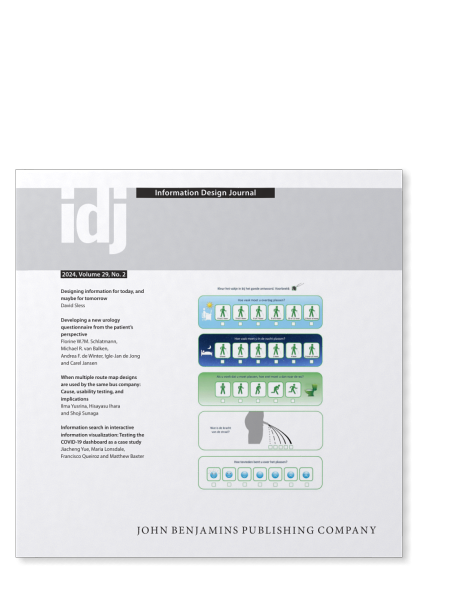
Developing a new urology questionnaire from the patient’s perspective
Published online: 6 March 2025
https://doi.org/10.1075/idj.24004.sch
https://doi.org/10.1075/idj.24004.sch
Abstract
In this qualitative study a new urology questionnaire to assess Lower Urinary Tract Symptoms (LUTS) in men was incrementally developed. The patient’s perspective was always paramount. Thirty-seven male participants aged 40 and over with different levels of health literacy completed several versions of the new questionnaire. Participants were asked to think aloud while completing the task. Participants’ utterances and comments in a follow-up interview were used to create improved versions of the questionnaire. The final version was the Dutch Reduced Illustrated Prostate Symptom Score (DRIPSS), a questionnaire consisting of pictorial scales. Participants’ feedback suggests that the DRIPSS will largely eliminate patients’ completion problems.
Article outline
- 1.Introduction
- 2.Method
- 2.1Study design
- 2.2Materials
- 2.3Participants and setting
- 2.4The working-aloud method
- 2.5Procedure
- 2.6Data analysis
- 2.7Characteristics of the investigators
- 3.Results
- 3.1First round
- 3.2Second round
- 3.3Third round
- 3.4Fourth round
- 4.Discussion
- 4.1Strengths and limitations
- 4.2Implications for research
- 5.Conclusion
- Acknowledgements
References

References (38)
American Urological
Association (2023). Management of lower urinary tract symptoms attributed to
benign prostatic hyperplasia: AUA guideline. Accessed 18 March 2024). Available at: [URL]
Arcia, A., Pho, A. T., Lor, M., & Bakken, S. (2023). Comparison
of newest vital sign and brief health literacy screen scores in a large, urban Hispanic
cohort. Patient Education and
Counseling, 1091: 107628.
Cam, K., Senel, F., Akman, Y., & Erol, A. (2003). The
efficacy of an abbreviated model of the International Prostate Symptom Score in evaluating benign prostatic
hyperplasia. BJU
International, 91(3), 186–189.
Ceylan, Y., Gunlucoy, B., Degirmency, T., Kozacioglu, Z., Bolat, D., & Minareci, S. (2015). Is
new visual prostate symptom score useful as International Prostate Symptom Score in the evaluation of men with lower
urinary tract symptoms? A prospective comparison of 2 symptom scores in Turkish
society. Urology, 85(3), 653–657.
Chawla, A., & Gali, K. V. (2024). Using
pictures instead of words: visual-validated questionnaires for LUTS and neurogenic
bladder. Current Bladder Dysfunction
Reports, 19(1), 27–36.
Chew, L. D., Bradley, K. A., & Boyko, E. J. (2004). Brief
questions to identify patients with inadequate health literacy. Family
medicine, 36(8), 588–594.
Chew, L. D., Griffin, J. M., Partin, M. R., Noorbaloochi, S., Grill, J. P., Snyder, A., Bradley, K. A., Nugent, S. M., Baines, A. D., & VanRyn, M. (2008). Validation
of Screening Questions for Limited Health Literacy in a Large VA Outpatient
Population. Journal of General Internal
Medicine, 23(5), 561–566.
Cooke, L. (2010). Assessing
concurrent think-aloud protocol as a usability test method: a technical communication
approach. IEEE transactions on professional
communication, 53(3), 202–215.
Descazeaud, A., Coloby, P., Davin, J. L., De la Taille, E. A., Karseny, G., Kouri, G., Rossi, D., Pouteau, J. C., & Zerbib, M. (2017). Validation
of Visual Prostate Symptom Score, VPSS, in the evaluation of lower urinary tract symptoms associated with benign prostatic
hyperplasia (550 patients). Progres en
urologie, 27(3), 176–183.
European Association of
Urology (2023). Guideline management of non-neurogenic male
LUTS. Accessed 18 March
2024) Available at: [URL]
Fan, M., Shi, S., & Truong, K. N. (2020). Practices
and challenges of using think-aloud protocols in industry: an international
survey. Journal of User
Experience, 15(2), 85–102. URL: [URL]
Fransen, M. P., Van Schaik, T. M., Twickler, T. B., & Essink-Bot, M. L. (2011). Applicability
of internationally available health literacy measures in the Netherlands. Journal
of health
communication 16(3), 134–149.
Frohlich, D. M. (1986). On
the organization of form-filling behaviour. Information Design
Journal, 5(1), 43–59.
(1987). On
the re-organisation of form-filling behaviour in an electronic medium. Information
Design
Journal, 5(2), 111–128.
HLS-EU
Consortium (2012). Comparative report of health literacy in
eight EU member states. The European Health Literacy Survey
HLS-EU (second revised and extended version, date July 22th, 2014).
Jansen, C. J. M. (2023). Using
a U-turn construction in information design (Editorial). Information Design
Journal, 28(3), 1–5.
Jansen, C. J. M., & Steehouder, M. (1989). Taalverkeersproblemen
tussen overheid en burger. [PhD
Thesis, SDU, Den Haag, The Netherlands].
(1992). Forms
as a source of communication problems. Journal of Technical Writing and
Communication, 22(2), 179–194.
Johnson, T. V., Goodman, M., & Master, V. A. (2007). The
efficacy of written screening tools in an inner city hospital: literacy based limitations on patient access to appropriate
care. The Journal of
urology, 178(2), 623–629.
Johnson, T. V., Abbasi, A., Ehrlich, S. S., Kleris, R. S., Schoenberg, E. D., Owen-Smith, A., Goodman, M., & Master, V. A. (2008). Patient
misunderstanding of the individual questions of the American Urological Association symptom
score. The Journal of
urology, 179(6), 2291–2294.
Koops van ’t Jagt, R., De Winter, A. F., Reijneveld, S. A., Hoeks, J. C. J., & Jansen, C. J. M. (2016). Development
of a communication intervention for older adults with limited health literacy: photo stories to support doctor–patient
communication. Journal of Health
Communication 21(2), 69–82.
Kutner, M., Greenberg, E., Jin, Y., & Paulsen, C. (2006). The
health literacy of America’s adults: results from the 2003 national assessment of adult
literacy. U.S. Department of Education. Washington, DC. National Center for Education
Statistics 2006–483. URL: [URL]
Lonsdale, M. D. S. (2022). Information
visualisation: from theory, to research, to practice… and back. Sage Publications Limited.
MacDiarmid, S. A., Goodson, T. C., Holmes, T. M., Martin, P. R., & Doyle, R. B. (1998). An
assessment of the comprehension of the American Urological Association Symptom
Index. The Journal of
urology, 159(3), 873–874.
Mantwill, S., Allam, A., Camerini, A. L., & Schulz, P. J. (2018). Validity
of three brief health literacy screeners to measure functional health literacy — evidence from five different
countries. Journal of Health
Communication, 23(2), 153–161.
Netto Júnior, N. R., & De Lima, M. L. (1995). The
influence of patient education level on the International Prostatic Symptom
Score. The Journal of
urology, 154(1), 97–99.
Nutbeam, D., & Bauman, A. (2006). Evaluation
in a nutshell: a practical guide to the evaluation of health promotion
programs. Sydney: McGraw-Hill.
Pianosi, P., Smith, C. P., Almudevar, A., & McGrath, P. J. (2006). Dalhousie
dyspnea scales: Pictorial scales to measure dyspnea during induced
bronchoconstriction. Pediatric
Pulmonology 41(12), 1182–1187.
Roter, D. L., Rudd, R. E., Frantz, S. C., & Comings, J. P. (1981). Community-produced
materials for health education. Public Health
Reports, 96(2), 169–172.
Roy, A., Singh, A., Sidhu, D. S., Jindal, R. P., Malhotra, M., & Kaur, H. (2016). New
visual prostate symptom score versus International Prostate Symptom Score in men with lower urinary tract symptoms: a
prospective comparision in Indian rural population. Nigerian journal of
surgery, 22(2), 111–117.
Sauer, J., Baumgartner, J., Frei, N., & Sonderegger, A. (2021). Pictorial
scales in research and practice. A review. European
Psychologist, 26(2), 112–130.
Schlatmann, F. W. M., Van Balken, M. R., De Winter, A. F., De Jong, I.-J., & Jansen, C. J. M. (2022). How
do patients understand questions about lower urinary tract symptoms? A qualitative study of problems in completing
urological questionnaires. International Journal of Environmental Research and
Public
Health, 19(15), 9650.
Stagliano, V., & Wallace, L. S. (2013). Brief
health literacy screening items predict newest vital sign scores. Journal of the
American Board of Family
Medicine, 26(5), 558–565.
Taneja, Y., Ram, P., Kumar, S., Raj, K., Singh, C. K., Dhaked, S. K., & Jaipuria, J. (2017). Comparison
of visual prostate symptom score and International Prostate Symptom Score in the evaluation of men with benign prostatic
hyperplasia: a prospective study from an Indian population. Prostate
international, 5(4): 158–161.
Van den Haak, M. J., De Jong, M. D. T., & Schellens, P. J. (2009). Evaluating
municipal websites: a methodological comparison of three think-aloud
variants. Government Information
Quarterly, 26(1), 193–220.
Van der Walt, C. L., Groeneveld, A. E., Heyns, C. F., Edlin, R. S., & Van Vuuren, S. P. J. (2011). Prospective
comparison of a new Visual Prostate Symptom Score versus the International Prostate Symptom Score in men with lower
urinary tract
symptoms. Urology 781: 17–20.
Cited by (1)
Cited by one other publication
This list is based on CrossRef data as of 21 november 2025. Please note that it may not be complete. Sources presented here have been supplied by the respective publishers. Any errors therein should be reported to them.