Article published In: Information Design Journal
Vol. 29:1 (2024) ► pp.3–24
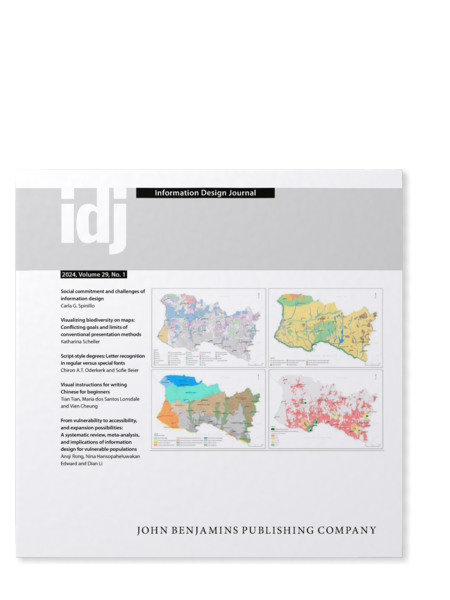
Visualizing biodiversity on maps
Conflicting goals and limits of conventional presentation methods
Published online: 27 May 2024
https://doi.org/10.1075/idj.23007.sch
https://doi.org/10.1075/idj.23007.sch
Abstract
Maps play a central role in the transfer of knowledge for biodiversity conservation. However, their production and reception contexts have not been sufficiently investigated so far. While critical cartography has demonstrated that maps are not objective representations of nature but are influenced by social conventions, these insights have not been fully reflected in ecological mapping practice. This paper draws on critical map theory and expands it with a critical evaluation of map visualization. By analyzing the design of biodiversity maps, our study demonstrates that the way biodiversity is visualized in maps does not adequately reflect the dynamics and interdependencies of natural systems, nor does it adequately reflect the species-specific needs. It is argued that design-led research provides relevant knowledge about evaluating maps in terms of their functionality as communication tools. This is of central importance if we wish to further develop ecological cartography and make it practicable and effective in its field of application.
Keywords: map design, biodiversity maps, visual analyses, critical cartography, ecology
Article outline
- 1.Introduction
- 2.The role of maps in the transfer of ecological knowledge
- 3.Critical takes on nature conservation mapping
- 4.Evaluation of biodiversity maps from the perspective of design research
- 4.1Theoretical foundation
- 4.2Synthesis and formal comparison
- 5.The design analysis of biodiversity maps
- 5.1Urban Tree Mapping
- 5.2Monitoring and inventory of species occurrences
- 5.3Spatial guidelines for future action
- 5.4Mapping ecosystem services
- 5.5Summing up
- 6.Towards new design approaches
- 7.Conclusion and further research
- Note
References Image credits

References (42)
Blaser, J., Gardi, O., Kern, M., Mack, S., Wiedemar, M., & Remund, J. (2016). Schlussbericht Urban Green & Climate Bern: Die Rolle und Bewirtschaftung von Bäumen in einer klimaangepassten Stadtentwicklung. Hochschule für Agrar-, Forst- und Lebensmittelwissenschaften HAFL, Bern.
Crampton, J. W., & Krygier, J. (2006). An Introduction to Critical Cartography. ACME: An International E-Journal for Critical Geographies, 4(1), 11–33.
Davies, H., Doick, K., Handley, P., O’Brien, L., & Wilson, J. (2017). Delivery of ecosystem services by urban forests. Forestry Commission Research Report. Forestry Commission.
Denil, M. (2003). Cartographic Design: Rhetoric and Persuasion. Cartographic perspectives, 451, 8–67.
Findeli, A. (2004). Die projektgeleitete Forschung: Eine Methode der Designforschung. In Swiss Design Network (Ed.), Erstes Design Forschungskolloquium (pp. 40–50). Swiss Design Network.
Gloor, S., & Göldi Hofbauer, M. (2018). Der ökologische Wert von Stadtbäumen bezüglich der Biodiversität. In D. Dujesiefken (Ed.), Jahrbuch der Baumpflege 2018 (1st ed.) (pp. 33–48). Haymarket Media.
Harris, L. M., & Hazen, H. D. (2006). Power of Maps: (Counter) Mapping for Conservation. ACME: An International E-Journal for Critical Geographies, 4(1), 99–130.
Kim, A. M. (2015). Sidewalk City: Remapping Public Space in Ho Chi Minh City. University of Chicago Press.
Koordinationsstelle BDM (2014). Biodiversitätsmonitoring Schweiz BDM. Beschreibung der Methoden und Indikatoren. Umwelt-Wissen Nr. 1410. Bundesamt für Umwelt.
Kowarik, I., Bartz, R., Brenck, M., & Naturkapital Deutschland – TEEB DE (Eds.) (2016). Ökosystemleistungen in der Stadt: Gesundheit schützen und Lebensqualität erhöhen. Technische Universität Berlin, Helmholtz-Zentrum für Umweltforschung – UFZ.
Maes, J., Zulian, G., Thijssen, M., Castell, C., Baró, F., Ferreira, A. M., Melo, J., Garrett, C. P., David, N., Alzetta, C.; Geneletti, D., Cortinovis, C., Zwierzchowska, I., Louro Alves, F., Souto Cruz, C., Blasi, C., Alós Ortí, M. M., Attorre, F., Azzella, M. M., Capotorti, G., Copiz, R., Fusaro, L., Manes, F., Marando, F., Marchetti, M., Mollo, B., Salvatori, E., Zavattero, L., Zingari, P. C., Giarratano, M. C., Bianchi, E., Duprè, E., Barton, D., Stange, E., Perez-Soba, M., van Eupen, M., Verweij, P., de Vries, A., Kruse, H., Polce, C., Cugny-Seguin, M., Erhard, M., Nicolau, R.; Fonseca, A., Fritz, M., & Teller, A. (2016). Mapping and Assessment of Ecosystems and their Services. Urban Ecosystems. Publications Office of the European Union.
Mose, J., & Strüver, A. (2009). Diskursivität von Karten – Karten im Diskurs. In G. Glasze & A. Mattissek (Eds.), Handbuch Diskurs und Raum: Theorien und Methoden für die Humangeographie sowie die sozial- und kulturwissenschaftliche Raumforschung (pp. 315–325). Transcript.
Peluso, N. L. (1995). Whose Woods are these? Counter-Mapping Forest Territories in Kalamantan, Indonesia. Antipode, 27(4), 383–406.
Rekacewicz, P. (26.03.2021). The Inspired Discipline: On Geography’s Search for New Mediums and Artistic Methods. Online symposium, mLAB, Geographisches Institut, Universität Bern. [author’s transcript]
Scheuermann, A. (2017). Die rhetorische Designanalyse und Buchanans ›Design-Argument‹ – am Beispiel des Lego Star Wars At-At Walker 4483. In W. Neuber, P. L. Oesterreich, G. Ueding, & F. Vidal (Eds.), Rhetorik. Ein internationales Jahrbuch. Band 36: Rhetorik im digitalen Zeitalter (pp. 109–127). De Gruyter.
Fig. 1, 2, 8
Source: Author
Fig. 3a
Naturnetz Pfannenstil (2022). Gemeinde Meilen, Vernetzungsplan [map]. In: [URL]
Fig. 3b
Knaus, F. (2015). Anzahl Arten mit hoher Schutzpriorität in der UBE [map]. In: Die räumliche Verteilung ökologischer, landschaftlicher und gesellschaftlicher Werte und Gefahren für diese Werte in der UNESCO Biosphäre Entlebuch. Interner Bericht, Biosphärenmanagement und ETH Zürich. p. 7. © ETH Zürich und UNESCO Biosphäre Entlebuch, © data: swisstopo and Kanton Luzern
Fig. 3c
Department of Economic, Social and Environmental Affairs of the Canton of Basel-Stadt, Office for the Environment and Energy, Coordination Office for Environmental Protection/Agriculture (Eds.) (2014). Zonenplan Perimeter Wiesental [map]. In: Vernetzungskonzept DZV Kanton Basel-Stadt. p. 12. © Geodata Basel-City. [URL]
Fig. 3d
Swiss Confederation (Ed.) (2021). Amphibians stationary objects [map]. In: [URL] © swisstopo, BAFU
Fig. 4a
Fig. 4b
Fig. 4c
Jonas Oesch (2022). Schutzgebiete und Zonen mit hoher Artenvielfalt im Kanton Zürich [map]. In: Titz, S. (2022, December 13). Biodiversität Schweiz: Der aktuelle Stand enttäuscht. Neue Zürcher Zeitung. [URL] © Info Flora und NZZ
Fig. 5
Geodata Basel-City (2023). Tree cadastre [map]. In: [URL]
Fig. 6
Geodata City of Bern, Amt für Geoinformation des Kantons Bern (2023). Baumkataster [map]. In: [URL]
Fig. 7
City of Zurich (2023). Tree cadastre [map]. In: [URL]
Fig. 9a
Geodata Basel-City (2021). Grasshoppers [map]. In: Cantonal inventory of nature conservation sites [URL]
Fig. 9b
Geodata Basel-City (2021). Butterflies [map]. In: Cantonal inventory of nature conservation sites [URL]
Fig. 10
Fig. 11