Article published In: Information Visualization
Edited by Isabel Meirelles, Marian Dörk and Yanni Loukissas
[Information Design Journal 27:1] 2022
► pp. 21–34
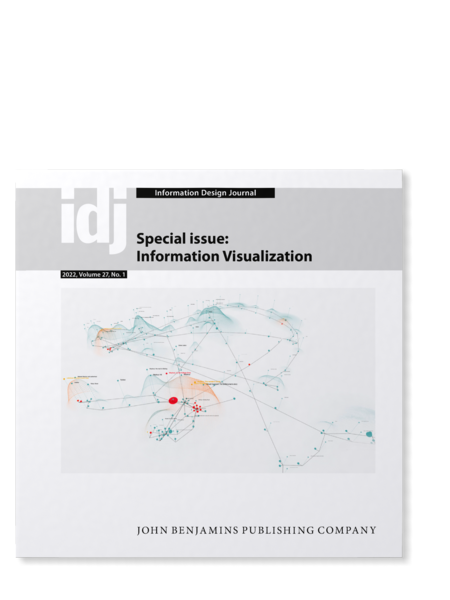
Surprise machines
Revealing Harvard Art Museums’ image collection
Available under the Creative Commons Attribution (CC BY) 4.0 license.
For any use beyond this license, please contact the publisher at rights@benjamins.nl.
Published online: 10 November 2022
https://doi.org/10.1075/idj.22013.rod
https://doi.org/10.1075/idj.22013.rod
Abstract
Surprise Machines is a project of experimental museology that
sets out to visualize the entire image collection of the Harvard Art Museums,
with a view to opening up unexpected vistas on more than 200,000 objects usually
inaccessible to visitors. The project is part of the exhibition organized by
metaLAB (at) Harvard entitled Curatorial A(i)gents and explores the limits of
artificial intelligence to display a large set of images and create surprise
among visitors. To achieve this feeling of surprise, a choreographic interface
was designed to connect the audience’s movement with several unique views of the
collection.
Article outline
- 1.Introduction
- 2.Harvard Art Museums
- 3.Can machines curate?
- 4.How to map 200,000 images
- 5.Designing a post-pandemic, choreographic interface
- 6.A substantial drawback
- 7.Conclusions
Bibliography

References (50)
American Museum of Natural History– American Museum of Natural History. (2022). Collectionscope [JavaScript]. [URL] (Original work published 2020)
Barabási, A.-L., Bello, M., Kluge-Fabényi, J., Forde, K., Készman, J., Meirelles, I., Ratti, C. G., Ritchie, M., & Szántó, A.– Barabási, A.-L., Bello, M., Kluge-Fabényi, J., Forde, K., Készman, J., Meirelles, I., Ratti, C. G., Ritchie, M., & Szántó, A. (2020). Hidden patterns: Visualizing networks at BarabásiLab (A. Stang & P. Weibel, Eds.). Hatje Cantz Verlag.
Benedetti, A.– Benedetti, A. (2022, January 5). Browsing and visualizing collections of images. [URL]
Birkle, C., & Däwes, B.– Birkle, C., & Däwes, B. (2019). “Old media don’t go away, they mutate”: An interview with Jeffrey
Schnapp. Amerikastudien/American Studies,
64
(1), 111–125.
Bludau, M.-J., Dörk, M., & Heidmann, F.– Bludau, M.-J., Dörk, M., & Heidmann, F. (2021). Relational perspectives as situated visualizations of art
collections. Digital Scholarship in the Humanities,
36
(Supplement_2), ii17–ii29.
Börner, K., Maltese, A., Balliet, R. N., & Heimlich, J.– Börner, K., Maltese, A., Balliet, R. N., & Heimlich, J. (2016). Investigating aspects of data visualization literacy using 20
information visualizations and 273 science museum visitors. Information Visualization,
15
(3), 198–213.
Bostock, M., Ogievetsky, V., & Heer, J.– Bostock, M., Ogievetsky, V., & Heer, J. (2011). D3: Data-Driven Documents. IEEE Transactions on Visualization and Computer Graphics,
17
(12), 2301–2309.
Champion, E. M.– Champion, E. M. (2016). Digital humanities is text heavy, visualization light, and
simulation poor. Digital Scholarship in the Humanities, i25–i32.
Crawford, K., & Paglen, T.– Crawford, K., & Paglen, T. (2019). Excavating AI: the politics of images in machine learning training
sets. AI Now Institute. [URL]
Crockett, D.– Crockett, D. (2019). IVPY: iconographic visualization inside computational
notebooks. International Journal for Digital Art History,
4
1, 3.60–3.79.
Cuno, J. B.– Cuno, J. B. (Ed.). (1996). Harvard’s art museums: 100 years of collecting. Harvard University Museums.
Derry, L., Kruguer, J., Muelle, M., & Schnapp, J.– Derry, L., Kruguer, J., Muelle, M., & Schnapp, J. (2022). Designing a choreographic interface during covid-19. Movement and Computing Conference.
Diagne, C., Barradeau, N., & Doury, S.– Diagne, C., Barradeau, N., & Doury, S. (2018). T-SNE Map. Experiments with Google. [URL]
DiMaggio, P., & Hargittai, E.– DiMaggio, P., & Hargittai, E. (2001). From the “digital divide” to “digital inequality”: Studying internet use
as penetration increases. Center for Arts and Cultural Policy Studies, Princeton University.
Drucker, J.– Drucker, J. (2013). Performative materiality and theoretical approaches to
interface. Digital Humanities Quarterly,
7
(1). [URL]
Duhaime, D.– Duhaime, D. (2021). PixPlot. Yale Digital Humanities Lab. [URL] (Original work published 2017)
Harvard Art Museums– Harvard Art Museums. (2012). International Image Interoperability Framework at Harvard
University. [URL]
Impett, L., & Moretti, F.– Impett, L., & Moretti, F. (2017). Totentanz. Operationalizing Aby Warburg’s
Pathosformeln. New Left Review,
107
1, 68–97.
Jacomy, M., Venturini, T., Heymann, S., & Bastian, M.– Jacomy, M., Venturini, T., Heymann, S., & Bastian, M. (2014). ForceAtlas2, a continuous graph layout algorithm for handy
network visualization designed for the Gephi software. PLoS ONE,
9
(6), e98679.
Jodidio, P.– Jodidio, P. (2014). Piano: Renzo Piano building workshop, complete works,
1966-today. Taschen.
Karjus, A., Solà, M. C., Ohm, T., Ahnert, S. E., & Schich, M.– Karjus, A., Solà, M. C., Ohm, T., Ahnert, S. E., & Schich, M. (2022). Compression ensembles quantify aesthetic complexity and the evolution of
visual art.
Kenderdine, S., Mason, I., & Hibberd, L.– Kenderdine, S., Mason, I., & Hibberd, L. (2021). Computational archives for experimental museology, 3–18.
Klinke, H.– Klinke, H. (2021, October 28). V-lab workshop: Visual analysis in cultural data – image plots and t-SNE
maps made easy. History of Art Department. [URL]
Kräutli, F.– Kräutli, F. (2016). Visualising cultural data: Exploring digital collections through
timeline visualisations. Royal College of Art.
Latour, B.– Latour, B. (1988). The pasteurization of France (A. Sheridan & J. Law, Trans.; English edition). Harvard University Press.
Lima, M.– Lima, M. (2011). Visual complexity: Mapping patterns of information. Princeton Architectural Press.
Maaten, L. van der, & Hinton, G.– Maaten, L. van der, & Hinton, G. (2008). Visualizing data using t-SNE. Journal of Machine Learning Research,
9
(86), 2579–2605. [URL]
Maizels, M., & Qiu, C.– Maizels, M., & Qiu, C. (Eds.). (2020). Curatorial A(i)gents. metaLAB (at) Harvard. [URL]
Manovich, L.– Manovich, L. (2008). Data visualization as new abstraction and
anti-sublime. In B. Hawk, D. M. Rieder, & O. O. Oviedo (Eds.), Small tech: The culture of digital tools. University of Minnesota Press.
McCully, E. A.– McCully, E. A. (2019). Dreaming in code: Ada Byron Lovelace, computer pioneer. Candlewick Press.
McInnes, L., Healy, J., & Melville, J.– McInnes, L., Healy, J., & Melville, J. (2018). UMAP: Uniform Manifold Approximation and Projection for dimension
reduction. ArXiv.Org, stat.ML. [URL]
metaLAB– metaLAB. (2022). MetaLAB (at) Harvard & FU Berlin. [URL]
Moon, C. Y. E., & Rodighiero, D.– Moon, C. Y. E., & Rodighiero, D. (2020). Mapping as a contemporary instrument for orientation in
conferences. Atti Del IX Convegno Annuale AIUCD. La Svolta Inevitabile: Sfide e
Prospettive per l’informatica Umanistica.
O’Shea, K., & Nash, R.– O’Shea, K., & Nash, R. (2015). An introduction to convolutional neural networks. ArXiv:1511.08458 [Cs]. [URL]
Pietsch, C.– Pietsch, C. (2022). VIKUS viewer [JavaScript]. [URL] (Original work published 2018)
Rodighiero, D.– Rodighiero, D. (2021a). Mapping affinities: Democratizing data visualization (Open-access English edition). Métis Presses.
Rodighiero, D.– Rodighiero, D. (2021b, August 18). Ars memorativa as the genesis of information design: A
conversation with Manuel Lima. Nightingale. [URL].
Rodighiero, D., Wandl-Vogt, E., & Carsenat, E.– Rodighiero, D., Wandl-Vogt, E., & Carsenat, E. (2021). Making visible the invisible work of scientists during the
Covid-19 pandemic. Visual Culture Studies,
2
1.
Rodighiero, D., Wandl-Vogt, E., & Carsenat, E.– Rodighiero, D., Wandl-Vogt, E., & Carsenat, E. (2022). A visual translation of the pandemic. Leonardo,
55
(3).
Russakovsky, O., Deng, J., Su, H., Krause, J., Satheesh, S., Ma, S., Huang, Z., Karpathy, A., Khosla, A., Bernstein, M., Berg, A. C., & Fei-Fei, L.– Russakovsky, O., Deng, J., Su, H., Krause, J., Satheesh, S., Ma, S., Huang, Z., Karpathy, A., Khosla, A., Bernstein, M., Berg, A. C., & Fei-Fei, L. (2015). Imagenet large scale visual recognition challenge. ArXiv:1409.0575 [Cs]. [URL].
Seguin, B.– Seguin, B. (2018). The Replica project: Building a visual search engine for art
historians. XRDS: Crossroads, The ACM Magazine for Students,
24
(3), 24–29.
Steward, J.– Steward, J. (2021). API documentation. Harvard Art Museums. [URL] (Original work published 2015)
Turing, A. M.– Turing, A. M. (1950). Computing machinery and intelligence. Mind,
LIX
(236), 433–460.
Vane, O.– Vane, O. (2019). Timeline design for visualising cultural heritage data. Royal College of Art.
Weaver, W.– Weaver, W. (1948). Science and complexity. American Scientist,
36
(4), 536–544. JSTOR. [URL]
Cited by (5)
Cited by five other publications
Felsing, Ulrike & Max Frischknecht
Takahira, Kentaro, Yue Yu, Takanori Fujiwara, Ryo Suzuki & Huamin Qu
Ambalavan, Ayisha Saniya & Ashwarya Chauhan
Dhaenens, Laurens & Frederik Truyen
This list is based on CrossRef data as of 11 december 2025. Please note that it may not be complete. Sources presented here have been supplied by the respective publishers. Any errors therein should be reported to them.