Article published In: Information Design Journal
Vol. 28:3 (2023) ► pp.275–302
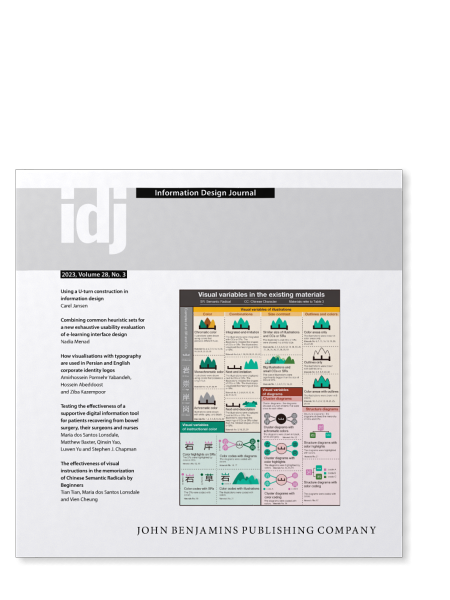
The effectiveness of visual instructions in the memorization of Chinese Semantic Radicals by Beginners
Published online: 27 November 2023
https://doi.org/10.1075/idj.21010.tia
https://doi.org/10.1075/idj.21010.tia
Abstract
The acquisition of Chinese Characters (CCs) is challenging for learners. Chinese Semantic Radicals (SRs) are semantic components of CCs. The memorization of SRs facilitates the acquisition of CCs when learning Chinese as a second language. This study investigates the effectiveness of Visual Instructions (VIs) in the memorization of SRs by beginners. A preliminary study and three other studies have been conducted. The results have shown that the use of color-coded illustrations helps learners remember the meanings, shapes, and positions of SRs. This could be seen in the significantly increased accuracy of the responses in memory tests. These findings are an important contribution to research on VIs and on the memorization of SRs by beginners.
Article outline
- 1.Introduction
- 2.Preliminary study
- 2.1Interview
- 2.1.1Method
- 2.1.2Findings
- 2.2Visual content audit
- 2.2.1Method
- 2.1Interview
- 3.Study A: Quasi-experimental study
- 3.1Method
- 3.1.1Participants
- 3.1.2Materials
- 3.1.3Procedure
- 3.2Results
- 3.1Method
- 4.Study B: Usability test
- 4.1Method
- 4.1.1Participants
- 4.1.2Materials
- 4.1.3Procedure
- 4.2Results
- 4.1Method
- 5.Study C: Experimental study
- 5.1Methods
- 5.1.1Participants
- 5.1.2Materials
- 5.1.3Procedure
- 5.2Results
- 5.1Methods
- 6.Conclusions and discussion
- 6.1Effective VIs for memorizing Chinese SRs
- 6.2Applications in the field of Information and Instructional Design
- 6.3Future research
- Acknowledgements
- Notes
References

References (90)
Akbari, O. (2008). Teaching vocabulary items through contextualization and picture to elementary Iranian EFL students. Asian EFL journal. 10(3), 53–77.
Aldalalah, M., Fong, S. F. and Ababneh, W. Z. (2010). Effects of multimedia-based instructional designs for Arabic language learning among pupils of different achievement levels. International Journal of Human and Social Sciences. 5(5), 311–317.
Ayres, P. and Sweller, J. (2005). The split-attention principle in multimedia learning. In Mayer, R. E. (Ed.), The Cambridge handbook of multimedia learning (pp.135–146). Cambridge University Press.
Banno, E., Ikeda, Y., Shinagawa, C., Tajima, K., & Tokashiki, K. (2009). Kanji Look and Learn. The Japan Times.
Bradshaw, A. C. (2003). Effects of presentation interference in learning with visuals. Journal of Visual Literacy, 23(1), 41–68.
Birzer, S. and Zinsmeister, H. (2016). The utility of colour markup in texts for learners of Russian. In: Proceedings of the 8th International Biannual Conference Applied Linguistics in Research and Education. (pp.139–145).
British Council (2013). Languages for the future. [URL]
(2017). Languages for the future. [URL]
Chandler, P., & Sweller, J. (1991). Cognitive load theory and the format of instruction. Cognition and Instruction, 8(4), 293–332.
(1992). The split-attention effect as a factor in the design of instruction. British Journal of Educational Psychology, 62(2), 233–246.
(1996). Cognitive load while learning to use a computer program. Applied Cognitive Psychology, 10(2), 151–170.
Chang, W. (2016). Chinese Radicals-Learn 102 High – frequency Radicals Quickly with Memory Tricks. Amazon Kindle.
Clark, J. M., & Paivio, A. (1991). Dual coding theory and education. Educational Psychology Review, 3(3), 149–210.
Confucius Institute (2022). Confucius Institute official website. [Online] [Accessed 20 August 2022]. Available from: [URL]
Curran, T., & Doyle, J. (2011). Picture superiority doubly dissociates the ERP correlates of recollection and familiarity. Journal of Cognitive Neuroscience, 23(5), 1247–1262.
Dave. (2014). CharacterPop. [URL]
Defeyter, M. A., Russo, R., & McPartlin, P. L. (2009). The picture superiority effect in recognition memory: A developmental study using the response signal procedure. Cognitive Development, 24(3), 265–273.
Digmandarin Team. (2013). DigMandarin. [URL]
Ferguson, K. (2013). GotCharacters. [URL]
Gombrich, E. (1990). Pictorial instructions. In Benlow, H., Blakemore, C. & Weston-Smith, M. (Eds.), Images and understanding (pp.26–45). Cambridge University Press.
Hirzel, J., Evan, Cathy, & Ivy. (2007). Lenaia. Learn Chinese Visually, Systematically and Easily with Lenaia. [URL]
Horn, R. E. (1999). Information design: Emergence of a new profession. In Jacobson, R. (Ed.), Information design (pp. 15–33). The MIT Press.
Kuo, M.-L. A. and Hooper, S. (2004). The effects of visual and verbal coding mnemonics on learning Chinese characters in computer-based instruction. Educational technology research and development. 52(3), 23–34.
Lai, F.-Q. and Newby, T. J. (2012). Impact of static graphics, animated graphics and mental imagery on a complex learning task. Australasian Journal of Educational Technology. 28(1), 91–104.
Li, Y. S., & Song, J. (2008). Chinese Radicals for Beginners-workbook. CreateSpace Independent Publishing Platform.
Lonsdale, M. D. S., & Lonsdale, D. (2019). Design2Inform: Information visualisation. The Office of the Chief Scientific Advisor, Gov UK.
Louie, B. and Sierschynski, J. (2015). Enhancing English learners’ language development using wordless picture books. The Reading Teacher. 69(1), 103–111.
Lü, C., Koda, K., Zhang, D., & Zhang, Y. (2015). Effects of semantic radical properties on character meaning extraction and inference among learners of Chinese as a foreign language. Writing Systems Research, 7(2), 169–185.
Matthews, A., & Matthews, L. (2007). Learning Chinese Characters: Volume. 1 (1st Ed.). Tuttle Publishing.
Mayer, R. E. (1993). Illustrations that instruct. Advances in Instructional Psychology, 41, 253–284.
Moreno, R., & Mayer, R. E. (2000). A learner-centered approach to multimedia explanations: Deriving instructional design principles from cognitive theory. Interactive Multimedia Electronic Journal of Computer-Enhanced Learning, 2(2), 12–20.
Nguyen, T. P., Zhang, J., Li, H., Wu, X., & Cheng, Y. (2017). Teaching Semantic Radicals Facilitates Inferring New Character Meaning in Sentence Reading for Nonnative Chinese Speakers. Frontiers in Psychology, 81(1846), 1–12.
Nielsen, J. 2000. Why You Only Need to Test with 5 Users. Nielsen Norman Group. [Online]. Available from: [URL]
Ninchanese Team. (2013). Ninchanese. Chinese character components. [URL]
Olurinola, O., & Tayo, O. (2015). Colour in Learning: Its Effect on the Retention Rate of Graduate Students. Journal of Education and Practice, 6(14), 1–5.
Oldendick, R. W. (2008). Ranking In: P. Lavrakas, ed. Encyclopedia of Survey Research Methods [Online]. California: Sage Publications, Inc. Available from: [URL]
Paivio, A. (1971). Imagery and language. In S. J. Segal (Ed.), Imagery current cognitive approaches (pp. 7–32). Academic Press.
Peck, K. L., & Hannafin, M. J. (1988). The design, development & evaluation of instructional software. Macmillan Publishing Co.
Peeck, J. (1993). Increasing picture effects in learning from illustrated text. Learning and instruction. 3(3), 227–238.
Peng, T. H. (2012). Fun with Chinese Characters 1: The Straits Times Collection 1. Master Communications, Inc.
Peter, T. (2013). Chinese Characters for Internet Users: First 100 simplified characters. iSrcibio!.
Pettersson, R. (1998). Information design and learning. In Vision Plus 05 (pp. 1–16). International Institute for Information Design.
Rowley, M. (1992). Kanji Pict-o-Graphix: Over 1,000 Japanese Kanji and Kana Mnemonics. Stone Bridge Press.
Sadoski, M., & Paivio, A. (2013). Imagery and text: A dual coding theory of reading and writing. Routledge.
Schriver, K. A. (1997). Dynamics in document design: Creating text for readers. John Wiley & Sons, Inc.
Shen, H. H., & Ke, C. (2007). Radical awareness and word acquisition among nonnative learners of Chinese. The Modern Language Journal, 91(1), 97–111.
Simlinger, P. (2007). IdX development of international core competencies and student and faculty exchange in information design within the EU/US cooperation program in higher education and vocational education and training. International Institute for Information Design.
Snyder, H. R. and Colón, I. (1988). Foreign Language Acquisition and Audio-Visual Aids. Foreign Language Annals. 21(4), 343–348.
Su, X., & Young-Suk, K. (2014). Semantic radical knowledge and word recognition in Chinese for Chinese as foreign language learners. Reading in a Foreign Language, 26(1), 131–152.
Szlichcinski, K. P. (1980). The syntax of pictorial instructions. In Bouma, H., Kolers, P. A. & Wrolstad, M. E. (Eds.), Processing of visible language 21 (pp. 113–124). Springer.
Taiwan Knowledge Bank Co. Ltd. (2012). Art of Chinese characters [English]. [URL]
Wang, J., Chen, H.-C., Radach, R., & Inhoff, A. (1999). Semantic radicals in phonetic compounds: Implications for visual character recognition in Chinese. In Reading Chinese script (pp. 31–48). Psychology Press.
Wang, L. (2014). The effects of single and dual coded multimedia instructional methods on Chinese character learning. Chinese as a Second Language Research. 3(1), 1–25.
Ward, M., & Sweller, J. (1990). Structuring effective worked examples. Cognition and Instruction, 7(1), 1–39.
Wichmann, F. A., Sharpe, L. T., & Gegenfurtner, K. R. (2002). The contributions of color to recognition memory for natural scenes. Journal of Experimental Psychology: Learning, Memory, and Cognition, 28(3), 509–520.
Wieger, L. (1965). Chinese characters; their origin, etymology, history, classification and signification; a thorough study from Chinese documents. Paragon Book Reprint Corp.
Winn, W. (1993). Perception principles. In Fleming, M. L. (Eds.) Instructional Message Design: Principles from the Behavioral and Cognitive Sciences (pp. 55–126). Educational Technology.
Xu, Y., Chang, L.-Y., & Perfetti, C. A. (2014). The effect of radical-based grouping in character learning in Chinese as a foreign language. The Modern Language Journal, 98(3), 773–793.