Article published In: Information Design Journal
Vol. 26:2 (2021) ► pp.105–123
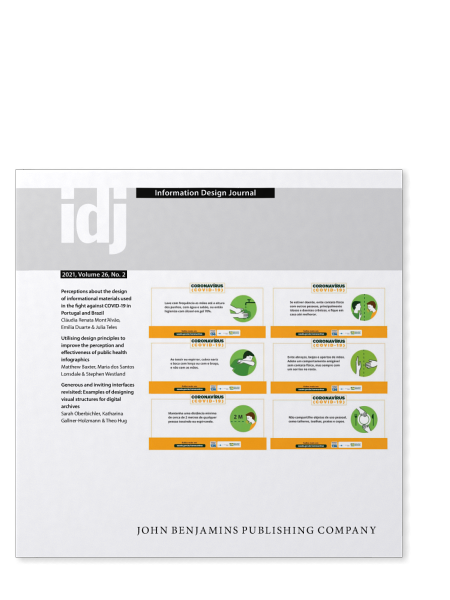
Perceptions about the design of informational materials used in the fight against COVID-19 in Portugal and Brazil
Published online: 13 September 2021
https://doi.org/10.1075/idj.20027.mon
https://doi.org/10.1075/idj.20027.mon
Abstract
This study aimed to assess perceptions on the graphical informational materials designed to help in the fight
against COVID-19 in Portugal and Brazil. We assessed the perceptions using an online survey incorporating the AttrakDiff2TM
questionnaire. The results show that the perception of risk with relation to the COVID-19 pandemic is high among the respondents,
and that they believe that they will have mild symptoms if infected by the virus. The results also show that the materials
available in these countries were poorly designed and not effective in promoting adequate behaviour change. These findings can
contribute to future design projects whose aim is to design risk communication materials to inform and guide people facing health
crisis situations.
Article outline
- 1.Introduction
- 2.Information design and its role during the pandemic
- 2.1From data to wisdom to DIKW
- 2.2Information design in emergency situations
- 3.Risk perception facing the pandemic
- 4.Cross-cultural survey: Portugal and Brazil
- 4.1Stimuli
- 4.2Procedure
- 4.3Participants
- 4.4Questionnaire
- 5.Results and discussion
- 5.1Emotional state
- 5.2Risk perception
- 5.3Search for information
- 5.4Demographic differences
- 5.5Familiarity with the informative materials
- 6.Conclusions
- Acknowledgements
References

References (23)
Dick, M. E. et al. (2017). Design
da informação e competência em informação: relações possíveis. Revista Brasileira de Design da
Informação, 17 (1), p. 1–13.
Dubb SS. Coronavirus pandemic: applying a
whole-of-society model for the whole-of-the world. Br J Oral Maxillofac
Surg (2020).
European Centre for Disease Prevention and
Control. COVID-19 situation updates worldwide, as
of July 17th 2020.
Frascara, J. (2000). Diseño
gráfico para la gente. Comunicaciones de masa y cambio social (2nd
ed.). Ediciones Infinito.
Hassenzahl, M. (2004). The
Interplay of Beauty, Goodness, and Usability in Interactive Products. Marc Human-Computer
Interaction, New York: Lawrence Erlbaum Associates Inc, vol 191, pp. 319–349.
Human Factors and Ergonomics
Society. (2020). Human Factors Science: Guidelines for Effective
Communication of COVID-19 Messages to the Public. [URL]
Huynh, T. L. D. (2020). ‘The
COVID-19 risk perception: A survey on socioeconomics and media attention’, Economics
Bulletin, v 40, Issue 1, 758–764.
Manzini, E. (2014). Design
in a changing, connected world. Strategic Design Research
Journal, 7(2): 95–99.
Laughery, K. R. & Wogalter, M. S. (2011). A
three-stage model summarizes product warning and environmental sign research. Safety
Science, 611:3–10.
Milenkovic, A. et al. (2020). Extensions
and adaptations of existing medical information system in order to reduce social contacts during COVID-19
pandemic. International Journal of Medical
Informatics 1411 (2020) 104–224.
Mukhtar, S. Psychological
health during the coronavirus disease 2019 pandemic
outbreak. (2020). International Journal of Social
Psychiatry, 1–5. [URL] [URL]
Nicomedes, C. J. C., Avila, R. M. A. (2020). An
Analysis on the Panic During COVID-19 Pandemic Through An Online Form. Journal of Affective
Disorders.
Pan, S. et al. (2020). Information
resource orchestration during the COVID-19 pandemic: A study of community lockdowns in
China. International Journal of Information
Management, 541 102–143.
Peters, E., Slovic, P. (2014). Risk
Perception and Affect. Current Directions in Psychological
Science 2006, 15 (6): 322–325. Sage Publications, NY, USA
Rowley, J. (2007). The
Wisdom Hierarchy: Representations of the DIKW hierarchy. Journal of Information
Science, 33 (2): 163–180. . Sage Publications, NY, USA.
SEF/GEPF, Serviço de Estrangeiros e
Fronteiras. (2020). Relatório de Imigração, Fronteiras e Asilo
2019. Barcarena: SEF. ISSN: 2183–2935. [URL]
Tran, B. X. et al. (2020). Coverage
of Health Information by Different Sources in Communities: Implication for COVID-19. Epidemic
Response Int. J. Environ. Res. Public Health
2020, 171, 3577;
Tromp, N. & Hekkert, P. (2019). Designing
for society. Products and Services for a Better
World. Bloomsbury.