Editorial published In: Information Design Journal
Vol. 29:3 (2024) ► pp.199–203
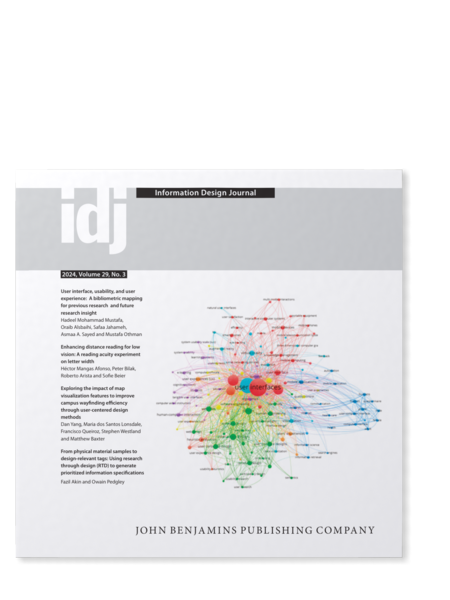
Editorial
Exploring problems of information design
The ties that bind us
This article is available free of charge.
Published online: 21 August 2025
https://doi.org/10.1075/idj.00022.sch
https://doi.org/10.1075/idj.00022.sch
Article outline
- 1.Commitment to evaluating what works
- 2.Use of multiple research methods
- 3.Concern with ethics and social justice
- 4.Curiosity about people as they engage with language — writing, visual design, typography
- 5.Seeing these ties in practice
- 5.1Analyzing publications about user-interface design and user-experience design to trace their growth
- 5.2Designing typography to improve distance reading for people with low vision
- 5.3Uncovering students’ needs for wayfinding maps on campus
- 5.4Designing specialized information for budding experts in industrial and product design
References

References (4)
De Jong, M., & Lentz, L. (1996). Expert judgments versus reader feedback: A comparison of text evaluation techniques. Journal of Technical Writing and Communication, 26(4), 507–519.
Schriver, K. A. (2012). What we know about expertise in professional communication. In V. W. Berninger (Ed.), Past, present, and future contributions of cognitive writing research to cognitive psychology (pp. 275–312). Psychology Press.
(2017). Plain language in the United States gains momentum: 1940–2015. IEEE Transactions on Professional Communication, 60(4), 343–383. [URL] Available: [URL]
Waller, R., van der Waarde, K., Schriver, K. A., Slabbert, C., & Cheek, A. (2025, June 5). Document design pattern library. International Plain Language Federation. [URL]