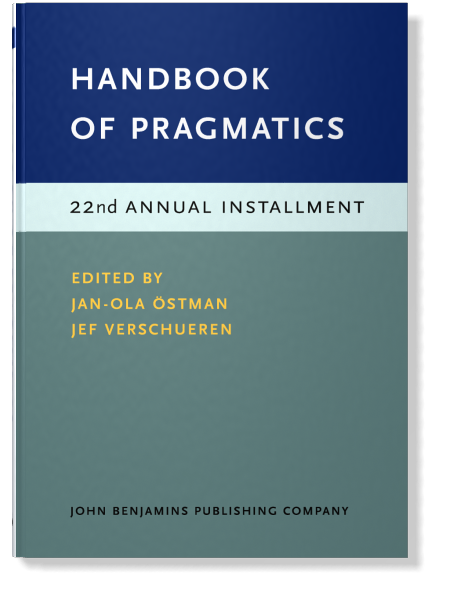
In:Handbook of Pragmatics: 22nd Annual Installment
Edited by Jan-Ola Östman and Jef Verschueren
[Handbook of Pragmatics 22] 2019
► pp. 93–114
Evidentiality
Published online: 23 December 2019
https://doi.org/10.1075/hop.22.evi1
https://doi.org/10.1075/hop.22.evi1
Article outline
- 1.Preliminaries
- 2.Modality and evidentiality
- 3.Information sources
- 4.Engagement, epistemic authority and right to know
- 5.Non-evidential uses of evidentials
- 6.Acquisition of evidentials
- 7.Summary
Abbreviations Notes References

References (51)
Aikhenvald, A. Y. 2003. “Evidentiality in Tariana.” In Studies in Evidentiality (Typological Studies in Language 54), ed. by Alexandra Y. Aikhenvald and R. M. W. Dixon, 131–164. Amsterdam/Philadelphia: John Benjamins.
Aikhenvald, A. Y. and R. M. W. Dixon. (eds.). 2003. Studies in Evidentiality. Amsterdam: John Benjamins.
Aksu-Koç, A. A. 1988. The Acquisition of Aspect and Modality: The Case of Past Reference in Turkish. Cambridge: Cambridge University Press.
Aksu-Koç, A. A. and D`. I. Slobin. 1982. “Tense, aspect and modality in the use of Turkish evidential.” In Tense-aspect: Between Semantics and Pragmatics, ed. by Paul J. Hopper, 185–200. Amsterdam: John Benjamins.
Bergqvist, H. 2015. “Epistemic marking and multiple perspective: An introduction. Sprachtypologie und Universalienforschung (STUF) 68(2): 1–19.
2016. “Complex epistemic perspective in Kogi (Arwako).” International Journal of American Linguistics 82(1): 1–34.
Boye, K. 2018. “Evidentiality: The notion and the term.” In The Oxford Handbook of evidentiality, ed. by A. Y. Aikhenvald, 261–272. Oxford: Oxford University Press.
Chafe, W. L. and J. Nichols (eds.). 1986. Evidentiality: The Linguistic Coding of Epistemology. Norwood, NJ: Ablex.
Choi, S. 1991. “Early acquisition of epistemic meaning in Korean: A study of sentence-ending suffixes in the spontaneous speech of three children.” First Language 11(31): 93–119.
1995. “The development of epistemic sentence-ending modal forms and functions in Korean children.” In Modality in Grammar and Discourse, ed. by J. Bybee and S. Fleischman, 165–204. Amsterdam: John Benjamins.
Cornillie, B. 2009. “Evidentiality and epistemic modality: On the close relationship between two different categories.” Functions of Language 16(1): 44–62.
Courtney, E. H. 1999. “Child acquisition of the Quechua suffix.” Santa Barbara Papers in Linguistics. Proceedings from the Second Workshop in American Indigenous Languages. UCSB, 30–41.
Creissels, D. 2008. “Remarks on so-called “conjunct/disjunct” systems.” In Proceedings of Syntax of the World’s Languages III, Berlin, 25–28, September 2008.
Curnow, T. J. 2003. “Nonvolitionality expressed through evidentials.” Studies in Language 27(1): 39–59.
DeLancey, S. 1997. “Mirativity: The grammatical marking of unexpected information.” Linguistic Typology 1: 33–52.
Dickinson, C. 2000. “Mirativity in Tsafiki.” Studies in Language 24(2): 379–421.
(eds.). 2010b. Linguistic Realization of Evidentiality in European Languages. Berlin: Mouton de Gruyter.
Evans, N. 2006. “View with a view: Towards a typology of multiple perspective.” Berkeley Linguistics Society (BLS) 32: 93–120.
Evans, N. H. Bergqvist and L. San Roque. 2018. “The grammar of engagement I: Framework and initial exemplification. Language and Cognition 10(1): 110–140.
Faller, M. T. 2002. Semantics and Pragmatics of Evidentials in Cuzco Quechua. Ph.D. dissertation, Palo Alto: Stanford University.
Fitneva, S. A. 2018. “The acquisition of evidentiality.” In The Oxford Handbook of Evidentiality, ed. by Alexandra Y. Aikhenvald, 185–201. Oxford: Oxford University Press.
Floyd, R. 1999. The Structure of Evidential Categories in Wanka Quechua. Dallas: Summer Institute of Linguistics and University of Texas at Arlington.
Floyd, S. E. Norcliffe and L. San Roque (eds.). 2018. Egophoricity. Amsterdam: John Benjamins.
Grunow-Hårsta, K. 2007. “Evidentiality and mirativity in Magar.” Linguistics of the Tibeto-Burman Area 30(2): 151–194.
De Haan, F. 2001. “The place of inference within the evidential system.” International Journal of American Linguistics 67: 193–219.
Hengeveld, K and H. Olbertz. 2012. “Didn’t you know? Mirativity does exist!” Linguistic Typology 16(3): 487–503.
Hill, N. 2012. ““Mirativity” does not exist. hdug in “Lhasa” Tibetan and other suspects.” Linguistic Typology 16(3): 389–433.
Jalava, L. 2017. “Grammaticalization of modality and evidentiality in Tundra Nenets.” In The Grammaticalization of Tense, Aspect, Modality and Evidentiality. A Functional Perspective, ed. by K. Hengeveld, H. Narrog and H. Olbertz, 133–162. Berlin: Mouton de Gruyter.
Kiefer, F. 1998. “Modality.” In Handbook of Pragmatics, ed. by J.-O. Östman and Jef Verschueren. Amsterdam: John Benjamins. [URL]
Landaburu, J. 2007. “La modalisation du savoir en langue andoke (Amazonie colombienne).” In L’énonciation Médiatisée II: Le Traitement Epistémologique de L’information; Illustrations Amérindiennes et Caucasiennes, ed. by Z. Guentchéva and J. Landaburu, 23–47. Leuven: Peeters.
Matsui, T and T. Yamamoto. 2013. “Developing sensitivity to the sources of information: Early use of the Japanese quotative particles tte and to in mother-child conversation.” Journal of Pragmatics 59: 5–25.
Pillow, B. H. 1989. “Early understanding of perception as a source of knowledge.” Journal of Experimental Child Psychology 47: 116–129.
Plungian, V. 2010. “Types of verbal evidentiality marking: An overview.” In The Linguistic Realization of Evidentiality in European Languages, ed. by G. Diewald and E. Smirnova, 15–58. Berlin: Mouton de Gruyter.
Romero-Ménde, R. 2008. A Reference Grammar of Ayutla Mixe (Tukyo’m Ayuujk). Ph.D. dissertation, Buffalo: University of New York.
Roulet, E. 1996. “Polyphony.” In Handbook of Pragmatic, ed. by J.-O. Östman and Jef Verschueren. Amsterdam: John Benjamins. [URL]
Sandman, E. 2016. A Grammar of Wutun. Ph.D. dissertation, Helsinki: University of Helsinki.
Sodian, B and H. Wimmer. 1987. “Children’s understanding of inference as a source of knowledge.” Child Development 58(2): 424–433.
Valenzuela, P. 2003. “Evidentiality in Shipibo-Konibo, with a comparative overview of the category in Panoan.” In Studies in Evidentiality, ed. by A. Y. Aikhenvald and R. M. W. Dixon, 33–62. Amsterdam: John Benjamins.
Verhagen, A. 2005. Constructions of Intersubjectivity: Discourse, Syntax and Cognition. Oxford: Oxford University Press.
Cited by (2)
Cited by two other publications
Margova, Ruslana
This list is based on CrossRef data as of 11 december 2025. Please note that it may not be complete. Sources presented here have been supplied by the respective publishers. Any errors therein should be reported to them.