In:Broader Perspectives on Motion Event Descriptions
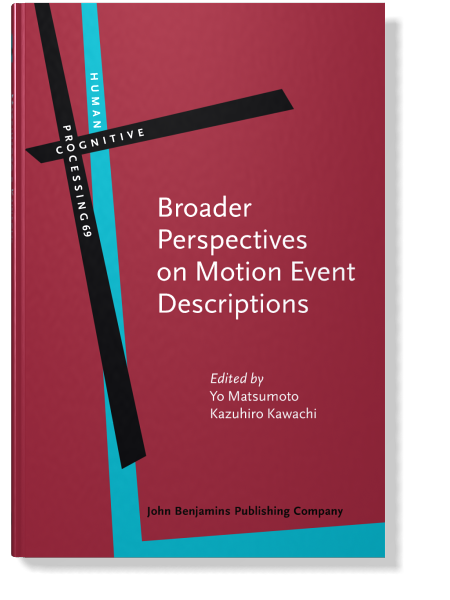
Edited by Yo Matsumoto and Kazuhiro Kawachi
[Human Cognitive Processing 69] 2020
► pp. 205–234
Chapter 7Should Talmy’s motion typology be expanded to visual
motion?
An investigation into expressions of motion, agentive motion, and visual motion in Sidaama (Sidamo)
Published online: 11 August 2020
https://doi.org/10.1075/hcp.69.07kaw
https://doi.org/10.1075/hcp.69.07kaw
Abstract
This chapter addresses the question of whether or
not Talmy’s (1985, 1991, 2000b) motion typology should be expanded
to visual motion (Matsumoto
2001, 2017;
Slobin 2009; Cifuentes-Férez 2014), by
examining how Sidaama (Cushitic; Ethiopia) expresses (i)
self-agentive/non-agentive motion, (ii) agentive motion, and (iii)
fictive motion along a visual emanation path. It shows that although
this language closely follows the verb-framed pattern in expressing
(i) and (ii), it does not do so in expressing (iii), as in many
other verb-framed languages. A possible reason for this is that
(iii) is not conceptualized as a macro-event, whereas Talmy’s
typology is built on expression patterns of macro-events. This study
also observes that there are other types of events to which Talmy’s
typology does not apply, presumably for the same reason: they are
not really macro-events.
Keywords: fictive motion, macro-event, verb-framed language, visual emanation
Article outline
- 1.Introduction
- 2.Literature review
- 3.Data
- 3.1Profile of Sidaama and morphemes used for motion events
- 3.2Multiple-verb constructions in Sidaama
- 3.3Patterns of expressing self-agentive/non-agentive motion and
agentive motion events in Sidaama
- 3.3.1Motion events with a manner of motion as a co-event
- 3.3.2Motion events with a means of causation as a co-event
- 3.4Patterns of expressing visual emanation events in Sidaama
- 4.Analysis and discussion
- 4.1Can visual emanation be conceptualized as a macro-event?
- 4.2Another type of case where V-languages can deviate from their characteristic pattern
- 4.3Types of cases where Sidaama can deviate from the V-language pattern
- 5.Conclusion
Acknowledgements Notes Abbreviations References

References (26)
Aske, J. 1989. Path
predicates in English and Spanish: A closer
look. Proceedings of the 34th
Annual Meeting of the Berkeley Linguistics
Society, 15, 1–14.
Banti, G. 2007. Remarks
on the typology of converbs and their functional equivalents
in East
Cushitic. In S. Völlmin, A. Amha, C. Rapold, & S. Zaugg-Coretti (Eds.), Converbs,
medial verbs, clause chaining and related
issues (31–80). Köln: Rüdiger Köppe.
Bohnemeyer, J., Enfield, N. J., Essegbey, J., Ibarretxe-Antuñano, I., Kita, S., Lüpke, F., & Ameka, F. K. 2007. Principles
of event segmentation in language: The case of motion
events. Language, 83, 495–532.
Cifuentes-Férez, P. 2014. A
closer look at Paths of vision, Manner of vision and their
translation from English into
Spanish. Languages in
Contrast, 14(2), 214–250.
Croft, W., Barðdal, J., Hollmann, W., Sotirova, V., & Taoka, C. 2010. Revising
Talmy’s typological classification of complex
events. In H. Boas (Ed.), Contrastive
construction
grammar (201–235). Amsterdam & Philadelphia: John Benjamins.
Haspelmath, M. 1995. The
converb as a cross-linguistically valid
category. In M. Haspelmath & E. König (Eds.), Converbs
in cross-linguistic perspective: Structure and meaning of
adverbial verb forms – adverbial participles,
gerunds (1–55). Berlin & New York: Mouton de Gruyter.
Kawachi, K. 2007. A
grammar of Sidaama (Sidamo), a Cushitic language of
Ethiopia. Ph.D.
dissertation, State University of New York at Buffalo.
2012. Event
integration patterns in Sidaama
(Sidamo). Proceedings of the
34th Annual Meeting of the Berkeley Linguistics Society,
General
Session, 175–186. Berkeley, CA: Berkeley Linguistics Society.
2018. Event
integration patterns in Sidaama and
Japanese. In P. Pardeshi & T. Kageyama (Eds.), Handbook
of Japanese contrastive
linguistics (313–342). Berlin & Boston: De Gruyter Mouton.
Kawachi, K. (with the help of data provided by Y. Abe, O. Hieda, K. Koga, J. Komori, M. Wakasa, N. Yoneda, & H. Yoshino). 2016. Introduction:
An overview of event integration patterns in African
languages. Asian and African
Languages and
Linguistics, 10, 1–36. [Permanent
URL: [URL]]
Kawachi, K. 2020. Sidaama. In R. Vossen, & G. J. Dimmendaal (Eds.), The
Oxford handbook of African
languages (543–552). Oxford: Oxford University Press.
Forthcoming. Sidaama. In B. Wakjira, R. Meyer, Y. Treis, & Z. Leyew (Eds.), The
Oxford handbook of Ethiopian
languages. Oxford: Oxford University Press.
Matsumoto, Y. 2001. Lexicalization
patterns in the descriptions of caused motion and fictive
motion. Presented at
the University at
Buffalo on October
5, 2001.
2003. Typologies
of lexicalization patterns and event integration:
Clarifications and
reformulations. In S. Chiba et al. (Eds.), Empirical
and theoretical investigations into language: A festschrift
for Masaru
Kajita (403–417). Tokyo: Kaitakusha.
Slobin, D. I. 1997. Mind,
code, and
text. In J. Bybee & J. Haiman (Eds.), Essays
on language function and language
type (437–467). Amsterdam & Philadelphia: John Benjamins.
2004. The
many ways to search for a frog: Linguistic typology and the
expression of motion
events. In S. Strömqvist & L. Verhoeven (Eds.), Relating
events in narrative: Typological and contextual
perspectives (219–257). Mahwah: Lawrence Erlbaum Associates.
2009. Relations
between Paths of motion and Paths of vision: A
crosslinguistic and developmental
exploration. In V. C. M. Gathercole (Ed.), Routes
to language: Studies in honor of Melissa
Bowerman (197–222). New York & London: Psychology Press.
Slobin, D. I., & Hoiting, N. 1994. Reference
to movement in spoken and signed languages: Typological
considerations. Proceedings
of the Twentieth Annual Meeting of the Berkeley Linguistics
Society, 487–505.
Talmy, L. 1985. Lexicalization
patterns: Semantic structure in lexical
forms. In T. Shopen (Ed.), Language
typology and lexical descriptions, Vol. 3: Grammatical
categories and the
lexicon (36–149). Cambridge: Cambridge University Press.
1991. Path
to realization: A typology of event
conflation. Proceedings of
the Seventeenth Annual Meeting of Berkeley Linguistics
Society, 17, 480–519.
1996. Fictive
motion in language and
‘ception’. In P. Bloom, M. A. Peterson, L. Nadel, & M. F. Garrett (Eds.), Language
and
space (211–276). Cambridge, MA: MIT Press.
Cited by (3)
Cited by three other publications
Ma, Sai, Ye Jin & Michael Barlow
Dai, Ying & Yicheng Wu
Matsumoto, Yo, Kimi Akita, Anna Bordilovskaya, Kiyoko Eguchi, Hiroaki Koga, Miho Mano, Ikuko Matsuse, Takahiro Morita, Naonori Nagaya, Kiyoko Takahashi, Ryosuke Takahashi & Yuko Yoshinari
2022. Linguistic representations of visual motion. In Neglected Aspects of Motion Events Description [Human Cognitive Processing, 72], ► pp. 43 ff.
This list is based on CrossRef data as of 10 december 2025. Please note that it may not be complete. Sources presented here have been supplied by the respective publishers. Any errors therein should be reported to them.