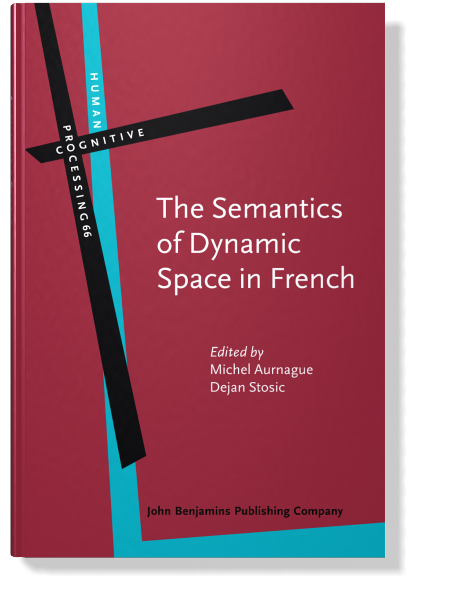
In:The Semantics of Dynamic Space in French: Descriptive, experimental and formal studies on motion expression
Edited by Michel Aurnague and Dejan Stosic
[Human Cognitive Processing 66] 2019
► pp. 1–28
Recent advances in the study of motion in French
A survey
Published online: 29 July 2019
https://doi.org/10.1075/hcp.66.intro
https://doi.org/10.1075/hcp.66.intro
Article outline
- 1.Dynamic space in language and cognition
- 2.Analyzing dynamic space in French: A longstanding line of research
- 3.Scope of the book
- 3.1Arguments, modifiers, asymmetry of motion
- 3.2Manner of motion and fictive motion
- 3.3Psycholinguistic issues
- 3.4Formal and computational aspects of motion-based narrations
- 4.New perspectives for the study of dynamic space in language and cognition
- 4.1Searching for the semantic components of motion events
- 4.2Path and localization
- 4.3Interacting with manner
Acknowledgments Notes References

References (112)
Asher, N., & Sablayrolles, P. (1995). A typology and discourse semantics for motion verbs and spatial PPs in French. Journal of Semantics, 12(2), 163–209.
Aske, J. (1989). Path predicates in English and Spanish: A close look. In K. Hall, M. Meacham, & R. Shapiro (Eds.), Proceedings of the 15th Annual Meeting of the Berkeley Linguistics Society (pp. 1–14). Berkeley, CA: Berkeley Linguistics Society.
Aurnague, M. (2004). Les structures de l’espace linguistique: Regards croisés sur quelques constructions spatiales du basque et du français. Leuven: Peeters.
(2009). A cet endroit vs. dans un tel endroit: Ce que à nous dit d’endroit et vice-versa. Langages, 173, 34–53.
(2011). How motion verbs are spatial: The spatial foundations of intransitive motion verbs in French. Lingvisticae Investigationes, 34(1), 1–34.
Aurnague, M., Hickmann, M., & Vieu, L. (Eds.). (2007). The categorization of spatial entities in language and cognition. Amsterdam & Philadelphia: John Benjamins.
Aurnague, M., & Vieu, L. (1993). A three-level approach to the semantics of space. In C. Zelinsky-Wibbelt (Ed.), The semantics of prepositions: From mental processing to natural language processing (pp. 395–439). Berlin: Mouton de Gruyter.
Berman, R. A., & Slobin, D. I. (Eds.). (1994). Relating events in narrative: A crosslinguistic developmental study. Hillsdale, NJ: Lawrence Erlbaum.
Blomberg, J., & Zlatev, J. (2014). Actual and non-actual motion: Why experimentalist semantics needs phenomenology (and vice versa). Phenomenology and the Cognitive Sciences, 13(3), 395–418.
Bohnemeyer, J., Enfield, N. J., Essegbey, J., Ibarretxe-Antuñano, I., Kita, S., Lüpke, F., & Ameka, F. K. (2007). Principles of event segmentation in language: The case of motion events. Language, 83(3), 495–532.
Boons, J.-P. (1985). Préliminaire à la classification des verbes locatifs: Les compléments de lieu, leurs critères, leurs valeurs aspectuelles. Lingvisticae Investigationes, 9(2), 195–267.
(1987). La notion sémantique de déplacement dans une classification syntaxique des verbes locatifs. Langue Française, 76, 5–40.
Boons, J.-P., Guillet A., & Leclère C. (1976). La structure des phrases simples en français: Constructions intransitives. Geneva: Droz.
Borillo, M., & Sablayrolles, P. (1993). The semantics of motion verbs in French. In Proceedings of the 13th International Conference on Artificial Intelligence, Expert Systems and Natural Language Processing (vol. 3), Avignon’93 (pp. 189–199). Avignon, 24–28 May 1993.
Bourdin, P. (1997). On goal-bias across languages: Modal, configurational and orientational parameters. In Proceedings of LP’96 “Typology: prototypes, item orderings and universals” (pp. 185–216). Prague, 20–22 August 1996.
Bowerman, M., de León, L., & Choi, S. (1995). Verbs, particles, and spatial semantics: Learning to talk about spatial actions in typologically different languages. In E. V. Clark (Ed.), Proceedings of the Twenty-Seventh Annual Child Language Research Forum (pp. 101–110). Stanford, CA: CSLI.
Burenhult, N., & Levinson, S. C. (2008). Language and landscape: A cross-linguistic perspective. Language Sciences, 30(2–3), 135–150.
Buscaldi, D., & Rosso, P. (2008). A conceptual density-based approach for the disambiguation of toponyms. International Journal of Geographical Information Science, 22(3), 301–313.
Cablitz, G. H. (2008). When “what” is “where”: A linguistic analysis of landscape terms, place names and body part terms in Marquesan (Oceanic, French Polynesia). Language Sciences, 30(2–3), 200–226.
Cappelli, F. (2013). Etude du mouvement fictif à travers un corpus d’exemples du français: Perspective sémantique du lexique au discours. PhD dissertation. Toulouse: Université de Toulouse-Le Mirail.
Cooper, G. S. (1968). A semantic analysis of English locative prepositions (Bolt, Beranek & Newman report 1587). Springfield, VA: Clearing House for Federal Scientific and Technical Information.
Creissels, D. (2006). Encoding the distinction between location, source and destination: A typological study. In M. Hickmann, & S. Robert (Eds.), Space in languages: Linguistic systems and cognitive categories (pp. 19–28). Amsterdam & Philadelphia: John Benjamins.
Fibigerova, K., Guidetti, M., & Šulová, L. (2012). Verbal and gestural expression of motion in French and Czech. In L. Filipović, & K. M. Jaszczolt (Eds.), Space and time across languages and cultures II: Language, culture and cognition (pp. 251–268). Amsterdam & Philadelphia: John Benjamins.
Grinevald, C. (1994). Jacaltec directionals: Their meaning and their function. Languages of the World, 7, 23–36.
(2006). The expression of static location in a typological perspective. In M. Hickmann & S. Robert (Eds.), Space in languages: Linguistic systems and cognitive categories (pp. 29–58). Amsterdam & Philadelphia: John Benjamins.
Guillet, A., & Leclère, C. (1992). La structure des phrases simples en français: Les constructions transitives locatives. Geneva: Droz.
Gumperz, J. J., & Levinson, S. C. (1996). Rethinking linguistic relativity. Cambridge: Cambridge University Press.
Hasko, V., & Perelmutter, R. (Eds.). (2010). New approaches to Slavic verbs of motion. Amsterdam & Philadelphia: John Benjamins.
Herskovits, A. (1982). Space and the prepositions in English: Regularities and irregularities in a complex domain. PhD dissertation. Stanford: Stanford University.
(1986). Language and spatial cognition: An interdisciplinary study of the prepositions in English. Cambridge: Cambridge University Press.
Hickmann, M. (2006). The relativity of motion in first language acquisition. In M. Hickmann & S. Robert (Eds.), Space in languages: Linguistic systems and cognitive categories (pp. 281–308). Amsterdam & Philadelphia: John Benjamins.
Hill, D. (1996). Distinguishing the notion “place” in an Oceanic language. In M. Pütz, & R. Dirven (Eds.), The construal of space in language and thought (pp. 307–328). Berlin: Mouton de Gruyter.
Iacobini, C., & Fagard, B. (2011). A diachronic approach to variation and change in the typology of motion event expression. A case study: From Latin to Romance, Faits de Langues. Les Cahiers, 3, 151–171.
(1996). The architecture of the linguistic-spatial interface. In P. Bloom, M. A. Peterson, L. Nadel, & M. F. Garrett (Eds.), Language and space (pp. 1–30). Cambridge, MA: MIT Press.
Kelly, A., & Melinger, A. (Eds.). (2001). Max-Planck-Institute for Psycholinguistics: Annual report 2001. Nijmegen: MPI für Psycholinguistik.
Kopecka, A. (2006). The semantic structures of motion verbs in French. In M. Hickmann & S. Robert (Eds.), Space in languages: Linguistic systems and cognitive categories (pp. 83–101). Amsterdam & Philadelphia: John Benjamins.
Krifka, M. (1995). Telicity in movement. In P. Amsili, M. Borillo, & L. Vieu (Eds.), Time, Space and Movement: Meaning and knowledge in the sensible world, Working Notes of the 5th International Workshop (pp. 63–75 Part A). Toulouse: LRC.
Lakoff, G., & Ross, J. (1976). Is deep structure necessary? In J. D. McCawley (Ed.), Syntax and Semantics, 7, 159–164.
Lakusta, L., & Landau, B. (2005). Starting at the end: The importance of goals in spatial language. Cognition, 96, 1–33.
Lamiroy, B. (1983). Les verbes de mouvement en français et en espagnol. Amsterdam & Philadelphia: John Benjamins.
Langacker, R. W. (1986). Abstract motion. In Proceedings of the 12th Annual Meeting of the Berkeley Linguistics Society (pp. 455–471). Berkeley, CA: Berkeley Linguistics Society.
(1987). Foundations of cognitive grammar I: Theoretical prerequisites. Stanford, CA: Stanford University Press.
(2010). Reflections on the functional characterization of spatial prepositions. CORELA, HS-7, [URL]
Laur, D. (1991). Sémantique du déplacement et de la localisation en français: Une étude des verbes, des prépositions et de leurs relations dans la phrase simple. PhD dissertation. Toulouse: Université de Toulouse-Le Mirail.
(1993). La relation entre le verbe et la préposition dans la sémantique du déplacement. Langages, 110, 47–67.
Levin, B., & Rappaport Hovav, M. (1992). The lexical semantics of verbs of motion: The perspective from unaccusativity. In I. M. Roca (Ed.), The thematic structure: Its role in grammar (pp. 247–269). Berlin: Foris Publications.
(1998). Morphology and lexical semantics. In A. Spencer & A. Zwicky (Eds.), Handbook of morphology (pp. 248–271). Oxford: Blackwell.
Levinson, S. C., & Wilkins, D. (Eds.). (2006). Grammars of space: Explorations in cognitive diversity. Cambridge: Cambridge University Press.
Mani, I., & Pustejovsky, J. (2012). Interpreting motion: Grounded representations for spatial language. Oxford: Oxford University Press.
Matsumoto, Y. (1996). Subjective motion and English and Japanese verbs. Cognitive Linguistics, 7(2), 183–226.
McNeill, D. (1992). Hand and mind: What gestures reveal about thought. Chicago and London: The University of Chicago Press.
Moncla, L., & Gaio, M. (2015). A Multi-layer markup language for geospatial semantic annotations. In Proceedings of the 9th Workshop on Geographic Information Retrieval, GIR’15 (pp. 5:1–5:10), Paris: ACM.
Montague, R. (1974). The proper treatment of quantification in ordinary English. In R. Thomason (Ed.), Selected papers of Richard Montague (pp. 247–270). New Haven, CT: Yale University Press.
Muller, P., & Sarda, L. (1998). Représentation de la sémantique des verbes de déplacement transitifs directs du français. TAL, 39(2), 127–147.
Nespoulous, J.-L. (1990). Linguistique, neurolinguistique et neuropsycholinguistique. In J.-L. Nespoulous, & M. Leclercq (Eds.), Linguistique et neuropsycholinguistique: Tendances actuelles (pp. 1–4). Paris: Société de Neuropsychologie de Langue Française.
Nikanne, U., & van der Zee, E. (2012). The lexical representation of path-curvature in motion expression: A three-way path curvature distinction In M. Vulchanova, & E. van der Zee (Eds.), Motion encoding in language and space (pp. 187–212). Oxford: Oxford University Press.
Purves, R. S., & Derungs, C. (2015). From space to place: Place-based explorations of text. International Journal of Humanities and Arts Computing, 9(1), 74–94.
Retoré, C. (2014). The Montagovian generative lexicon ΛTyn: A type-theoretical framework for natural language semantics. In R. Matthes & A. Schubert (Eds.), Proceedings of the 19th International Conference on Types for Proofs and Programs (TYPES 2013) (pp. 202–229). Dagstuhl: Schloss Dagstuhl – Leibniz-Zentrum für Informatik.
Sarda, L. (1999). Contribution à l’étude de la sémantique de l’espace et du temps: Analyse des verbes de déplacement transitifs directs du français. PhD dissertation. Toulouse: Université de Toulouse-Le Mirail.
Slobin, D. I. (1996). Two ways to travel: Verbs of motion in English and Spanish. In M. Shibatani, & S. A. Thompson (Eds.), Grammatical constructions: Their form and meaning (pp. 195–219). Oxford: Clarendon Press.
(2003). Language and thought online: Cognitive consequences of linguistic relativity. In D. Gentner, & S. Goldin-Meadow (Eds.), Language in mind: Advances in the investigation of language and thought (pp. 157–191). Cambridge, MA: MIT Press.
(2004). The many ways to search for a frog: Linguistic typology and the expression of motion events. In S. Strömqvist, & L. Verhoeven (Eds.), Relating events in narrative: Typological and contextual perspectives (pp. 219–257). Mahwah, NJ: Lawrence Erlbaum.
Slobin, D. I., Ibarretxe-Antuñano, I., Kopecka, A., & Majid, A. (2014). Manners of human gait: A crosslinguistic event-naming study. Cognitive Linguistics, 25(4), 701–741.
Soroli, E., & Hickmann, M. (2011). Language and spatial representations in French and in English: Evidence from eye movements. In G. Marotta, A. Lenci, L. Meini, & F. Rovai (Eds.), Space in language (pp. 581–597). Pisa: Editrice Testi Scientifici.
Stefanowitsch, A., & Rohde, A. (2004). The goal bias in the encoding of motion events. In G. Radden, & K.-U. Panther (Eds.), Motivation in grammar (pp. 249–268). Berlin: Mouton de Gruyter.
Stolova, N. I. (2015). Cognitive linguistics and lexical change: Motion verbs from Latin to Romance. Amsterdam & Philadelphia: John Benjamins.
Stosic, D. (2001). Par et l’expression des relations spatiales en français. Revue de Sémantique et Pragmatique, 9/10, 75–102.
(2002). Par et à travers dans l’expression des relations spatiales: Comparaison entre le français et le serbo-croate. PhD dissertation. Toulouse: Université de Toulouse-Le Mirail.
(2007). The prepositions par and à travers and the categorization of spatial entities in French. In M. Aurnague, M. Hickmann, & L. Vieu (Eds.), The categorization of spatial entities in language and cognition (pp. 71–91). Amsterdam & Philadelphia: John Benjamins.
Stosic, D., & Amiot, D. (2011). Quand la morphologie fait des manières: Les verbes évaluatifs et l’expression de la manière en français. In D. Amiot, W. De Mulder, E. Moline, & D. Stosic (Eds.), Ars Grammatica. Hommages à Nelly Flaux (pp. 403–430). Bern: Peter Lang.
Talmy, L. (1983). How language structures space. In H. L. Pick, & L. P. Acredolo (Eds.), Spatial orientation: Theory, research and application (pp. 225–282). New York: Plenum Publishing Corporation.
(1985). Lexicalization patterns: Semantic structure in lexical forms. In T. Shopen (Ed.), Language typology and syntactic description (vol. 3): Grammatical categories and the lexicon (pp. 57–149). Cambridge: Cambridge University Press.
(1996). Fictive motion in language and “ception”. In P. Bloom, M. A. Peterson, L. Nadel, & M. F. Garrett (Eds.), Language and space (pp. 211–276). Cambridge, MA: MIT Press.
Tenny, C. (1995). How motion verbs are special: The interaction of linguistic and pragmatic information in aspectual verb meanings. Pragmatics and Cognition, 3(1), 31–73.
Tenny, C., & Pustejowsky, J. (Eds.). (1999). Events as grammatical objects: The converging perspectives of lexical semantics and syntax. Stanford, CA: CSLI.
Traugott, E. C. (2008). Grammaticalization, constructions and the incremental development of language: Suggestions from the development of degree modifiers in English. In R. Eckardt, G. Jäger, & T. Veenstra (Eds.), Variation, selection, development – Probing the evolutionary model of language change (pp. 219–250). Berlin & New York: Mouton de Gruyter.
Trueswell, J., & Papafragou, A. (2010). Perceiving and remembering events cross-linguistically: Evidence from dual-task paradigms. Journal of Memory and Language, 63, 64–82.
Tversky, B. (1996). Spatial perspective in descriptions. In P. Bloom, M. A. Peterson, L. Nadel, & M. F. Garrett (Eds.), Language and space (pp. 463–491). Cambridge, MA: MIT Press.
van Eijck, J., & Kamp, H. (1997). Representing discourse in context. In J. van Benthem, & A. ter Meulen (Eds.), Handbook of logic and language (pp. 179–237). Amsterdam & Cambridge: Elsevier/MIT Press.
Vandeloise, C. (1984). Description of space in French. PhD dissertation, University of California, San Diego. Duisburg: LAUTD.
(2006). Are there spatial prepositions? In M. Hickmann, & S. Robert (Eds.), Space in languages: Linguistic systems and cognitive categories (pp. 139–154). Amsterdam & Philadelphia: John Benjamins.
Vieu, L. (1991). Sémantique des relations spatiales et inférences spatio-temporelles: Une contribution à l’étude des structures formelles de l’espace en langage naturel. PhD dissertation. Toulouse: Université Paul Sabatier.
Vieu, L., & Aurnague, M. (2007). Part-of relations, functionality and dependence. In M. Aurnague, M. Hickmann, & L. Vieu (Eds.), The categorization of spatial entities in language and cognition (pp. 307–336). Amsterdam & Philadelphia: John Benjamins.
Vulchanova, M., & Martinez, L. (2013). A basic level for the encoding of biological motion. In C. Paradis, J. Hudson, & U. Magnusson (Eds.), The construal of spatial meaning: Windows into conceptual space (pp. 144–168). Oxford: Oxford University Press.
Vulchanova, M., & van der Zee, E. (2012). Motion encoding in language and space. Oxford: Oxford University Press.
Winston, M., Chaffin, R., & Herrmann, D. (1987). A taxonomy of part-whole relations. Cognitive Science, 11, 417–444.