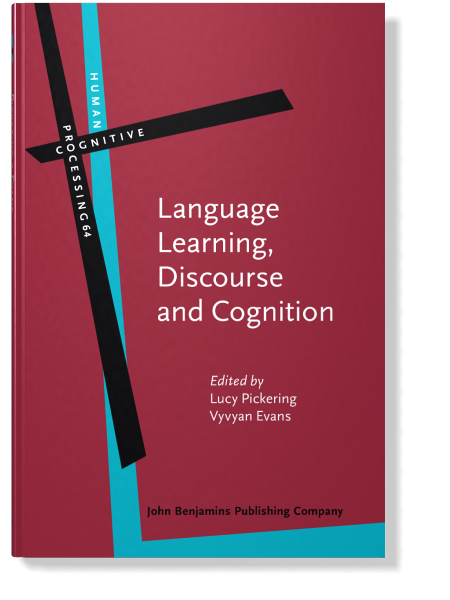
In:Language Learning, Discourse and Cognition: Studies in the tradition of Andrea Tyler
Edited by Lucy Pickering and Vyvyan Evans
[Human Cognitive Processing 64] 2018
► pp. 1–8
IntroductionDiscourse and cognitive perspectives on language learning
Published online: 20 December 2018
https://doi.org/10.1075/hcp.64.01pic
https://doi.org/10.1075/hcp.64.01pic
Article outline
- Part I.Discourse perspectives
- Part II.Cognitive perspectives
- Part III.Applications to L2 teaching and learning
References

References (22)
Bardovi-Harlig, K. (2009). Conventional expressions as a pragmalinguistic resource: Recognition and production of conventional expressions in L2 pragmatics. Language Learning, 9, 755–795.
Bardovi-Harlig, K., Mossman, S., & Vellenga, H. E. (2015a). The effect of instruction on pragmatic routines in academic discussion. Language Teaching Research, 19, 324–350.
Boxer, D. & Cortés-Conde, F. (1997). From bonding to biting: Conversational joking and identity display. Journal of Pragmatics, 27, 275–294.
Davies, C. E., & Tyler, A. (1994). Demystifying cross-cultural (mis)communication: Improving performance through balanced feedback in a situated context. In C. Madden & C. Myers (Eds.), Discourse and performance of international teaching assistants (pp. 201–220). Alexandria, VA: TESOL.
(2005). Discourse strategies in the context of cross-cultural institutional talk: Uncovering interlanguage pragmatics in the university classroom. In K. Bardovi-Harlig & B. S. Hartford (Eds.), Interlanguage pragmatics: Exploring institutional talk (pp. 133–156). Mahwah, NJ: Erlbaum.
Grady, J. (1999). A typology of motivation for conceptual metaphor: Correlation vs. resemblance. In R. W. Gibbs & G. J. Steen (Eds.), Metaphor in Cognitive Linguistics: Selected Papers from the Fifth International Cognitive Linguistics Conference (pp. 79–100). Amsterdam: John Benjamins.
Nakahama, Y., Tyler, A., & van Lier, L. (2001). Negotiation of meaning in conversational and information gap activities: A comparative discourse analysis. TESOL Quarterly, 35, 377–405.
Porte, G. (2012). Replication research in applied linguistics. New York: Cambridge University Press.
Tapper, G., Drzazga, G., Mendoza, M., & Grill, J. C. (XXXX). Discourse management strategies revisited: Building on Tyler’s early insights regarding international teaching assistant comprehensibility. In L. Pickering & V. Evans (Eds.), Language learning, discourse and cognition: Studies in the tradition of Andrea Tyler (pp. XXX). Amsterdam: John Bejamins.
Tyler, A. (1992a). Discourse structure and specification of relationships: A cross-linguistic analysis. Text Interdisciplinary Journal for the Study of Discourse, 12(1), 1–18.
(1992b). Discourse structure and the perception of incoherence in international teaching assistants’ spoken discourse. TESOL Quarterly, 26(4), 713–729.
(1994a). The role of repetition in perceptions of discourse coherence. Journal of Pragmatics, 21(6), 671–688.
(1994b). The role of syntactic structure in discourse structure: Signaling logical and prominence relations. Applied Linguistics, 15(3), 243–262.
(1995). The co-construction of cross-cultural miscommunication. Studies in Second Language Acquisition, 17(2), 129–152.
(2012a). Cognitive linguistics and second language learning: Theoretical basics and experimental evidence. NY: Routledge.
(2012b). Spatial language, polysemy, and cross-linguistic semantic mismatches: Cognitive linguistics insights into challenges for second language learners, spatial cognition & computation. An Interdisciplinary Journal, 12(4), 305–335.
Tyler, A., & Bro, J. (1992). Discourse structure in nonnative English discourse: The effect of ordering and interpretive cues on perceptions of comprehensibility. Studies in Second Language Acquisition, 14(1), 71–86.
Tyler, A. & Evans, V. (2001). Reconsidering prepositional polysemy networks. Language 77(4), 724–765.
Tyler, A., & Evans, V. (2003). The semantics of English prepositions: Spatial scenes, embodied meaning, and cognition. Cambridge: Cambridge University Press.