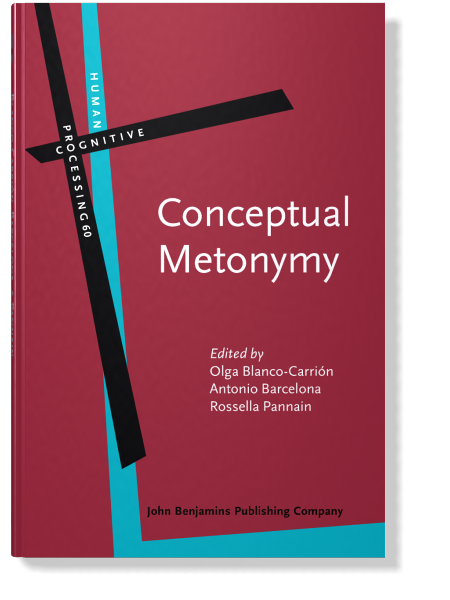
In:Conceptual Metonymy: Methodological, theoretical, and descriptive issues
Edited by Olga Blanco-Carrión, Antonio Barcelona and Rossella Pannain
[Human Cognitive Processing 60] 2018
► pp. 1–24
Introduction
The complex task of studying metonymy
Published online: 17 May 2018
https://doi.org/10.1075/hcp.60.int
https://doi.org/10.1075/hcp.60.int
Article outline
- 1.On the main purpose and characteristics of this book
- 2.Methodological and descriptive issues in the creation of a metonymy database
- 3.Theoretical problems in the study of metonymy
- 4.Case studies
-
5.Recapitulation
- 5.1New descriptive methods and criteria
- 5.2Theoretical issues
- 5.2.1New answers to older debates
- 5.2.2Challenges to present theories of metonymy
- 5.3New concepts and trends in metonymy research
- 5.3.1New concepts or new aspects of metonymy not previously noted or emphasized
- 5.3.2New trends in metonymy research
- 5.4New empirical data on metonymy
Acknowledgments References

References (52)
Barcelona, A. 2000. On the plausibility of claiming a metonymic motivation for conceptual metaphor. In A. Barcelona (Ed.), Metaphor and metonymy at the crossroads. Cognitive approaches (31–58). Berlin & New York: Mouton de Gruyter.
2002. On the ubiquity and multiple-level operation of metonymy. In B. Lewandowska-Tomaszczyk & K. Turewicz (Eds.), Cognitive Linguistics today [Lódz Studies in Language] (207–224). Frankfurt am Main: Peter Lang.
2005. The multilevel operation of metonymy in grammar and discourse, with particular attention to metonymic chains. In F. Ruiz de Mendoza & S. Peña Cervel (Eds.), Cognitive Linguistics: Internal dynamics and interdisciplinary interaction (313–352). Berlin & New York: Mouton de Gruyter.
2007. The role of metonymy in meaning at discourse level: A case study. In G. Radden, K.-M. Köpcke, T. Berg, & P. Siemund (Eds.), Aspects of meaning construction (51–75). Amsterdam & Philadelphia: John Benjamins.
2008. The interaction of metonymy and metaphor in the meaning and form of ‘bahuvrihi’ compounds. Annual Review of Cognitive Linguistics, 6, 208–281.
2009. Motivation of construction meaning and form: The roles of metonymy and inference. In K.-U Panther, L. L. Thornburg, & A. Barcelona (Eds.), Metonymy and metaphor in grammar (363–401). Amsterdam & Philadelphia: John Benjamins.
2011. Reviewing the properties and prototype structure of metonymy. In R. Benczes, A Barcelona, & F. J. Ruiz de Mendoza Ibáñez (Eds.), Defining metonymy in Cognitive Linguistics. Towards a consensus view (7–57). Amsterdam & Philadelphia: John Benjamins.
2013. Metonymy is not just a lexical phenomenon. In N.-L. Johannesson and D. C. Minugh (Eds.), Selected Papers from the 2008 Stockholm Metaphor Festival [Stockholm Studies in English 105] (13–46). Stockholm: Acta Universitatis Stockholmiensis.
2016. Salience in metonymy-motivated constructional abbreviated form with particular attention to English clippings. Cognitive Semantics, 2, 30–58.
In preparation. On the pervasive role of metonymy in constructional meaning and form and in discourse comprehension: A corpus-based study from a cognitive-linguistic perspective. (Provisional title.)
Barnden, J. A. 2010. Metaphor and metonymy: Making their connections more slippery. Cognitive Linguistics 21(1), 1–34.
Benczes, R. 2006. Creative compounding in English: The semantics of metaphorical and metonymical noun-noun combinations. Amsterdam: John Benjamins.
Benczes, R., Barcelona, A., & Ruiz de Mendoza Ibáñez, F. J. (Eds). 2011. Defining metonymy in Cognitive Linguistics. Towards a consensus view [Human Cognitive Processing 28]. Amsterdam: John Benjamins.
2014. On constructivization – A few remarks on the role of metonymy in grammar. In K. Rudnicka-Szozda & A. Szwedek (Eds.), Cognitive Linguistics in the making (5–20). Frankfurt am Main: Peter Lang.
Brdar, M. 2007. Metonymy in grammar. Towards motivating extensions of grammatical categories and constructions. Osijek (Croatia): Faculty of Philosophy, Josip Juraj Strossmayer University.
Dancygier, B., & Sweetser, E. 2005. Mental spaces in grammar. Conditional constructions. Cambridge: Cambridge University Press.
Darmesteter, A. 1932. La vie des mots étudiée dans leurs significations. Paris: Librairie Delagrave.
Fauconnier, G. 2009. Generalized integration networks. In V. Evans & S. Pourcel (Eds.), New directions in Cognitive Linguistics (147–160). Amsterdam: John Benjamins.
Geeraerts, D. 2002. The interaction of metaphor and metonymy in composite expressions. In Dirven, R. & Pörings, R. (Eds), Metaphor and metonymy in comparison and contrast (435–465). Berlin: Mouton de Gruyter.
Gibbs, R W., Jr. 1994. The Poetics of mind. Figurative thought, language, and understanding. Cambridge: Cambridge University Press.
2007. Experimental tests of figurative meaning construction. In G. Radden, K.-M. Köpcke, T. Berg, & P. Siemund (Eds.), Aspects of meaning construction (19–32). Amsterdam & Philadelphia: John Benjamins.
Goossens, L. 2002 [1990]. Metaphtonymy: The interaction of metaphor and metonymy in expressions for linguistic action. In R. Dirven & R. Pörings (Eds.), Metaphor and metonymy in comparison and contrast (349–377). Berlin & New York: Mouton de Gruyter.
Goossens, L., Pauwels, P., Rudzka-Ostyn, B., Simon-Vanderbergen, A.-M., & Vanparys, J. 1995. By word of mouth. Metaphor, metonymy and linguistic action in a cognitive perspective. Amsterdam & Philadelphia: John Benjamins.
Jing-Schmidt, Z. 2008. Much mouth much tongue: Chinese metonymies and metaphors of verbal behavior. Cognitive Linguistics 19(2), 241–282.
Kövecses, Z. 1986. Metaphors of anger, pride and love. Amsterdam: John Benjamins.
Kövecses, Z., & Radden, G. 1998. Metonymy: Developing a cognitive linguistic view. Cognitive Linguistics 9(1), 37–77.
Lakoff, G. 1987. Women, fire, and dangerous things. What categories reveal about the mind. Chicago: University of Chicago Press.
1999. Philosophy in the flesh. The embodied mind and its challenge to western thought. New York: Basic Books.
Langacker, R. W. 2009. Metonymic grammar. In K.-U. Panther, L. Thornburg, & A. Barcelona (Eds.), Metonymy and metaphor in grammar (45–71). Berlin & New York: Mouton de Gruyter.
Littlemore, J. 2015. Metonymy: Hidden shortcuts in language, thought and communication. Cambridge: Cambridge University Press.
Panther, K.-U., & Radden, G. (Eds.). 1999. Metonymy in language and thought. Amsterdam & Philadelphia: John Benjamins.
Panther, K.-U., & Thornburg, L. (Eds.). 2003. Metonymy and pragmatic inferencing [Pragmatics and Beyond New Series]. Amsterdam & Philadelphia: John Benjamins.
2007. Metonymy. In D. Geeraerts & H. Cuyckens (Eds.), Handbook of Cognitive Linguistics (236–263). Oxford: Oxford University Press.
Panther, K.-U., Thornburg, L., & Barcelona, A. (Eds.). 2009. Metonymy and metaphor in grammar. Berlin & New York: Mouton de Gruyter.
Pauwels, P., & Simon-Vandenbergen, A.-M. 1995. Body parts in linguistic action: underlying schemata and value judgments. In Goossens et al.. (Eds.), By word of mouth: Metaphor, metonymy and linguistic action in a cognitive perspective (35–69). Amsterdam & Philadelphia: John Benjamins.
Peirsman, Y., & Geeraerts, D. 2006. Metonymy as a prototypical category. Cognitive Linguistics 17(3), 269–316.
Radden, G. 2002. How metonymic are metaphors? In R. Dirven & R. Pörings (Eds.), Metaphor and metonymy in comparison and contrast (407–434). Berlin & New York: Mouton de Gruyter.
2004. The metonymic folk model of language. In B. Lewandowska-Tomaszczyk & A. Kwiatkowska (Eds.), Imagery in Language (543–565). Bern: Peter Lang.
Ruiz de Mendoza Ibáñez, F. J. 2014. On the nature and scope of metonymy in linguistic description and explanation: Towards settling some controversies. In J. Littlemore & J. R. Taylor (Eds.), The Bloomsbury companion to Cognitive Linguistics (143–166). London & New York: Bloomsbury.
Ruiz de Mendoza Ibáñez, F. J., & Otal Campo, J. L. 2002. Metonymy, grammar and communication. Albolote (Granada, Spain): Comares.
Ruiz de Mendoza Ibáñez, F. J., & Peña Cervel, S. 2005. Conceptual interaction, cognitive operations and projection spaces. In F. J. Ruiz de Mendoza Ibáñez & S. Peña Cervel (Eds.), Cognitive Linguistics: Internal dynamics and interdisciplinary interaction. Cognitive Linguistics Research (254–280). Berlin & New York: Mouton de Gruyter.
Ruppenhofer, J., & Michaelis, L. 2010. A constructional account of argument omissions. Constructions and Frames 2(2), 158–184.
Soriano, C. 2005. The conceptualization of anger in English and Spanish. A cognitive approach. Unpublished PhD dissertation. University of Murcia.
Taylor, J. 1995 [1989]. Linguistic categorization. Prototypes in linguistic theory. Oxford: Clarendon Press.
Yu, N. 2011. Speech organs and linguistic activity/function in Chinese. In Z. A. Maalej & N. Yu (Eds.), Embodiment via body part. Studies from various languages and cultures (117–148). Amsterdam & Philadelphia: John Benjamins.
Cited by (1)
Cited by one other publication
This list is based on CrossRef data as of 10 december 2025. Please note that it may not be complete. Sources presented here have been supplied by the respective publishers. Any errors therein should be reported to them.