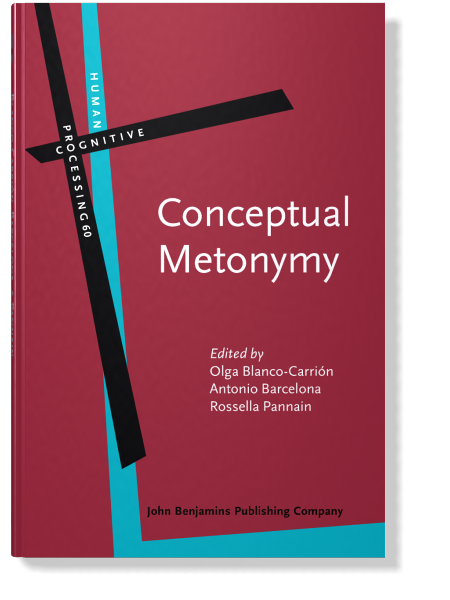
In:Conceptual Metonymy: Methodological, theoretical, and descriptive issues
Edited by Olga Blanco-Carrión, Antonio Barcelona and Rossella Pannain
[Human Cognitive Processing 60] 2018
► pp. 161–182
Chapter 6
Molly married money
Reflections on conceptual metonymy
Published online: 17 May 2018
https://doi.org/10.1075/hcp.60.06rad
https://doi.org/10.1075/hcp.60.06rad
Abstract
This chapter is concerned with the conceptual basis of metonymy. Particular attention is devoted to properties that are considered crucial to conceptual metonymy. The metonymic source has received little attention. However, it plays an important role as an element of the target and is given due attention. The notion of association is applied to metonymic interconnections, inference, and strength of association. A central element of metonymy is the notion of relation: However, neither contiguity nor indexicality adequately covers the range of metonymic relations. The paper argues that two more properties are pertinent to conceptual metonymy: a metonymic shift from a source concept to a complex metonymic target, and the conceptual
integration of source and target and its resulting emergent meanings.
Article outline
- 1.Introduction
- 2.Metonymic source and target
-
3.Association
- 3.1Co-activation
- 3.2Inference
- 3.3Strength of association
- 4.Metonymic relation
- 4.1Contiguity
- 4.2Indexicality
- 5.Metonymic shift
- 6.Conceptual integration
- 7.Conclusions
Notes References

References (32)
Alač, M., & Coulson, S. 2004. The man, the key, or the car: Who or what is parked out back? Cognitive Science Online, 2, 21–34.
Barcelona, A. 2004. Metonymy behind grammar: The motivation of the seemingly “irregular” grammatical behavior of English paragon names. In G. Radden & K.-U. Panther (Eds.), Studies in linguistic motivation (357–384). Berlin & New York: Mouton de Gruyter.
2011. Reviewing the properties and prototype structure of metonymy. In R. Benczes, A. Barcelona, & F. J. Ruiz de Mendoza Ibáñez (Eds.), Defining metonymy in Cognitive Linguistics: Towards a consensus view (7–57). Amsterdam & Philadelphia: Benjamins.
Brdar, M., & Brdar Szabó, R. 2014. Where does metonymy begin? Some comments on Janda (2011). Cognitive Linguistics 25(2), 313–340.
Brinton, L. J. 1988. The development of English aspectual systems: Aspectualizers and post-verbal particles. Cambridge: Cambridge University Press.
Coulson, S., & Oakley, T. 2003. Metonymy and conceptual blending. In K.-U. Panther & L. L. Thornburg (Eds.), Metonymy and pragmatic inferencing (51–79). Amsterdam & Philadelphia: Benjamins.
Denroche, Ch. 2015. Metonymy and language: A new theory of linguistic processing. New York & London: Routledge.
Dirven, R. 1999. Conversion as a conceptual metonymy of event schemata. In K.-U. Panther & G. Radden (Eds.), Metonymy in language and thought (275–287). Amsterdam & Philadelphia: John Benjamins.
Frisson, S., & Pickering, M. J. 1999. The processing of metonymy: Evidence from eye movements. Journal of Experimental Psychology: Learning, Memory and Cognition, 25, 1366–1383.
Gibbs, R. W., Jr. 1994. The poetics of mind: Figurative thought, language, and understanding. Cambridge: Cambridge University Press.
Haser, V. 2005. Metaphor, metonymy, and experientialist philosophy: Challenging cognitive semantics. Berlin & New York: Mouton de Gruyter.
Hernández-Gomariz, I. this volume. Analysis of metonymic triggers, metonymic chaining and patterns of interaction with metaphor and with other metonymies as part of the metonymy database in the Córdoba project.
Lakoff, G. 2009. The neural theory of metaphor. [URL]
Littlemore, J. 2015. Metonymy: Hidden shortcuts in language, thought and communication. Cambridge: Cambridge University Press.
Norrick, N. R. 1981. Semiotic principles in semantic theory. Amsterdam: Benjamins.
Panther, K.-U. 2005. The role of conceptual metonymy in meaning construction. In F. J. Ruiz de Mendoza Ibáñez & S. Peña Cervel (Eds.), Cognitive Linguistics: Internal dynamics and interdisciplinary interaction (353–386). Berlin & New York: Mouton de Gruyter.
Panther, K.-U., & Thornburg, L.L. this volume. What kind of reasoning mode is metonymy?
Panther, K.-U., & Thornburg, L. L. 2009. Introduction: On figuration in grammar. In K.-U. Panther & L. L. Thornburg (Eds.), Metonymy and metaphor in grammar (1–44). Amsterdam & Philadelphia: John Benjamins.
Peirsman, Y., & Geeraerts, D. 2006. Metonymy as a prototypical category. Cognitive Linguistics, 17, 269–316.
Radden, G. 2009. Generic reference in English: A metonymic and conceptual blending analysis. In K.-U Panther, L. L. Thornburg, & A. Barcelona (Eds.), Metonymy and metaphor in grammar (199–228). Amsterdam & Philadelphia: Benjamins.
Radden, G., & Kövecses, Z. 1999. Towards a theory of metonymy. In K.-U. Panther & G. Radden (Eds.), Metonymy in language and thought (17–59). Amsterdam & Philadelphia: John Benjamins.
Ruiz de Mendoza Ibáñez, F. J. 2003. The role of mappings and domains in understanding metonymy. In A. Barcelona (Ed.), Metaphor and metonymy at the crossroads: A cognitive perspective (109–132). Berlin & New York: Mouton de Gruyter.
Song, N. S. 1997. Metaphor and metonymy. In R. Carston & S. Uchida (Eds.), Relevance theory: Applications and implications (87–104). Amsterdam: John Benjamins.
Strack, D. 2015. Metonymic connections are not mapped: Theoretical and neurological evidence for “metonymic binding”. Paper presented at the 13th ICLC at Newcastle upon Tyne.
Sweep, J. 2011. Metonymical transfers: The complex relation of metonymy and grammar. Linguistics in Amsterdam 4(1).
Warren, B. 1999. Aspects of referential metonymy. In K.-U. Panther & G. Radden (Eds.), Metonymy in language and thought (121-135). Amsterdam & Philadelphia: John Benjamins.
Cited by (9)
Cited by nine other publications
Coates, Adam
Elyamany, Nashwa & Maha SalahEldien Mohamed Hamed
2024. Metaphtonymy and semio-cognitive de-legitimation of Donald Trump in the meme discourse of The Daily Show with
Trevor Noah (January 2016–December 2019). International Journal of Language and Culture 11:1 ► pp. 123 ff.
Golubeva, Tatiana
2023. The proper names ‘Assad’, ‘ISIL’, ‘ISIS’, ‘Daesh’ and ‘European’ as metonymic blends in political
discourse. Review of Cognitive Linguistics 21:1 ► pp. 115 ff.
Barnden, John A.
2022. Metonymy, reflexive hyperbole and broadly reflexive relationships. Review of Cognitive Linguistics 20:1 ► pp. 33 ff.
Martynyuk, Alla & Olga Meleshchenko
2022. Socio-pragmatic potential of (verbo)-visual metaphtonymy in Internet memes featuring Donald Trump. Metaphor and the Social World 12:1 ► pp. 69 ff.
Pannain, Rossella & Lucia di Pace
2022. Metonymy and the polysemy ofCovidin Italian. Review of Cognitive Linguistics 20:1 ► pp. 231 ff.
Thomou, Paraskevi & Marilena Koutoulaki
2022. From usage patterns to meaning construction. Review of Cognitive Linguistics 20:2 ► pp. 305 ff.
Barcelona, Antonio
2019. The tripartite typology and the Córdoba Metonymy Database. In Metaphor and Metonymy in the Digital Age [Metaphor in Language, Cognition, and Communication, 8], ► pp. 49 ff.
Denroche, Charles
2019. Employing cognitive metonymy theory in the analysis of semantic relations between source and target text in translation. Metaphor and the Social World 9:2 ► pp. 177 ff.
This list is based on CrossRef data as of 10 december 2025. Please note that it may not be complete. Sources presented here have been supplied by the respective publishers. Any errors therein should be reported to them.