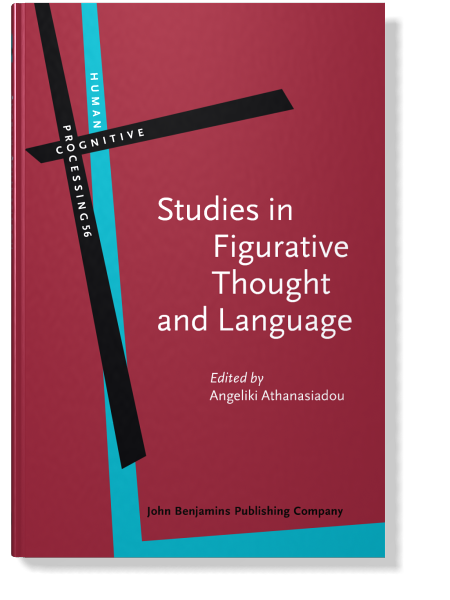
In:Studies in Figurative Thought and Language
Edited by Angeliki Athanasiadou
[Human Cognitive Processing 56] 2017
► pp. v–vi
Get fulltext
This article is available free of charge.
Table of contents
Editor and contributors
vii
Foreword
ix
Introduction: Figurative thought, figurative language, figurative grammar?
1
Editor
Angeliki Athanasiadou
Part I.Figuration and grammar
Chapter 1.Exploiting wh-questions for expressive purposes
17
Editors
Klaus-Uwe Panther
Linda L. Thornburg
Chapter 2.Construing and constructing hyperbole
41
Editors
Mª Sandra Peña
Francisco J. Ruiz de Mendoza
Chapter 3.How to do things with metonymy in discourse
75
Editor
Annalisa Baicchi
Chapter 4.Cognitive motivation in the linguistic realization of requests in Modern Greek
105
Editor
Evgenia Vassilaki
Chapter 5.How metonymy and grammar interact: Some effects and constraints in a cross-linguistic perspective
125
Editors
Mario Brdar
Rita Brdar-Szabó
Chapter 6.
If-clauses and their figurative basis
151
Editor
Angeliki Athanasiadou
Part II.Figuration and the lexicon
Chapter 7.The hand in figurative thought and language
179
Editor
Ad Foolen
Chapter 8.
Shakespeare on the shelf, Blue Helmets on the move: Human-related metonymic conceptualization in English and Serbian
199
Editor
Katarina Rasulić
Chapter 9.Metaphor, conceptual archetypes and subjectification: The case of completion is up and the polysemy of shang in Chinese
231
Editor
Wei-lun Lu
Part III.Figuration from a cultural-anthropological and psycholinguistic perspective
Chapter 10.Metaphor and metonymy as fanciful "asymmetry"-builders
253
Editor
Ioannis Veloudis
Chapter 11.Pragmatic effects in blended figures: The case of metaphtonymy
273
Editor
Herbert L. Colston
Chapter 12.The psychological reality of spatio-temporal metaphors
295
Editors
Panos Athanasopoulos
Steven Samuel
Emanuel Bylund
Name index
323
Subject index
325
