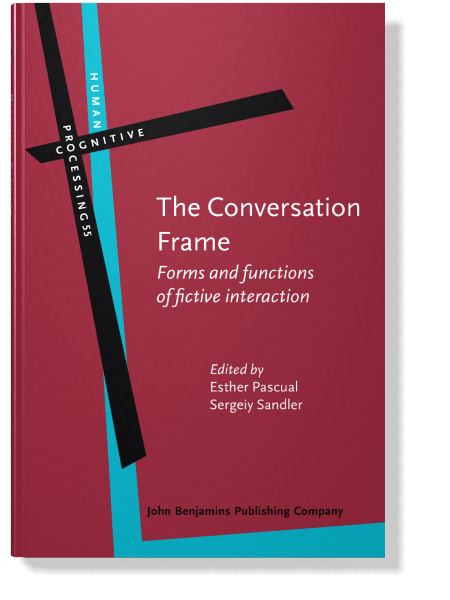
In:The Conversation Frame: Forms and functions of fictive interaction
Edited by Esther Pascual and Sergeiy Sandler
[Human Cognitive Processing 55] 2016
► pp. v–viii
Get fulltext
This article is available free of charge.
Published online: 1 November 2016
https://doi.org/10.1075/hcp.55.toc
https://doi.org/10.1075/hcp.55.toc
Table of contents
List of contributorsix
Acknowledgementsxi
Part I. Introduction
Fictive interaction and the conversation frame: An overview
Fictive interaction and the nature of linguistic meaning
Part II. Fictive interaction as cognitive reality
Generic integration templates for fictive communication
Real, imaginary, or fictive? Philosophical dialogues in an early Daoist text and its pictorial version
Silent abstractions versus “Look at me” drawings: Corpus evidence that artworks’ subject matter affects their fictive speech
Part III. Fictive interaction as discourse structure
Persuading and arguing with the reader: Fictive interaction as discourse organizing device in witchcraft pamphlet prefaces (1566–1621)
Invocation or apostrophe? Prayer and the conversation frame in public discourse
On discourse-motivated “sorries”: Fictive apologies in English, Hungarian, and Romanian
Part IV. Fictive interaction as linguistic construction
What about? Fictive question-answer pairs for non-information-seeking functions across signed languages
Fictive questions in conditionals? Synchronic and diachronic evidence from German and English
Intonation of fictive vs. actual direct speech in a Brazilian Portuguese corpus
Polish nominal construction involving fictive interaction: Its scope and functions in discourse
Evidential fictive interaction (in Ungarinyin and Russian)
Recursive inflection and grammaticalized fictive interaction in the southwestern Amazon
Part V. Fictive interaction as communicative strategy
“Say hello to this ad”: The persuasive rhetoric of fictive interaction in marketing
The use of interactive structures as communicative strategy in Dutch and Portuguese aphasic speakers
Echolalia as communicative strategy: Fictive interaction in the speech of children with autism
About the contributors
Author index
Language index
Subject index
