In:Metaphor in Use: Context, culture, and communication
Edited by Fiona MacArthur, José Luis Oncins-Martínez, Manuel Sánchez-García and Ana M. Piquer-Píriz
[Human Cognitive Processing 38] 2012
► pp. 239–260
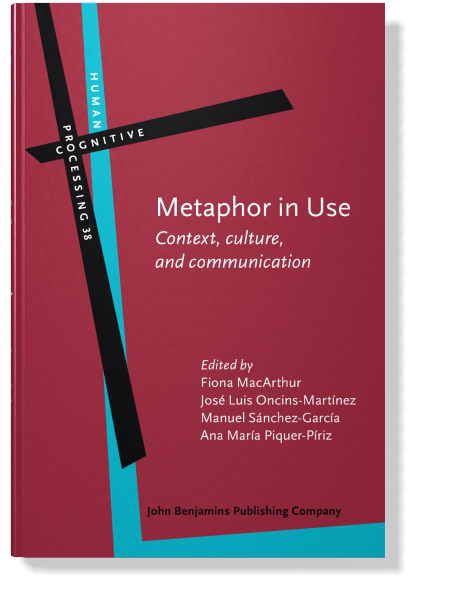
Chapter 11. Conceptual types of terminological metaphors in marine biology
An English-Spanish contrastive analysis from an experientialist perspective
Published online: 17 October 2012
https://doi.org/10.1075/hcp.38.18man
https://doi.org/10.1075/hcp.38.18man
Metaphor can be analysed from a structural, functional, conceptual, or contrastive point of view. From a conceptual viewpoint, an experientialist account of conceptual metaphor includes: (i) mechanisms of metaphorization, (ii) image metaphors vs. multiple-correspondence metaphors, (iii) motivation for metaphorical transfer, and (iv) conceptual themes (Alexiev 2004). This chapter draws on Alexiev’s parameters to analyse an inventory of metaphorical pairs in English and Spanish extracted from a bilingual corpus of specialized research articles and publications on marine biology. The results obtained point to the existence of cross-linguistic conceptual patterns in specialized discourse in the two languages studied. These findings and their implications are discussed in relation to some of the claims of Lakoff’s (1993) Conceptual Metaphor Theory.

Cited by (4)
Cited by four other publications
Meyers, Charlène
Luque Janodet, Francisco
Jiang, Na & Xiangqing Wei
2020. Multidimensionality, dynamicity, and complexity. Terminology. International Journal of Theoretical and Applied Issues in Specialized Communication 26:2 ► pp. 237 ff.
Roldan Riejos, Ana Maria
2016. Exploring specific differences. In Exploring Discourse Strategies in Social and Cognitive Interaction [Pragmatics & Beyond New Series, 262], ► pp. 187 ff.
This list is based on CrossRef data as of 10 december 2025. Please note that it may not be complete. Sources presented here have been supplied by the respective publishers. Any errors therein should be reported to them.