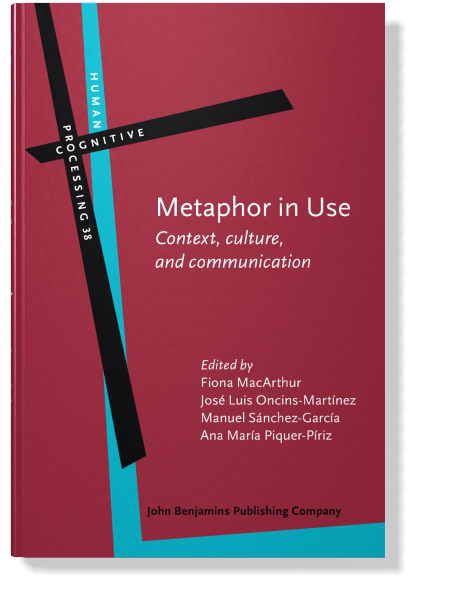
In:Metaphor in Use: Context, culture, and communication
Edited by Fiona MacArthur, José Luis Oncins-Martínez, Manuel Sánchez-García and Ana M. Piquer-Píriz
[Human Cognitive Processing 38] 2012
► pp. 21–50
Chapter 1. An assessment of metaphor retrieval methods
Published online: 17 October 2012
https://doi.org/10.1075/hcp.38.05sar
https://doi.org/10.1075/hcp.38.05sar
This chapter offers a quantitative assessment of different techniques and tools for retrieving metaphors from large electronic corpora. These are (i) reading parts of a larger corpus in order to find candidates that are then sought for in the whole corpus; (ii) searching for metaphors using different search terms; (iii) looking for metaphor clusters; (iv) finding metaphor candidates through keywords; (v) finding metaphor candidates through the Metaphor Candidate Identifier; and (vi) finding metaphor candidates by computing semantic relatedness between neighbouring words.

Cited by (6)
Cited by six other publications
Dhifallah, Asma
2025. Ego-centered motion metaphors of time across methods. Review of Cognitive Linguistics 23:2 ► pp. 375 ff.
Teresė, Anželika
Brdar, Mario, Rita Brdar-Szabó & Benedikt Perak
2020. Separating (non-)figurative weeds from wheat. In Figurative Meaning Construction in Thought and Language [Figurative Thought and Language, 9], ► pp. 45 ff.
Johansson Falck, Marlene
2016. What trajectors reveal about TIME metaphors. International Journal of Corpus Linguistics 21:1 ► pp. 28 ff.
Berber Sardinha, Tony
2015. Register variation and metaphor use. In Metaphor in Specialist Discourse [Metaphor in Language, Cognition, and Communication, 4], ► pp. 17 ff.
This list is based on CrossRef data as of 10 december 2025. Please note that it may not be complete. Sources presented here have been supplied by the respective publishers. Any errors therein should be reported to them.