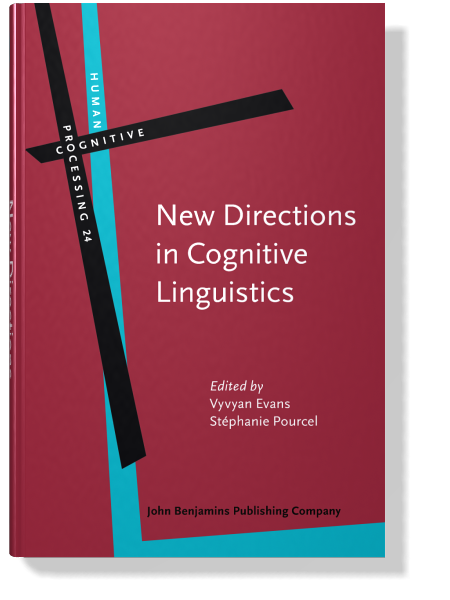
In:New Directions in Cognitive Linguistics
Edited by Vyvyan Evans and Stéphanie Pourcel
[Human Cognitive Processing 24] 2009
► pp. v–viii
Get fulltext
This article is available free of charge.
Published online: 24 June 2009
https://doi.org/10.1075/hcp.24.toc
https://doi.org/10.1075/hcp.24.toc
Table of contents
Contributorsix
Acknowledgementsxi
Introduction
Part I. Approaches to semantics: Theory and method
Meaning as input: The instructional perspective
Semantic representation in LCCM Theory
Behavioral profiles: A corpus-based approach to cognitive semantic analysis
Polysemy, syntax, and variation: A usage-based method for Cognitive Semantics
Part II. Approaches to metaphor and blending: Theory and method
Solving the riddle of metaphor: A salience-based model for metaphorical interpretation in a discourse context
When is a linguistic metaphor conceptual metaphor?
Generalized integration networks
Genitives and proper names in constructional blends
Part III. Approaches to grammar: Theory and method
What’s (in) a construction? Complete inheritance vs. full-entry models
Words as constructions
Constructions and constructional meaning
Partonomic structures in syntax
Part IV. Language, embodiment and cognition: Theory and application
Language as a biocultural niche and social institution
Understanding embodiment: Psychophysiological models in traditional medical systems
Get and the grasp schema: A new approach to conceptual modelling in image schema semantics
Motion scenarios in cognitive processes
Part V. Extensions and applications of cognitive linguistics
Toward a social cognitive linguistics
Cognitive and linguistic factors in evaluating text quality: Global versus local?
Reference points and dominions in narratives: A discourse level exploration of the reference point model of anaphora
The dream as blend in David Lynch’s Mulholland Drive
“I was in that room!”: Conceptual integration of content and context in a writer’s vs. a prosecutor’s description of a murder
Index
