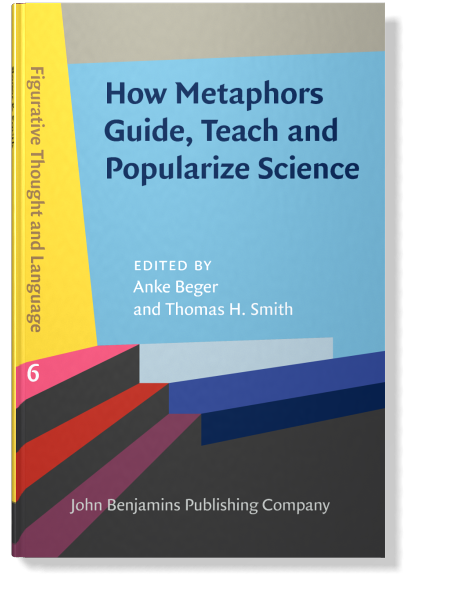
In:How Metaphors Guide, Teach and Popularize Science
Edited by Anke Beger and Thomas H. Smith
[Figurative Thought and Language 6] 2020
► pp. 297–318
Get fulltext
Conclusion
When metaphors serve scientific ends
Available under the Creative Commons Attribution-NonCommercial-NoDerivatives (CC BY-NC-ND) 4.0 license.
For any use beyond this license, please contact the publisher at rights@benjamins.nl.
Published online: 22 April 2020
https://doi.org/10.1075/ftl.6.09smi
https://doi.org/10.1075/ftl.6.09smi
Abstract
This final chapter uses the metaphor characteristics set
forth in the introductory chapter to comment on the individual
studies reported here. Where the introductory chapter describes the
principles of modern metaphor research that promise to improve
access to science, this chapter highlights the actual application of
these principles as found in the chapters of this book. When we
focus on key requirements of scientific inquiry – description,
explanation, and prediction – metaphor is found to be both very
helpful and sometimes to pose difficulties. Such results are
reviewed here, with discussions intended to benefit scientists,
communicators, and metaphor scholars.
Article outline
- 1.Scope of review
- 2.Characteristics of scientific metaphors
- 2.1Selection of metaphors to study: Intuitive versus systematic
- 2.2Three purposes served by scientific metaphor: Simple description, understandable explanation and
accurate prediction
- 2.2.1Simple description
- 2.2.2Explanatory models and metaphors
- 2.2.3Predictive models and metaphors
- 2.3Social models and metaphors: A level of scientific analysis where physically embodied metaphors may not work
- 2.4Groupings of metaphors
- 2.5Metaphors for argument and propaganda
- 2.6Macro metaphors and argumentation
- 3.Some conclusions
Notes References

References (27)
Bailer-Jones, D. M. & Bailer-Jones, C. A. L. (2002). Modeling data: Analogies in neural networks,
simulated annealing and genetic algorithms, In L. Magnani, & N. Nersessian (Eds.), Model-based reasoning: Science, technology,
values (pp.147–166). New York/Dordrecht: Kluwer Academic/Plenum Publishers.
Beretta, G. P. (2009). What is quantum thermodynamics? Presentation given at Perimeter Institute, Waterloo, Ontario, Canada, p.2. [URL] accessed Oct 2017.
Brown, T. L. (2003). Making truth: Metaphor in science. Urbana/Chicago: University of Illinois Press.
Denroche, C. (2015). Metonymy and language: A new theory of linguistic
processing. New York: Routledge.
Fauconnier, G. & Turner, M. (2002). The way we think: Conceptual blending and the mind’s
hidden complexities. New York: Basic Books.
Forceville, C. (2016). Pictorial and multimodal metaphor. In N. Klug, & H. Stöckl (Eds.), Handbuch Sprache im multimodalen Kontext (pp.241–260). Berlin, Boston: De Gruyter Mouton.
Gentner, D., Loewenstein J. & Thompson L. (2003). Learning and transfer: A general role for
analogical encoding. Journal of Educational Psychology, 95(2), 393–408.
Kövecses, Z. (2005). Metaphor in culture: Universality and variation, New York: Cambridge University Press.
(2015). Where metaphors come from: Reconsidering context in
metaphor. Oxford: Oxford University Press.
Lakoff, G. (1993). The contemporary theory of
metaphor. In A. Ortony (Ed.), Metaphor and thought (2nd ed.) (pp.202–251). New York, Cambridge: Cambridge University Press.
Lakoff, G., & Johnson, M. (1999). Philosophy in the flesh: The embodied mind and its
challenge to western thought. New York: Basic Books.
Laurel, B. & Mountford, S. J. (1990). The art of human-computer interface design. Boston: Addison-Wesley.
Liu, D. (2016). The cell and protoplasm as container, object, and
substance, 1835–1861, J Hist Biol, 50(4), 889–925.
Marcus, G., Marblestone, A. & Dean, T. (2014). The atoms of neural computation: Does the brain
depend on a set of elementary, reusable
computations? Science Magazine, 346(6209), 551–552.
Mikulecky, D. C. (2005). Complexity science as an aspect of science
complexity. In C. Gershenson, A. Diederik, & B. Edmonds (Eds.), Worldviews, science and us: philosophy and
complexity. Singapore: World Scientific Publishing.
Nerlich, B. (2007). Media, metaphors and modeling: how the UK
newspapers reported the epidemiological modelling
controversy during the 2001 foot and mouth
outbreak. Science, Technology & Human Values, 32(4), 432–457.
Pragglejaz group (2007). MIP: A method for identifying metaphorically used
words in discourse. Metaphor and Symbol, 22(1), 1–39.
Shutova, E., Teufel, S. & Korhonen, A. (2013) Statistical metaphor processing, Computational Linguistics, 39(2), 301–353.
Steinhart, E. (2001). The logic of metaphor – Analogous parts of possible
worlds. Synthese Library, Volume 299. Dordrecht, The Netherlands: Kluwer Academic Publishers.
Stickles, E., E. Dodge, O. David, & H. Jisup (2016). Formalizing contemporary conceptual metaphor
theory: A structured repository for metaphor
analysis. Constructions and Frames, 8(2), 166–213.
Sweetser, E. & Fauconnier, G. (1996). Cognitive links and domains: Basic aspects of
mental space theory. In G. Fauconnier & E. Sweetser (Eds.), Spaces, Worlds and grammar (pp.5–25). Chicago: University of Chicago Press.
Williams Camus, J. (2015). Metaphor, news discourse and
knowledge, In J. B. Herrmann & T. Berber Sardinha (Eds.), Metaphor in specialist discourse (pp.247–265). Amsterdam: John Benjamins.
Woodward, J. (2017). Scientific explanation. In E. N. Zalta (Ed.), The Stanford encyclopedia of philosophy (Spring 2017 Edition), ([URL] Accessed 10/2017.
Cited by (1)
Cited by one other publication
[no author supplied]
This list is based on CrossRef data as of 9 december 2025. Please note that it may not be complete. Sources presented here have been supplied by the respective publishers. Any errors therein should be reported to them.