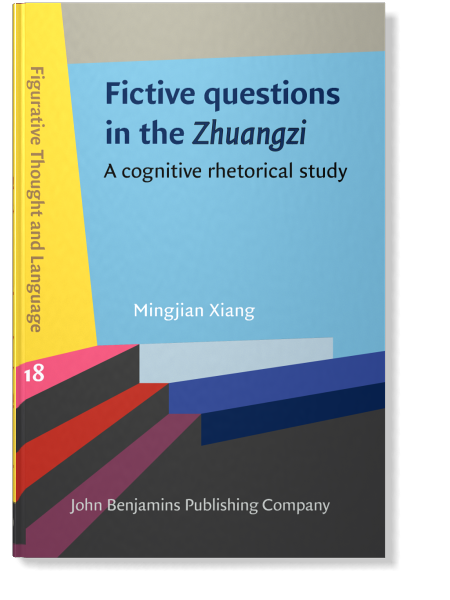
In:Fictive questions in the Zhuangzi: A cognitive rhetorical study
Mingjian Xiang
[Figurative Thought and Language 18] 2023
► pp. vii–ix
Published online: 24 May 2023
https://doi.org/10.1075/ftl.18.toc
https://doi.org/10.1075/ftl.18.toc
Table of contents
Acknowledgments
x
List of figures
xii
List of tables
xiii
Chapter 1.Introduction
1
1.1Motivation for the study
2
1.2Object of investigation
4
1.3Research questions
9
1.4Theoretical basis
9
1.5Methodology
10
1.6Structure of the book
12
Chapter 2.Review of relevant literature
14
2.1Review of previous study on expository questions
15
2.1.1Defining expository question
15
2.1.2Characteristics of expository questions
16
2.1.3Functions of expository questions
18
2.1.3.1Rhetorical approaches
18
2.1.3.2Pragmatic approaches
19
2.1.4Classification of expository questions
19
2.2Review of previous study on rhetorical questions
21
2.2.1Defining rhetorical question
21
2.2.2Characteristics of rhetorical questions
23
2.2.3Identifying rhetorical questions
27
2.2.4Functions of rhetorical questions
28
2.2.4.1Rhetorical approaches
29
2.2.4.2Pragmatic approaches
30
2.3A new typology of fictive questions
33
2.4Review of previous studies on fictive questions
in the Zhuangzi text 34
in the Zhuangzi text 34
Chapter 3.Theoretical framework
39
3.1Conceptual blending theory
39
3.1.1Types of conceptual integration networks
41
3.1.2Conceptual blending in discourse
45
3.2Fictive interaction: Conceptual blending at the communicative
level
46
3.2.1Fictive interaction blend
46
3.2.2Conversational monologues
49
3.3Writer–reader interaction networks in the Zhuangzi
text
51
Chapter 4.Forms and functions of expository questions in the Zhuangzi
text
54
4.1Distribution of expository questions in the Zhuangzi
text
54
4.2Expository questions as intersubjective mixed viewpoint constructions
in the Zhuangzi text 56
in the Zhuangzi text 56
4.2.1Expository questions in the Here-and-Now space
56
4.2.2Expository questions in the Current Discourse Space
62
4.3Functions of expository questions in the Zhuangzi
text
73
4.4Summary
75
Chapter 5.Forms and functions of rhetorical questions in the Zhuangzi
text
79
5.1Distribution of rhetorical questions in the Zhuangzi
text
80
5.1.1Rhetorical questions in classical Chinese
80
5.1.2Overview of rhetorical questions in the Zhuangzi
text
82
5.2Rhetorical questions as intersubjective mixed viewpoint constructions
in the Zhuangzi text 86
in the Zhuangzi text 86
5.2.1Rhetorical questions in the Here-and-Now space
86
5.2.2Rhetorical questions in the Current Discourse Space
88
5.3Functions of rhetorical questions in the Zhuangzi
text
100
5.4Summary
103
Chapter 6.Fictive questions and self-persuasion in the Zhuangzi
text
106
6.1Neural mechanisms of mental simulation and perspective taking
109
6.2Toward a simulation rhetorics model of self-persuasion
111
6.3Fictive questions as a therapeutic method in the
Zhuangzi text
114
6.4Summary
117
Chapter 7.Conclusion
118
7.1Summary of major findings
118
7.2Significance of the study
120
7.3Suggestions for future research
122
References
125
Appendix 1.Allegories in the Zhuangzi text
155
Appendix 2.Forms and functions of expository questions
in the Zhuangzi text 170
in the Zhuangzi text 170
Appendix 3.Forms and functions of rhetorical questions
in the Zhuangzi text 179
in the Zhuangzi text 179
Index
203
