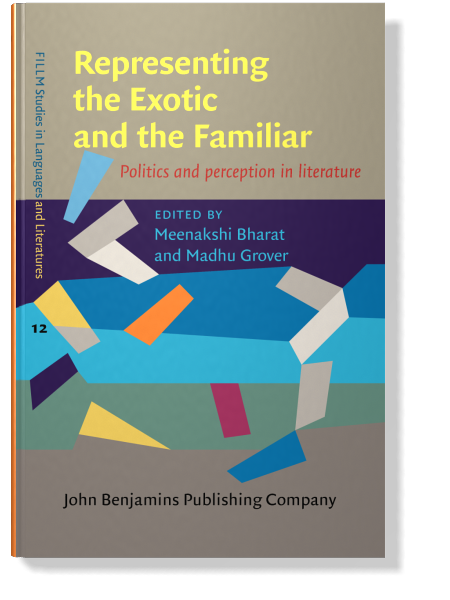
In:Representing the Exotic and the Familiar: Politics and perception in literature
Edited by Meenakshi Bharat and Madhu Grover
[FILLM Studies in Languages and Literatures 12] 2019
► pp. vii–x
Get fulltext
This article is available free of charge.
Published online: 28 November 2019
https://doi.org/10.1075/fillm.12.toc
https://doi.org/10.1075/fillm.12.toc
Table of contents
Series editor’s prefaceXI
AcknowledgementsXIII
ContributorsXV
Introduction1
Meenakshi Bharat
Madhu Grover
Foreword: Literary politics and perception: Moving beyond
representation9
Elleke Boehmer
Part I.Traversing unfamiliar spaces
Chapter 1.Magical modernities: The familiar and the exotic on Indian lifestyle
TV17
Tania Lewis
Chapter 2.Kipling’s “wild and strange” India: The “insider” perspective of the
short stories35
Madhu Grover
Chapter 3.Exoticism and familiarity in Victor Segalen’s travel poetry51
Ian Fookes
Chapter 4.Cambodia through Western eyes: The exotic, the familiar, and the
universal67
Robert Horne
Chapter 5.Italian travel narratives on twentieth century China: Alterity, distance
and self-identification79
Linetto Basilone
Chapter 6.Affect labelling as a means of challenging exotic stereotypes in readings
of Salwa Bakr’s “The Golden Chariot”95
Christa Knellwolf King
Chapter 7.Exoticization of Russia and the Russian people in Polish
literature109
Monika Wojciak
Barbara Sobczak
Part II.Mediating local voices
Chapter 8.Power and powerlessness: The literary exoticization of women127
Devika Brendon
Chapter 9.Challenging taxonomies of the local and the exotic: The works of Hansda
Showvendra Shekhar139
Vibha S. Chauhan
Chapter 10.Overturning the familiar and the exotic in the fiction of Ranendra and
Hansda Sowvendra Shekhar155
Namita Sethi
Chapter 11.Translation as the interplay of the familiar and the exotic in
A. K. Ramanujan’s Poems of Love and War173
S. Annapoorni
Chapter 12.The exotic and the familiar in translation189
Mitra Phukan
Chapter 13.The familiar, the exotic, and Madhwacharya’s Bhasha
theory: The Sangraha Ramayana and its translations197
Aparna Srinivas
Sunitha Rao
Chapter 14.Exoticizing 1984: Trauma, telling and the anti-Sikh pogrom213
Ritika Singh
Part III.Transcending familiar boundaries
Chapter 15.André Brink’s A Dry White Season as film: Foreignization
and domestication227
H. P. van Coller
A. van Jaarsveld
Chapter 16.“Thou art the unanswered question”: On the imagology of the riddle of the
Sphinx241
Suhaile Azavedo
Chapter 17.From exotic to domestic: The other, the native and cultural relativism in
Barbara Kingsolver’s The Poisonwood Bible253
Ansul Rao
Chapter 18.V. S. Naipaul and Jhumpa Lahiri: The politics of identity and the
performance of exoticism265
Afrinul Haque Khan
Chapter 19.Turning the exotic into the familiar: Tabish Khair’s novels in
context281
Liliana Sikorska
Chapter 20.Coloured exoticism in Toni Morrison’s God Help the
Child295
Lekha Roy
Chapter 21.Exotic madness in Caribbean literature: From marginalization to
empowerment and indigenization309
Bénédicte Ledent
Chapter 22.Plant/woman encounters in contemporary fairy tale adaptations323
Daniela Kato
Bibliography337
Index357
